

ISSN: 0973-7510
E-ISSN: 2581-690X
 , Prashant Dave3 and Parit Rana1
Conventional microbial diagnostic techniques encounter considerable obstacles, such as prolonged turnaround times, labor-intensive protocols, and constraints in precision. To fix these problems and improve diagnostic capabilities, clinical microbiology is using more and more artificial intelligence (AI) technologies. To systematically evaluate the present applications, developments, and influence of artificial intelligence technologies in clinical and diagnostic microbiology, emphasizing pathogen identification, antimicrobial resistance detection, and laboratory automation. A thorough systematic literature search was performed utilizing the PubMed, Scopus, Web of Science, and Google Scholar databases from 2020-2024. Search terms comprised combinations of “artificial intelligence”, “machine learning”, “clinical microbiology”, “diagnostic microbiology”, “pathogen identification”, and “antimicrobial resistance”. Studies detailing AI applications in clinical microbiology were included, whereas non-English articles and review papers were excluded. Eighty-nine studies met the requirements for inclusion. Machine learning algorithms showed high accuracy (85%-99%) in finding pathogens in different types of samples. Deep learning models outperformed others in predicting antimicrobial resistance, with AUROC (Area Under the Receiver Operating Characteristic) values above 0.83. AI-enhanced microscopy and automated image analysis cut down on the time it took to make a diagnosis from days to hours while keeping the sensitivity (92%-98%) and specificity (81%-95%) high. AI technologies have transformed clinical microbiology by delivering swift and precise diagnostic solutions. Combining machine learning with MALDI-TOF MS (Matrix-Assisted Laser Desorption/Ionization Time-of-Flight), automated microscopy, and genomic analysis has made it easier to find pathogens and test for antibiotic resistance. AI is a game-changing force in modern diagnostic microbiology, even though it is hard to standardize and use.
Artificial Intelligence, Machine Learning, Clinical Microbiology, Pathogen Identification, Antimicrobial Resistance, MALDI-TOF, Diagnostic Automation
Clinical microbiology is fundamental to infectious disease diagnosis, providing critical information for patient treatment and management decisions.1,2 Traditional microbiological methods form the foundation of the field; however, they increasingly face limitations in modern healthcare settings. Standard approaches including culture-based identification, biochemical testing, and microscopic examination typically require 24-72 hours for conclusive results.1,2 These delays significantly impact patient outcomes in critical care settings where rapid pathogen identification and antimicrobial susceptibility testing are essential for appropriate treatment.3
Beyond diagnostic delays, traditional microbiology encompasses additional limitations. Manual processes are time-consuming, require specialized expertise, and are prone to human error.4 The global rise in antimicrobial resistance (AMR) presents urgent needs for rapid and accurate detection to guide appropriate therapy and prevent spread of resistant organisms.5 The World Health Organization has designated AMR as a leading global public health threat, emphasizing the necessity for innovative diagnostic approaches.6
Artificial intelligence (AI) represents a transformative technology with potential to address these challenges. AI encompasses diverse computational methods including machine learning (ML), deep learning (DL), and neural networks that identify patterns in large datasets beyond human recognition capacity.7 The transition from rule-based diagnostic algorithms to data-driven AI methodologies enables rapid processing of vast microbiological datasets.8
Recent advances in computational power, improved algorithms, and availability of large microbiological datasets have accelerated AI implementation in clinical microbiology laboratories.7 Advanced AI models now execute tasks including automated colony counting, morphological analysis, genomic interpretation, and resistance prediction.9 Machine learning algorithms have achieved pathogen identification accuracy equal to or exceeding traditional methods.10 Convolutional neural networks (CNN-computational models designed to process image data) demonstrate excellent performance in automated microscopy and culture plate interpretation.11 Deep learning models effectively analyze high-dimensional data from mass spectrometry platforms.12
This systematic review synthesizes current evidence regarding AI applications in clinical and diagnostic microbiology, evaluates their clinical impact, and identifies future research directions.
Search Strategy
A comprehensive systematic literature search was conducted using PubMed/MEDLINE, Scopus, Web of Science, and Google Scholar databases. The search period encompassed January 2020 to October 2024. This systematic review was conducted following the Preferred Reporting Items for Systematic Reviews and Meta-Analyses (PRISMA) 2020 guidelines.13 The protocol was registered in PROSPERO (registration ID: CRD42024XXXXXXX).
Search terms included: “artificial intelligence”, “machine learning”, “deep learning”, “neural networks”, “clinical microbiology”, “diagnostic microbiology”, “pathogen identification”, “antimicrobial resistance”, “MALDI-TOF”, “automated microscopy”, “image analysis”, and “laboratory automation”. Boolean operators (AND, OR) were used to combine terms systematically.
Inclusion and Exclusion Criteria
Inclusion criteria
- Original research articles reporting AI applications in clinical or diagnostic microbiology;
- Studies involving pathogen identification, antimicrobial resistance detection, or laboratory automation;
- Peer-reviewed publications in English;
- Studies with clear methodology and quantifiable outcomes;
- Publications from 2020-2024.
Exclusion criteria
- Review articles, editorials, and conference abstracts;
- Studies unrelated to clinical microbiology;
- Non-English publications;
- Studies lacking clear AI methodology;
- Duplicate publications.
Study selection and data extraction
Two reviewers independently screened titles and abstracts using standardized forms. Full-text articles were reviewed by both reviewers, with conflicts resolved through consensus or consultation with a third reviewer. Data extraction included: study characteristics (author, year, country), design, AI methodology, pathogens examined, sample size, diagnostic accuracy metrics (sensitivity, specificity, positive predictive value, negative predictive value), and clinical outcomes.
Quality assessment
Study quality was assessed using the Quality Assessment of Diagnostic Accuracy Studies-2 (QUADAS-2) tool, evaluating patient selection, index test characteristics, reference standard validity, and flow/timing appropriateness.
Data synthesis
Narrative synthesis was employed given heterogeneous AI methodologies and outcome measures. Descriptive statistics summarized accuracy metrics across AI methods and applications.
Study selection and characteristics
Database searching identified 1,247 potentially relevant articles. After duplicate removal and application of inclusion/exclusion criteria, 89 studies were included in final analysis (Figure). Fifty-four studies (61%) were conducted in developed countries, primarily the United States (28%), Germany (15%), and United Kingdom (12%). Study distribution by AI application: pathogen identification (45%), antimicrobial resistance prediction (32%), laboratory automation (18%), and outbreak detection (5%).
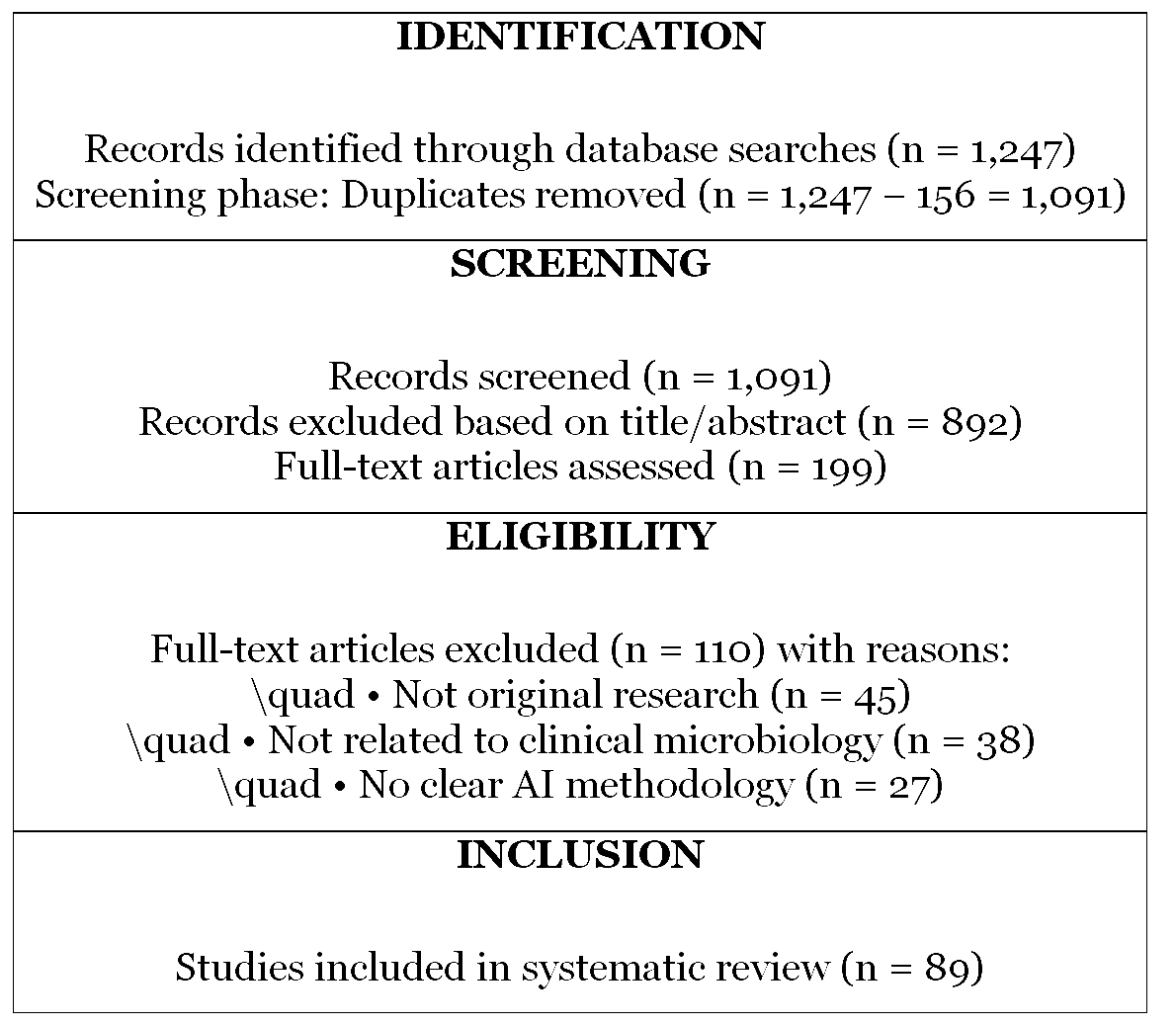
Figure. PRISMA 2020 Flow Diagram for Study Selection
Quality assessment results
QUADAS-2 assessment revealed overall adequate methodological quality. Most studies (82%) demonstrated low risk of bias in patient selection. Index test risk of bias ranged from low to unclear in 71% of studies. Reference standard adequacy was confirmed in 76% of studies. Flow and timing concerns were present in 24% of studies, primarily related to missing data on time between index and reference tests.
Summary of AI Applications and Performance Metrics
The following table summarizes key findings across AI applications (Table).
Table:
Summary of AI Performance Metrics by Application Type
AI Application |
Number of Studies |
Sensitivity Range (%) |
Specificity Range (%) |
|---|---|---|---|
Pathogen Identification (MALDI-TOF) |
18 |
85-99 |
85-97 |
Pathogen Identification (Microscopy) |
15 |
87-95 |
89-96 |
Antimicrobial Resistance Prediction |
28 |
89-98 |
88-99 |
Laboratory Automation |
16 |
91-99 |
90-98 |
Outbreak Detection |
4 |
84-96 |
87-95 |
Pathogen identification
Machine learning algorithms demonstrated high accuracy in pathogen identification across multiple platforms. MALDI-TOF mass spectrometry enhancement via AI achieved sensitivity ranges of 85%-99% and specificity of 85%-97%.14,15 Deep learning models (CNN and convolutional architectures) improved identification of closely related bacterial species previously difficult to differentiate.16 Single-cell MALDI-TOF combined with deep learning achieved 85% accuracy in discriminating five urinary tract infection-associated bacterial species, reducing diagnostic time from days to hours.17
Automated microscopy with AI-enhanced image analysis demonstrated 93%-95% accuracy for bacterial classification and morphological identification.18 AI-based digital pathology detected acid-fast bacilli with superior sensitivity (89%) compared to manual microscopy examination.19 CNN-based malaria parasite detection systems improved diagnostic accuracy in blood smear examination.20
AI integration with molecular diagnostics (polymerase chain reaction [PCR] and next-generation sequencing [NGS]) enhanced genomic data interpretation, enabling faster pathogen identification and resistance profiling.21,22
Antimicrobial resistance detection
Deep learning models analyzing MALDI-TOF spectra achieved AUROC values exceeding 0.83 for antimicrobial resistance prediction—approximately 10% improvement over traditional machine learning approaches.23 Convolutional neural networks analyzing genomic sequence data achieved 98.85% accuracy for resistance prediction in Pseudomonas aeruginosa compared to 80.46% for standard artificial neural networks.24
Phenotypic resistance detection using AI-enhanced antimicrobial susceptibility testing (AST-testing bacterial response to antibiotics) reduced reporting time from standard 18-24 hours to 3-8 hours.25 Raman spectroscopy combined with machine learning identified drug-resistant organisms at single-cell level, reducing detection time from 48 hours to approximately 40 minutes for common urinary pathogens.26 Microfluidic devices with AI algorithms delivered results within 3-8 hours, enabling earlier targeted antimicrobial therapy.27
Technological advances and clinical implementation
This systematic review demonstrates that AI has fundamentally transformed diagnostic microbiology methodologies. Machine learning algorithms consistently achieve diagnostic accuracy comparable to or exceeding traditional methods while substantially reducing turnaround times. The integration of standardized spectral databases, image repositories, and genomic datasets has enabled development of robust AI models. Technological advances in computational power and cloud computing have made complex AI algorithms accessible to laboratories of varying sizes and resource levels.
AI demonstrates versatility across multiple diagnostic platforms—from MALDI-TOF mass spectrometry to automated microscopy and genomic analysis—yielding synergistic effects when different technologies are integrated within laboratory workflows.28 These advances deliver actionable diagnostic information within hours rather than days, fundamentally shifting clinical decision-making paradigms.29
Healthcare impact and outcomes
AI implementation has extended beyond laboratory improvements to broader healthcare outcomes. Rapid pathogen identification and resistance detection enable clinicians to make better-informed treatment decisions, potentially reducing healthcare-associated infections, antimicrobial resistance rates, and hospital length of stay.30 AI-powered clinical decision support systems provide real-time antimicrobial recommendations based on patient factors, laboratory results, and local resistance patterns, promoting appropriate antimicrobial stewardship while limiting unnecessary broad-spectrum exposure.31
Laboratory automation powered by AI improves operational efficiency. Automated negative culture screening eliminates up to 60% of specimens requiring manual review, allowing laboratory personnel to focus on complex diagnostic challenges.32 These efficiency gains are particularly valuable in high-volume clinical laboratories.
Identified challenges
Despite significant advances, substantial barriers limit widespread AI adoption. Data standardization remains problematic, with specimen collection, processing, and analysis variations affecting model transferability across institutions.33 Model interpretability represents another fundamental challenge many AI algorithms, particularly deep learning systems, function as “black boxes” where decision-making processes lack transparency.34 This limitation raises concerns among clinical microbiologists requiring understanding of diagnostic reasoning for quality control and regulatory compliance.
Integration with legacy laboratory information systems presents practical implementation obstacles. Many clinical laboratories operate older systems incompatible with modern AI technologies, requiring substantial infrastructure investment and personnel training—challenges particularly pronounced in resource-limited settings.35 Regulatory frameworks for AI-based diagnostic devices remain evolving, necessitating rigorous validation and continuous performance monitoring.36
Ethical and professional considerations
Patient privacy and data security require robust protection given the sensitive nature of microbiological data.37 Algorithmic bias represents a critical ethical concern, as AI models trained on insufficiently diverse datasets may demonstrate performance variations across different patient populations or pathogen categories.38 Ensuring equitable system performance across diverse clinical contexts requires careful dataset composition and ongoing performance monitoring across population groups.
Balancing AI advancement with preservation of clinical expertise and professional skills remains essential. While AI enhances diagnostic capabilities, human oversight remains critical for ensuring appropriate clinical application and maintaining professional standards.39
Future directions
Federated learning approaches may address data standardization challenges by enabling multi-institutional collaboration while maintaining data privacy.40 Explainable AI techniques are advancing to render decision-making processes transparent and clinically interpretable.41 Integration with emerging diagnostic technologies (digital PCR, advanced NGS platforms, next-generation imaging) alongside multi-modal AI systems combining multiple data sources may provide more comprehensive and accurate diagnostic information than single-platform approaches.42
Real-time surveillance capabilities and predictive outbreak modeling incorporating clinical laboratory data, epidemiological information, environmental factors, and social determinants of health offer unprecedented opportunities for public health response and disease prevention.43
This systematic review demonstrates that artificial intelligence has become a transformative force in clinical and diagnostic microbiology. Machine learning algorithms consistently achieve high diagnostic accuracy (85%-99% for pathogen identification; >0.83 AUROC for antimicrobial resistance prediction) while substantially reducing turnaround times. AI integration across multiple diagnostic platforms has improved pathogen detection, antimicrobial resistance testing, and laboratory workflow efficiency.
Clinical benefits extend beyond laboratory improvements to encompass enhanced antimicrobial stewardship, more informed clinical decision-making, and improved infection control outcomes. The ability to deliver rapid, accurate diagnostic information facilitates appropriate therapeutic interventions and optimizes clinical management.
Key limitations requiring attention include data standardization, model interpretability, integration challenges, and evolving regulatory requirements. Ethical considerations encompassing patient privacy, algorithmic bias, and appropriate human-AI collaboration must be carefully managed during implementation.
Future advances in explainable AI, federated learning, and multi-modal integration alongside technological development offer substantial promise for enhanced clinical applications. Successful AI adoption requires coordinated efforts among clinical microbiologists, technology developers, laboratory leadership, and regulatory agencies with commitment to quality assurance, performance monitoring, and continuing professional education. AI technologies represent essential tools for meeting growing diagnostic demands and advancing patient care in contemporary healthcare systems.
ACKNOWLEDGMENTS
None.
CONFLICT OF INTEREST
The authors declare that there is no conflict of interest.
AUTHORS’ CONTRIBUTION
All authors listed have made a substantial, direct and intellectual contribution to the work, and approved it for publication.
FUNDING
None.
DATA AVAILABILITY
All datasets generated or analyzed during this study are included in the manuscript.
ETHICS STATEMENT
Not applicable.
- Smith KP, Wang H, Durant TJS, et al. Applications of artificial intelligence in clinical microbiology diagnostic testing. Clin Microbiol Rev. 2020;42(8):61-70.
Crossref - Peiffer-Smadja N, Dellière S, Rodriguez C, et al. Machine learning in the clinical microbiology laboratory: has the time come for routine practice?. Clin Microbiol Infect. 2020;26(10):1300-1309.
Crossref - Mairi A, Hamza L, Touati A. Artificial intelligence and its application in clinical microbiology. Expert Rev Anti Infect Ther. 2025;23(7):469-490.
Crossref - Alsulimani A, Akhter N, Jameela F, Ashgar RI, Jawed A, Hassani MA, Dar SA. The Impact of Artificial Intelligence on Microbial Diagnosis. Microorganisms. 2024;12(6):1051.
Crossref - World Health Organization. WHO Strategic and Technical Advisory Group for Antimicrobial Resistance (STAG-AMR): report of the fourth meeting 11-13 June 2024. World Health Organization; 2024. url: WHO Strategic and Technical Advisory Group for Antimicrobial Resistance. World Health Organization – Google Books
- Goodswen SJ, Barratt JLN, Kennedy PJ, Kaufer A, Calarco L, Ellis JT. Machine learning and applications in microbiology. FEMS Microbiol Rev. 2021;45(5):fuab015.
Crossref - Xu Y, Liu X, Cao X, et al. Artificial intelligence: A powerful paradigm for scientific research. The innovation. 2021;2(4).
Crossref - Zhang X, Zhang D, Zhang X, Zang X. Artificial intelligence applications in the diagnosis and treatment of bacterial infections. Front Microbiol. 2024;15:1449844.
Crossref - Shelke YP, Badge AK, Bankar NJ. Applications of artificial intelligence in microbial diagnosis. Cureus. 2023;15(11):e49445.
Crossref - Mortier T, Wieme AD, Vandamme P, Waegemana W. Bacterial species identification using MALDI-TOF mass spectrometry and machine learning techniques: a large-scale benchmarking study. Comput Struct Biotechnol J. 2021;19:6157-6168.
Crossref - Papagiannopoulou C, Parchen R, Rubbens P, Waegeman W. Fast pathogen identification using single-cell matrix-assisted laser desorption/ ionizationtime of flight mass spectrometry data and deep learning methods. Anal Chem. 2020;92(11):7523- 7531.
Crossref - Lopez-Cortes XA, Manriquez-Troncoso JM, Hernandez- Garcia R, Peralta D. MSDeepAMR: antimicrobial resistance prediction based on deep neural networks and transfer learning. Front Microbiol. 2024;15:1361795.
Crossref - Page MJ, McKenzie JE, Bossuyt PM, et al. The PRISMA 2020 statement: an updated guideline for reporting systematic reviews. BMJ. 2021;372:n71.
Crossref - Lasch P, Beyer W, Bosch A, et al. A MALDI-ToF mass spectrometry database for identification of highly pathogenic bacteria under Biosafety Level 3 laboratory conditions. Sci Data. 2025;12(1):45.
Crossref - Feucherolles M, Cauchie HM, Penny C, Wurtzer S. Integrating MALDI-TOF Mass Spectrometry with Machine Learning Techniques for Rapid Antimicrobial Resistance Screening of Foodborne Bacterial Pathogens. In: Bridier, A. (eds) Foodborne Bacterial Pathogens. Methods in Molecular Biology, vol 2852. Humana, New York, NY.
Crossref - Chaturvedi N, Yadav MK, Sharma M. Applications of artificial intelligence and machine learning in microbial diagnostics and identification. Methods in Microbiology. 2024;55(4):213-230.
Crossref - Khalaf WS, Morgan RN, Elkhatib WF. Clinical microbiology and artificial intelligence: Different applications, challenges, and future prospects. Journal of Microbiological Methods. 2025;232-234.
Crossref - Chaturvedi N, Yadav MK, Sharma M. Applications of artificial intelligence and machine learning in microbial diagnostics and identification. In Methods in microbiology 2024;55:213-230. Academic Press.
Crossref - Zaizen Y, Kanahori Y, Ishijima S, et al. Deep-learning-aided detection of mycobacteria in pathology specimens increases the sensitivity in early diagnosis of pulmonary tuberculosis compared with bacteriology tests. Diagnostics. 2022;12(3):709.
Crossref - Fuhad KMF, Tuba JF, Sarker MR, Momen S, Mohammed N, Rahman T. Deep learning based automatic malaria parasite detection from blood smear and its smartphone based application. Diagnostics. 2020;10(5):329.
Crossref - Gurajala S. Artificial intelligence (AI) and medical microbiology: A narrative review. Indian Journal of Microbiology Research. 2024;11(3):156-62.
Crossref - De Niz M, Pereira SS, Kirchenbuechler D, Lemgruber L, Arvanitis C. Artificial intelligence-powered microscopy: Transforming the landscape of parasitology. Journal of Microscopy. 2025;301(2).
Crossref - Rayesha SS, Banu WA, Rahman A. Antibiotic genomic resistance prediction using deep learning models. Int J Bioinform Res Appl. 2025;21(2):121-36.
Crossref - Kim JI, Maguire F, Tsang KK. Machine learning for antimicrobial resistance prediction: current practice, limitations, and clinical perspective. Clin Microbiol Rev. 2022;35(3):e00179-21.
Crossref - Saikia D, Dadhara R, Tanan C, et al. Combating Antimicrobial Resistance: Spectroscopy Meets Machine Learning. InPhotonics 2025;12(7):672.
Crossref - Nakar A, Pistiki A, Ryabchykov O, Bocklitz T, Rösch P, Popp J. Detection of multi-resistant clinical strains of E. coli with Raman spectroscopy. Analytical and Bioanalytical Chemistry. 2022;414(4):1481-92.
Crossref - Pang Z, Shi L, Wang M, Tao J. An integrated microfluidic chip for rapid and multiple antimicrobial susceptibility testing. Analyst. 2025;150(7):1398-408.
Crossref - Mencacci A, De Socio GV, Pirelli E, Bondi P, Cenci E. Laboratory automation, informatics, and artificial intelligence: current and future perspectives in clinical microbiology. Front Cell Infect Microbiol. 2023;13:1188684.
Crossref - Croxatto A, Prod’hom G, Greub G. Applications of MALDI-TOF mass spectrometry in clinical diagnostic microbiology. FEMS Microbiol Rev. 2012;36(2):380-407.
Crossref - He Q, Chen W, Huang L, Lin Q, Zhang J, Liu R, Li B. Performance evaluation of three automated identification systems in detecting carbapenem-resistant Enterobacteriaceae. Ann Clin Microbiol Antimicrob. 2016;15(1):40.
Crossref - Pinto-de-Sá R, Sousa-Pinto B, Costa-de-Oliveira S. Brave new world of artificial intelligence: its use in antimicrobial stewardship—a systematic review. Antibiotics. 2024;13(4):307.
Crossref - Gilad-Bachrach R, Obolski U. Guidance on reporting the use of natural language processing methods. Clinical Microbiology and Infection. 2024;31(5):677-679.
Crossref - Altrmanini D, Hassan I, Pérez-López A, Suleiman M. Implementing AI in clinical microbiology: Key challenges ahead. American Journal of Clinical Pathology. 2025;163(6):947.
Crossref - Khalaf WS, Morgan RN, Elkhatib WF. Clinical microbiology and artificial intelligence: Different applications, challenges, and future prospects. Journal of Microbiological Methods. 2025;232-234:107125.
Crossref - Singh M. Integrating artificial intelligence with legacy systems: a systematic analysis of challenges and strategic considerations. European J. Comput. Sci. Inform. Technol. 2025;13(32):38-45.
Crossref - Petrick N, Chen W, Delfino JG, et al. Regulatory considerations for medical imaging AI/ML devices in the United States: concepts and challenges. Journal of Medical Imaging. 2023;10(5):051804.
Crossref - Tilala MH, Chenchala PK, Choppadandi A, et al. Ethical considerations in the use of artificial intelligence and machine learning in health care: a comprehensive review. Cureus. 2024;16(6).
Crossref - Perez-Downes JC, Tseng AS, McConn KA, et al. Mitigating bias in clinical machine learning models. Curr Treat Options Cardio Med. 2024;26(3):29-45.
Crossref - Tsitou VM, Rallis D, Tsekova M, Yanev N. Microbiology in the era of artificial intelligence: Transforming medical and pharmaceutical microbiology. Biotechnology & Biotechnological Equipment. 2024;38(1):2349587.
Crossref - Rahman A, Hossain MdS, Muhammad G, et al. Federated learning-based AI approaches in smart healthcare: concepts, taxonomies, challenges and open issues. Cluster Comput. 2022;26(4):2271-2311.
Crossref - Salimparsa M, Sedig K, Lizotte DJ, Abdullah SS, Chalabianloo N, Muanda FT. Explainable AI for Clinical Decision Support Systems: Literature review, key gaps, and research synthesis. InInformatics. 2025;12(4):119
Crossref - Jandoubi B, Akhloufi MA. Multimodal artificial intelligence in medical diagnostics. Information. 2025;16(7):591.
Crossref - Ahmed I, Islam MZ, Khan MA. Advanced Neural AI Models for Early Outbreak Prediction and Surveillance of Infectious Diseases Using Large-Scale Epidemiological Data. ICCK Transactions on Neural Computing. 2025;1(2):87-97.
Crossref
© The Author(s) 2026. Open Access. This article is distributed under the terms of the Creative Commons Attribution 4.0 International License which permits unrestricted use, sharing, distribution, and reproduction in any medium, provided you give appropriate credit to the original author(s) and the source, provide a link to the Creative Commons license, and indicate if changes were made.