

ISSN: 0973-7510
E-ISSN: 2581-690X
 , Diya Patel2, B.K. Rajkumar1, Meet Dobariya2, D. H. Patel1, H.R. Desai1, V. Vekariya1, K.B. Sankat1 and M. M. Patel1
The present study aimed to screen potential plant growth promoting bacterial strain from calcareous soil, and explore it to improve the early cotton seedlings growth through seed bacterization. A bacterial strain NAU-RPJ-35 was found with mineral solubilization of phosphate and potash; production of siderophore, Indole 3-acetic acid (IAA), HCN, cellulase and tolerates 800 mM of salt concentration. The confrontation assay revealed a mycelium inhibition percentage of 93.76% against Sclerotium rolfsii, while 57.39% for Fusarium oxysporum f.sp. lycopersici. Microbial and molecular characters identified the strain as Enterobacter hormaechei. Haemolysis was not observed on blood agar indicates the non-pathogenicity of the strain. Data from TLC, Arnow’s, and Csaky’s assays indicated that the strain produced a catechol type of siderophore. Further, an in vitro study on seed bacterization of American (Gossypium hirsutum G.Cot.10 and G.Cot.44) and Desi (Gossypium herbaceum GN.Cot.25 and GN.Cot.27) cotton seeds with this strain exhibited enhanced morphological traits viz., germination percentage, fresh shoot and root weight, as well as dry shoot and root weight; whereas root to shoot ratio was notably higher in Desi cotton genotypes. Furthermore, the biochemical traits such as chlorophyll content, protein content, and total sugar content were statistically improved in all bio-primed cotton seedlings compared to unprimed seedlings; while proline content, SOD, and POD levels remained unchanged or decreased. The data suggested that Enterobacter hormaechei NAU-RPJ-35 warranting further comprehensive studies to investigate its potential in agricultural management practices.
Calcareous soil, Enterobacter hormaechei, Seed bacterization, Gossypium hirsutum, Gossypium herbaceum
Nature has diverse soil types such as fertile normal soil, acidic, saline, calcareous, etc. Among different types of soils, calcareous soil is known for its richness in micronutrients, but these micronutrients are in bonded form or not freely available to the plants. Hence, calcareous soil is not suitable for the better crop growth and yield.1 Each niche has their own microbial habitat, calcareous soils also have its microbial communities. The microbial strains of calcareous soil are potential in plant growth promoting characters, specifically mineral solubilization and siderophore production. The unavailable micronutrient salts can be made available to the plants by these microbes through acid or enzyme production,2 while siderophore can convert Fe+3 into Fe+2 rendering it soluble and facilitating its transfer to plants. Moreover, siderophores also acquire ferric ions that enhance the availability of flavonoid pigments, sugars, and other compounds which promote plant growth. Furthermore, siderophores can form complexes with other metals such as zinc, molybdenum, manganese, cobalt, and nickel in the environment, thereby increasing their availability to both microbial cells and plants. Genera such as Pseudomonas, Bacillus, Rhizobium, Enterobacter, and Escherichia have been documented to exhibit multiple plant growth-promoting activities including mineral solubilization, production of phytohormones, hydrolytic enzymes, HCN, and ammonia.3 Consequently, researchers are currently focusing on the appropriate utilization of microbes of calcareous soil in agriculture to promote environment friendly crop improvement as an alternative to synthetic pesticides and fertilizers.
The present study collected the soil samples from brick manufacturing industries, particularly in the Morbi district of Gujarat, which is well-known for its ceramic and brick production. These kinds of industries make the soil calcareous in nature.4 The microbes surviving under this stressed environment can be actively synthesize organic acids like glutamic, malic, citric and other acids along with production of siderophore and other essential plant growth promoting traits.
Further, the efficient use of microbes in agriculture remains an essential area of the study. Among the different techniques for introducing plant growth-promoting bacteria to crops, seed biopriming is particularly notable as a method for applying live bacteria or microbial inoculants directly onto the seeds. It is reported that this approach promotes the adherence and adaptation of bacteria to seeds under the prevailing conditions.5 The seed bacterization leads to improved germination, better stand establishment, strengthening of plant defenses from the initial stages of seedling growth, and the deterrence of pathogenic soil and seed microbes from invading the seed surface. Deshmukh et al. reported that seeds treated with PGPR not only showed enhanced seedling growth but also improves the overall plant health.6 The present study isolated and screened bacterial strain with various PGP activities from the soil of industrial area; identified Enterobacter hormaechei as promising strain, and conducted bacterization of American (Gossypium hirsutum) and Desi (Gossypium herbaceum) cotton seeds to assess its impact on the morphological and biochemical traits of cotton seedlings.
Soil sample collection and isolation of bacteria
The soil sample was collected from bricks making industrial area, Wankaner, Morbi, Gujarat, India (22°42’52.0″N; 70°51’45.0″E). The soil was carefully collected, kept in sterile polythene bags and stored at 4 °C in the laboratory.7, 8 The isolation of bacteria was carried out by standard microbial method using nutrient agar medium, purified and were stored on nutrient agar slant at 4 °C.
Screening assays to identify potential bacterial strain
The plate assay for solubilization of minerals viz., potash and phosphate were detected through Alexandrov and Pikovskaya’s medium, respectively.9,10 The dissolved phosphate was analyzed by vanadate molybdate method11; while potassium were measured using Flame photometer.
To screen the siderophore producing bacteria, enrichment was done by inoculating each purified bacteria into the succinic acid medium and kept for three days at 120 rpm at 30 °C. Chorme Azurol Sulphonate (CAS) agar plate and liquid assay was adopted to determine the siderophore production.12 For qualitative screening, CAS agar plates was spotted by each enriched bacterial culture and kept at 30 ± 2 °C for 72 hrs. After incubation, zone index as per following formula was calculated based on yellow to orange halo zone around the bacterial colonies: Zone Index (ZI) = Diameter of zone (mm) – Diameter of colony (mm)/Diameter of colony (mm); while quantitative assay was performed by mixing of one of culture supernatant with one ml of CAS blue dye followed by incubation for 25 min to develop the yellow/orange color. Reference sample was prepared using un-inoculated medium with CAS reagent. The optical density was taken spectrophotometrically at 630 nm. Percentage Siderophore Unit (PSU) was calculated according to the formula: PSU (%) = [(Absorbance of reference – Absorbance of sample)]/Absorbance of reference × 100.
The phytohormone production Indole-3-Acetic Acid (IAA) was performed as per method of Bric et al.13 For that each bacterial colony was suspended into the nutrient broth supplemented with 5 mM L-tryptophan at 120 rpm for 72 hrs. The supernatant (1.0 ml) collected was mixed with 2.0 ml of Salwaski reagent and kept at dark for 30 min. Pink color was developed that quantified spectrophotometrically at 530 nm with the standard calibration curve of IAA (5.0-50.0 μg/ml). Production of hydrolytic enzymes, viz., cellulase and protease were observed on Carboxy Methyl Cellulose (CMC) agar plate and skim milk agar plates, respectively.14,15 The zone index was measured as per the standard protocols. The production of hydrogen cyanide (HCN) was identified through the cultivation of the strain on nutrient agar supplemented with glycine, which was then covered with filter paper impregnated with alkaline picrate. A transition in color from yellow to reddish-brown on the filter paper signified the presence of HCN.16 The salt tolerance ability of the bacteria was carried out by inoculating each bacterial suspension into nutrient broth embedded with 100, 200, 400, 600 and 800 mM salts of NaCl, CaCl2 and MgCl2 in the ratio of 3:2:1, respectively, and optimal density was recorded spectrophotometrically at 660 nm.17 Antifungal activity was performed using confrontation assay as per method Kotasthane et al. against soil borne pathogenic fungi, viz., Sclerotium rolfsii and Fusarium oxysporum f.sp. lycopersici.18 Antagonistic activity indicated through the inhibition of fungal mycelia growth toward the direction of the bacterial isolates growth was observed and percentage of a radial mycelia growth inhibition was calculated by the following formula:
[Growth of pathogen in control (mm) – Growth of pathogen in test (mm)/Growth of pathogen in control (mm)] x 100
Detection of type of siderophore production
The type of siderophore produced by the bacteria was assayed through Thin Layer Chromatography (TLC) along with Arnow’s and Csaky’s assay. During the study, 2, 3-dihydrobenzoic acid and hydroxylamine hydrochloride used as positive control for catechol and hydroxamate type of siderophore, respectively. Thin Layer Chromatography (TLC) was performed as per method of Cai.19 Briefly, culture supernatant was spotted on silica plates (10 × 20 mm, Merck), dried and run with the solvent system of n-butanol: acetic acid:distilled water (12:3:5). Spot color was developed through the spraying of 0.1 M FeCl3 solution. Catechol and Hydroxamate type of siderophore were detected through grey and wine-red color development, respectively. Arnow’s assay was performed by mixing equal volume of culture supernatant, 0.5 N HCL with Arnow’s reagent and kept for 5 min followed by addition of 1 ml of NaOH that kept at room temperature for the development of orange-red color to detect catechol siderophore.20 Csaky’s assay was done by mixing of 1.0 ml of culture supernatant with 1.0 ml of 6 N H2SO4 and autoclaved at 121 °C for 30 min at 15 psi. Neutralization of samples was carried out by addition of 1 ml of 1% sulphanilic acid in 30% acetic acid (v/v) and 0.5 ml of 1.3% iodine in 30% acetic acid (v/v) and kept for 4-5 min. The excess of the iodine was removed by addition of 1.0 ml of 2% (w/v) Na3ASO4 solution that followed by addition of 1.0 ml of α-naphthylamine (0.3% in 30% acetic acid) and color was allowed to develop for 20-30 min. The presence of hydroxamates in the sample was confirmed by the presence of deep pink color.21
Microbial and molecular characterization of potential strain
The potent strain was characterized using microbial and molecular tools for its identification. Microbial characterization was done through morphological, cultural and biochemical test of the bacteria. Biochemical test was performed using KB003 Hi25 Identification kit and KB009 Hi-carbohydrate kit.22
Molecular characterization was carried out using 16S rDNA sequencing of the bacteria. The purified genomic DNA was used to amplify 16S rDNA with universal primers 357F (CCTACGGGAGGCAGCAG) and 1391R (GACGGGCGGTGWGTRCA). Contaminants of PCR amplicon was removed using column purification. Sequencing reaction of PCR amplicon was carried using BDT v3.1 Cycle sequencing kit on ABI 3730xl Genetic Analyzer. The consensus sequence of 16S rDNA obtained using sequence alignment. BLAST along with NCBI Genbank database was performed using 16S rDNA sequence. The first ten best sequences based on maximum identity was selected and aligned using multiple alignment software programs and Neighbor-Joining method used for the evolutionary history followed by use of Maximum Composite Likelihood method to compute the evolutionary distances. The evolutionary analyses were conducted in programme MEGA 11.23-25
Haemolytic activity of the strain
The pathogenicity of Enterobacter hormaechei was performed as per method of Russell et al.26 An overnight culture was spotted on blood agar plate comprising 5% sheep blood and incubated at 30 ˚C for 48 hrs. Haemolysis of red blood cells assessed by the formation of clear zone (β-haemolysis), or greenish colouration (α-haemolysis), while no clear zone indicates γ-haemolysis after incubation.
American and Desi cotton seeds bacterization
The potential siderophore producing bacterial strain was used as American (Gossypium hirsutum L.) and Desi (Gossypium herbaceum L.) cotton seed bio-priming agent and studied for its impact on morphological and biochemical characters of cotton seedlings. For that, pot experiment was performed in greenhouse condition. The de-linted seeds of American genotypes (G.Cot.10 and G.Cot.44) and Desi genotypes (GN.Cot.25 and GN.Cot.27) were surface sterilized and inoculated into bacterial culture suspension (109 cfu ml-1) for 12 hrs.27,28; while seeds inoculated into sterile distilled water was acted as control or non-primed seeds. The bio-primed and non-primed seeds of each cotton varieties were sown into soil and observed for the seedling growth characters. The germination percentage was recorded at seven days; while other characters of seedlings were studied at 30 days after sowing. Morphological characters like shoot and root length (cm), fresh and dry weights of shoot and root (g), and root to shoot ratio was recorded as per standard practices; while biochemical parameters like estimation of chlorophyll content was conducted using an 80% acetone extract with absorbance readings at 645 nm and 663 nm as per the method outlined by Aron.29 The total soluble protein content was performed using Lowry technique with bovine serum albumin (BSA) as standard and absorbance was measured at 660 nm.30 The quantification of soluble sugars from leaf extracts was performed using the anthrone method with absorbance readings taken at 620 nm. The estimation of proline content was carried out as per method31 that utilized sulphosalicylic acid and acid ninhydrin. The chromophore formed was extracted with toluene and quantified at 520 nm. Furthermore, the activities of antioxidant enzymes, viz., superoxide dismutase (SOD), peroxidase (POD), and catalase (CAT) were assessed from leaf tissue homogenates using conventional spectrophotometric protocols.32
Statistical analysis
The complete randomized design (CRD) concept was used to study level of significance. The critical difference (CD) among the variance was calculated at P ≤ 0.05.33 Results were expressed as mean with standard error (mean ± SE). The results were graphically presented using Microsoft Excel.
Isolation and screening potential plant growth promoting strain
A total of 11 morphologically distinct bacterial strains (NAU-RPJ-26 to NAU-RPJ-36) were isolated from the soil of industrial area of Morbi district. The plant growth promoting activities revealed that the strain NAU-RPJ-35 produced solubilization index for potash (7.25), phosphate (2.44), cellulase (3.71); produced Indole-3-acetic acid (26.34 μg ml-1), and hydrogen cyanide (orange color). Quantitative data of phosphate and potash solubilization showed that the strain was able to dissolve 60.5 mg/l of phosphate and 71.5 mg/l of potash. A qualitative and quantitative assay was conducted to assess the siderophore production by each bacterial strain. To enrich the siderophore production succinic acid medium was utilized. Among the 11 strains, only three demonstrated siderophore production as determined by the CAS assay. The bacterial isolate NAU-RPJ-35 exhibited a statistically higher zone index (ZI) of 1.81 compared to NAU-RPJ-29 with a ZI of 0.88 and NAU-RPJ-26 with a ZI of 0.71. Furthermore, the Percent Siderophore Unit (PSU) production measured through the CAS liquid assay revealed that NAU-RPJ-35 produced the highest siderophore of 81.60%, followed by NAU-RPJ-29 of 60.97% and NAU-RPJ-26 of 47.83% at 72 hours at room temperature (30 ± 2 °C).
Further, salt tolerance ability of the strain was performed by inoculation bacterial culture (24 hrs old) in nutrient broth that amended with varied concentration (100, 200, 400, 600 and 800 mM) of NaCl, CaCl2 and MgCl2 in the ratio of 3:2:1, respectively.34
The ideal density progressively diminished from the standard nutrient broth tubes (control) to the nutrient broth supplemented with different concentrations of salt (Figure 1). No complete decline or stable optical density was noted in any of the tubes, indicating that our strain NAU-RPJ-35 could tolerate salt concentrations of up to 800 mM. Additionally, the presence of colonies on nutrient agar plates containing various salts verified that the strain NAU-RPJ-35 is capable of surviving in saline conditions.
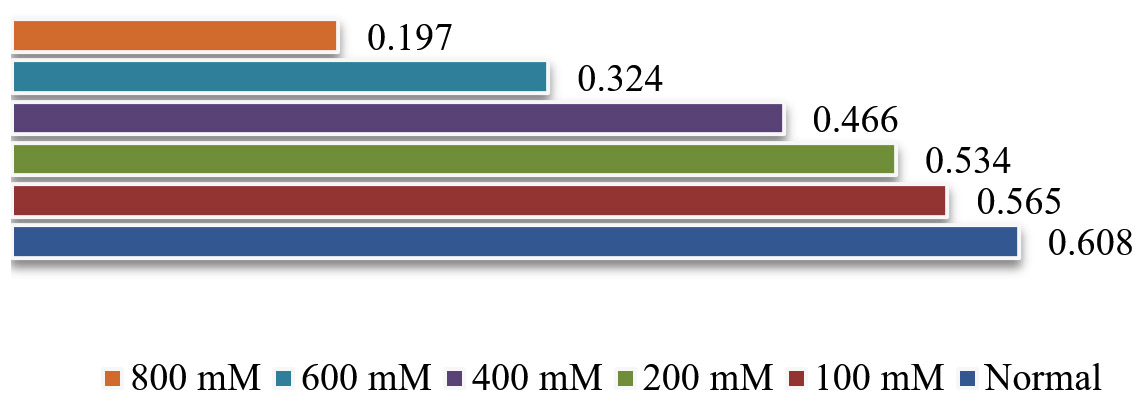
Figure 1. Spectrophotometric analysis of growth pattern of NAU-RPJ-35 with varied salt concentration
The antifungal activity tested against two prominent soil-borne phytopathogenic fungi, viz., Sclerotium rolfsii and Fusarium oxysporum f.sp. lycopersici, demonstrated that our strain achieved a 93.76% inhibition of S. rolfsii, while it inhibited F. oxysporum f.sp. lycopersici by 57.39% (Figure 2).
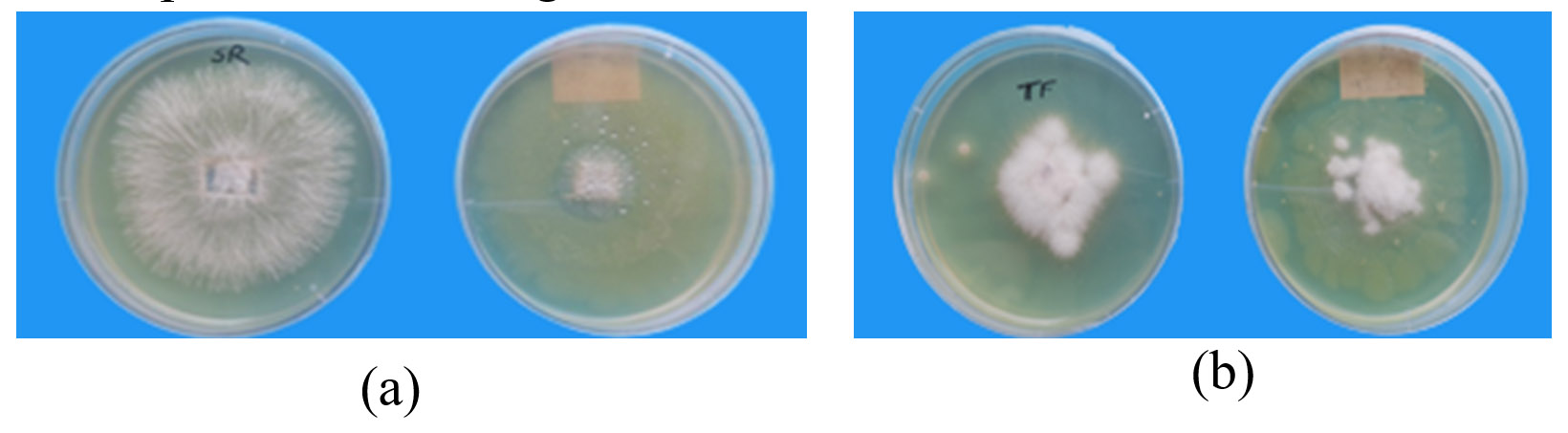
Figure 2. In vitro antifungal activity against (a) S. rolfsii and (b) F. oxysporum f.sp. lycopersici
Haemolysis detection
The absence of zone around the colony revealed γ-haemolysis by the strain on blood agar that indicated that the strain may not be pathogenic for humans, and thus safe to use for further plant assays studies.
Types of siderophore produced by NAU-RPJ-35
The type of siderophore produced by NAU-RPJ-35 was assayed through Thin Layer Chromatography (TLC) along with Arnnow’s and Csaky’s assay. TLC was conducted utilizing a solvent system composed of n-butanol, acetic acid, and distilled water in a ratio of 12:3:5, followed by the application of a 0.1M FeCl3 solution as the developing agent. The emergence of grey and pink colors, with Rf values close to the control indicates the presence of catechol and hydroxamate types of siderophores, respectively. The TLC results demonstrated the formation of a grey color with an Rf value of 0.51 for the bacterial siderophore that was in proximity to the Rf value of 0.52 for the control (3-dihydrobenzoic acid) suggested the existence of the catechol siderophore group. Additionally, the catechol group of the siderophore reacts with nitrite molybdate under acidic conditions resulting in a pink color in Arnow’s assay; conversely, the hydroxamate group of the siderophore oxidizes nitrite, yielding an orange-red color complex through diazonium coupling in Csaky’s assay. The assay data indicated the production of a pink color by the bacterial siderophore that strongly corroborated the presence of the catechol type of siderophore. Therefore, based on the findings from TLC, Arnow’s, and Csaky’s assays, our strain NAU-RPJ-35 is confirmed to produce catechol type siderophores.
Microbial and molecular characterization of the strain
Microbiological characterization indicated that NAU-RPJ-35 was gram-negative short rods, and produced medium-sized, round, glistening, transparent, non-pigmented colonies on Nutrient agar. It was found to be a lactose fermenter on MacConkey’s agar medium. Furthermore, the strain demonstrated the ability to utilize a variety of sugars, including malonate, esculin, ONPG, arabinose, xylose, adonitol, rhamnose, cellobiose, melibiose, sucrose, raffinose, trehalose, fructose, dextrose, galactose, mannose, glycerol, salicin, sorbitol, mannitol, and arabitol. Moreover, it exhibited positive reactions in tests for lysine utilization, urease activity, nitrate reduction, Voges-Proskauer, methyl red, oxidase, and amylase.
The identification of the bacteria at the molecular level was accomplished through the use of 16S rDNA, followed by a BLAST analysis utilizing the NCBI Genbank database. A distance matrix was created, and a phylogenetic tree was constructed using MEGA 11. The homology analysis revealed that the sequence of the 16S rDNA from NAU-RPJ-35 exhibited a high degree of sequence similarity to the genus Enterobacter hormaechei (98.70%). Based on the analysis of microbial data in accordance with Bergey’s Manual of Systematic Bacteriology and molecular data, the strain NAU-RPJ-35 was identified as Enterobacter hormaechei NAU-RPJ-35 with the NCBI accession number ON764273.
Seed bacterization effect on American and Desi cotton seedlings
The Enterobacter hormaechei NAU-RPJ-35 was utilized to bio-prime the seeds of American (Gossypium hirsutum-G.Cot.10 and G.Cot.44) and Desi cotton (Gossypium herbaceum – GN.Cot.25 and GN.Cot.27) genotypes. Each of the cotton seedlings was examined for its morphological and biochemical responses in comparison to non-primed seedlings through a pot experiment conducted under greenhouse conditions.
Seed bio-priming indicated that Enterobacter hormaechei NAU-RPJ-35 significantly enhanced the morphological characteristics of the American cotton varieties, viz., G.Cot.10 and G.Cot.44 (Figure 3 a-e). The improvements were noted in several parameters including germination percentage (22.22% and 29.41%), shoot length (21.67% and 13.64%), root length (25.00% and 13.33%), fresh shoot weight (38.53% and 37.71%), dry shoot weight (134.55% and 108.81%), fresh root weight (65.00%), and dry root weight (83.33% and 127.78%), respectively, when compared to non-primed seeds (Figures 3 a-d and Figure 4).
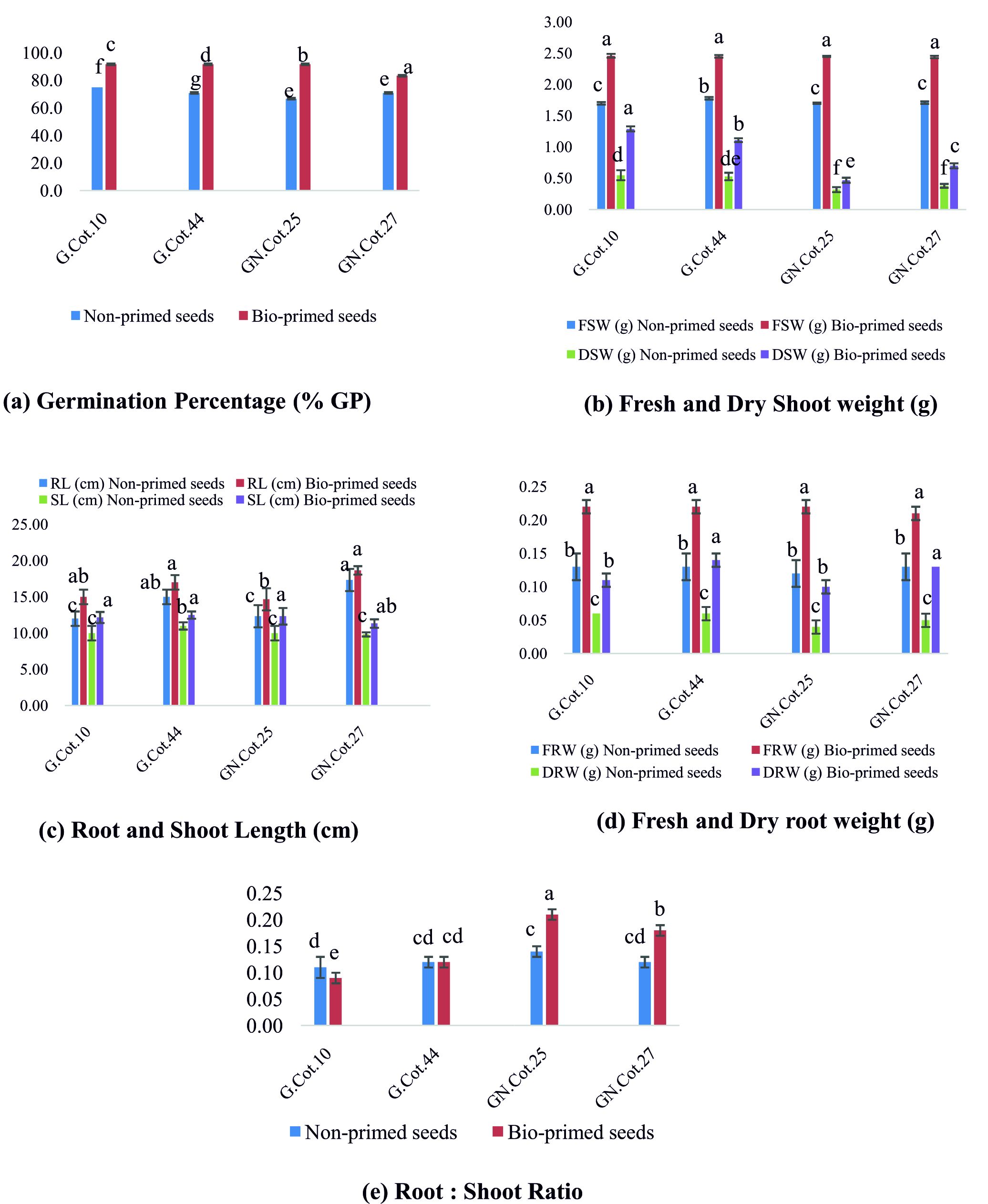
Figure 3. Morphological traits of bio-primed and non-primed cotton seedlings (a) Germination Percentage (% GP); (b) Fresh and Dry Shoot weight (g); (c) Root and Shoot Length (cm); (d) Fresh and Dry root weight (g) and (e) Root:Shoot ratio. Bars represents the mean ± SD (n = 3 replicates per treatment). Labels displayed on bars with same lower-case letters do not differ significantly; whereas the labels displayed on bars with different combinations of lower-case letters are significantly different from each other (P = 0.05 according to least significant difference)
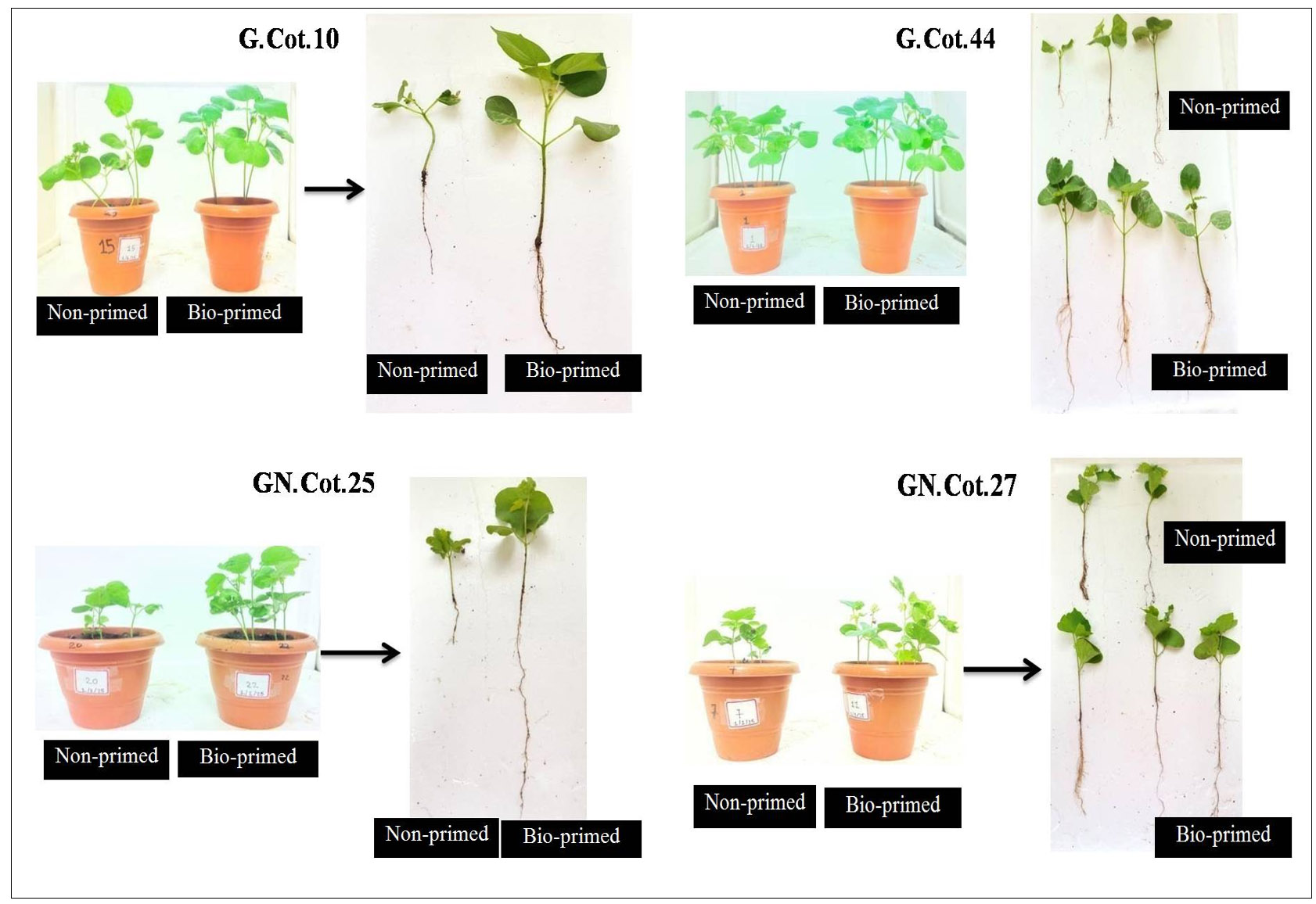
Figure 4. Bio-priming effect on cotton seedlings on American cotton (G.Cot.10 and G.Cot.44) and desi cotton GN.Cot.25 and GN.Cot.27) genotypes
Our findings also revealed a decrease in the root to shoot ratio for G.Cot.10 (-22.78), while the results for G.Cot.44 were comparable to their respective controls. The morphological characteristics of bio-primed seedlings of desi cotton GN.Cot.25 and GN.Cot.27 also indicated that Enterobacter hormaechei NAU-RPJ-35 significantly improved the germination rates (37.50% and 17.65%), shoot lengths (23.33% and 15.25%), root lengths (18.92% and 7.69%), fresh shoot weights (44.12% and 42.41%), dry shoot weights (45.83% and 85.09%), fresh root weights (78.38% and 64.10%), and dry root weights (130.77% and 178.57%), respectively, when compared to their non-primed counterparts. Additionally, the highest root-to-shoot ratio was recorded in the bio-primed seeds of GN.Cot.25 (55.61%) followed by GN.Cot.27 (48.95%) in comparison to their respective controls (Figure 3 e).
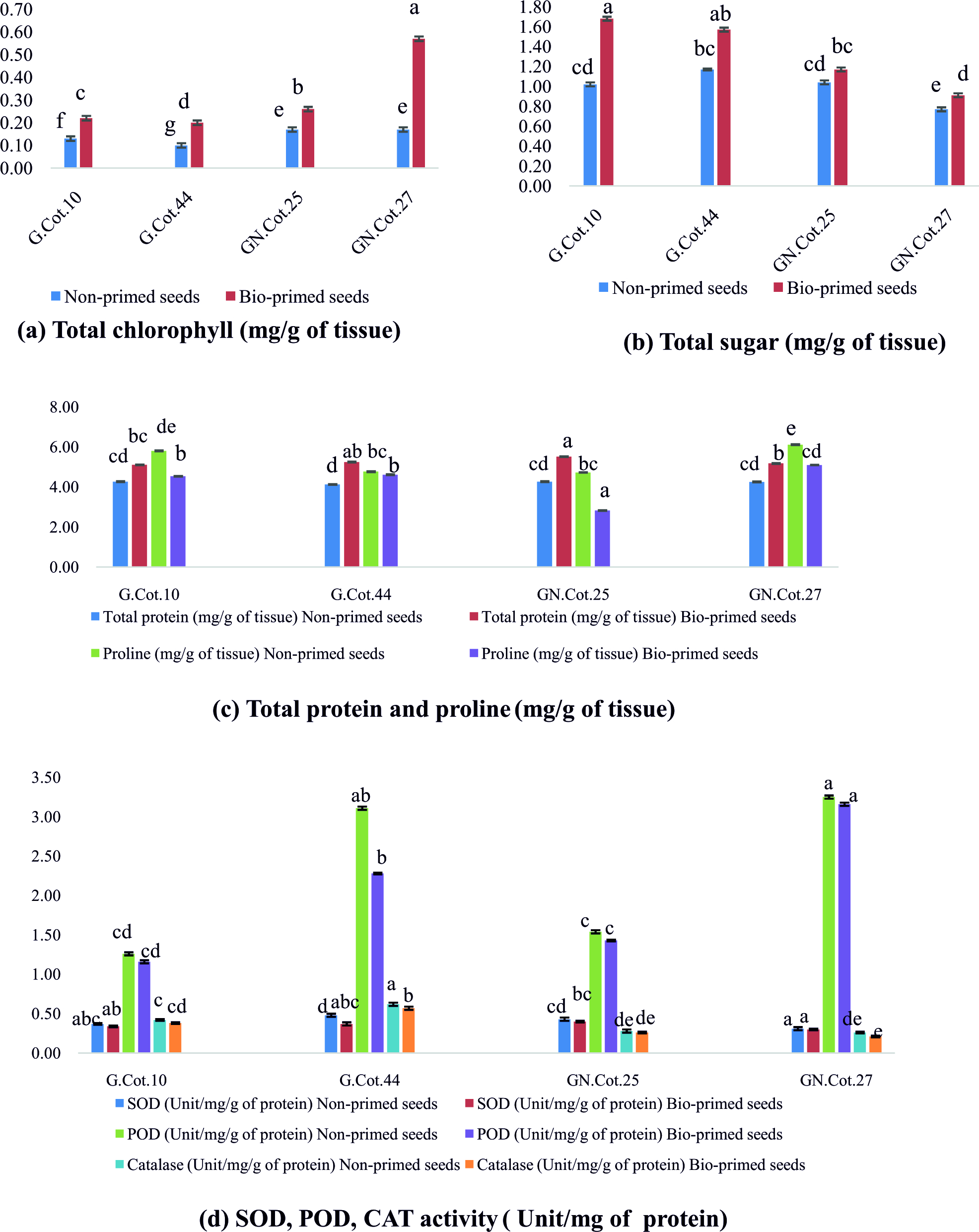
Figure 5. Biochemical traits of bio-primed and non-primed cotton seedlings. (a) Total chlorophyll (mg/g of tissue) ; (b) Total sugar (mg/g of tissue); (c) Total protein and proline (mg/g of tissue), and (d) SOD, POD, Catalase activity (Unit/mg of protein). Bars represents the mean ± SD (n = 3 replicates per treatment). Labels displayed on bars with same lower-case letters do not differ significantly; whereas the labels displayed on bars with different combinations of lower-case letters are significantly different from each other (P = 0.05 according to least significant difference)
The data on biochemical characteristics presented in Figure 5 a-d. It showed that the bio-primed seedlings of American cotton genotypes viz., G.Cot.10 and G.Cot.44 indicated that the chlorophyll content (71.05% and 96.77%), protein content (19.75% and 27.30%), and total sugar content (63.84% and 34.09%) were enhanced in comparison to the control; conversely, proline content (21.85% and 3.14%), SOD (8.11% and 21.68%), POD (7.43% and 26.77%), and CAT (10.24% and 8.02%), respectively, were either comparable or reduced relative to the control. Similarly, the biochemical traits of bio-primed seedlings of desi cotton genotypes viz., GN.Cot.25 and GN.Cot.27 also demonstrated that our strain significantly elevated chlorophyll content (50.00% and 230.01%), protein content (29.30% and 21.42%), and total sugar content (11.82% and 18.61%) as compared to the control. However, proline content (40.10% and 16.57%), SOD (7.03% and 2.17%), POD (7.34% and 2.97%), and CAT (4.82% and 19.23%) were either comparable or diminished in comparison to the control.
Calcareous soils (high pH) create significant plant stress, primarily causing nutrient deficiencies. The microbes within this type of soil may have potential in multifarious plant growth promoting and protecting traits. Hence, to study the versatile trait of bacterial strains particularly from the calcareous soil was undertaken. The Morbi district is well-known for its ceramic industries that result in calcareous soil. Therefore, soil from the industrial area of the Morbi district was chosen to isolate the bacteria.
The plant growth-promoting activities, salt tolerance capacity, and antifungal properties of the NAU-RPJ-35 strain were investigated. Our strain demonstrated exceptional capabilities in solubilizing phosphate (60.5 mg/l) and potash (71.5 mg/l) within 48 hours; whereas findings of Roslan et al. reported potash (72.90 μg/ml) and phosphate solubilization (508.25 μg/ml) within five days of incubation by Enterobacter hormaechei.35 Additionally, the assessment of salt tolerance revealed that our strain could endure up to 800 mM salt stress, suggesting that NAU-RPJ-35 is a salt-tolerant strain, potentially aiding in plant protection under stress conditions. Similarly, the production of indole-3-Acetic Acid (IAA) by our strain indicates its role in supporting plant growth. The limited availability of iron in this soil type presents a greater opportunity to discover potential siderophore producing strains because microbial siderophore secretion is higher in iron limiting condition. The highest zone index and percent siderophore production unit (% SPU) of 1.81 and 81.60%, respectively, was produced by the isolate NAU-RPJ-35.
Besides, acquiring essential mineral nutrients microbes also possesses such virulence factors, providing protection to plants against pathogens. Therefore, our strain was evaluated for its production of cellulase, protease, and hydrogen cyanide (HCN), along with its inhibitory effects against phytopathogenic fungi such as Sclerotium rolfsii and Fusarium oxysporum f.sp. lycopersici. The presence of catechol type of siderophore, cellulase and HCN are the key indicators that NAU-RPJ-35 have inbuilt capacity to inhibit the phytopathogens and it was noted that the strain was excellent to inhibit the phytopathgenic fungi. Our microbial and molecular analyses identified this promising bacterial strain as Enterobacter hormaechei NAU-RPJ-35 (Accession number ON764273), and the results of antifungal activity align with the findings of Przemieniecki et al. who reported that Enterobacter hormaechei acts as a biological fungicide against Fusarium species.36 Moreover, the species of family Enterobacteriaceae may be pathogenic and thus haemolytic activity of the strain was carried out. The absence of haemolysis indicated that our strain can be a non pathogenic and thus used for further plant assays studies.
Siderophores are key component produced by microbes and categorized into several types viz., catecholate, hydroxamate, phenolate, carboxylate, and mixed types.37 Our research also sought to identify the type of siderophore synthesized by Enterobacter hormaechei NAU-RPJ-35. Consequently, we conducted TLC and Arnow’s and Csaky’s assays, which revealed that our strain produced a catechol-type siderophore. Previous studies by Raymond et al. and Khan et al. have indicated that among the various siderophore metabolites, catechol siderophores are particularly noteworthy due to their strong affinity for Fe(III), especially attributed to the presence of 2,3-dihydroxybenzamide motifs, and are typically produced by bacterial strains within the Enterobacteriaceae family.38,39 Our identified strain also belongs to the Enterobacteriaceae family suggested that it indeed produced a catechol group of siderophore.
Numerous documents are available that illustrate the plant growth-promoting activities of Enterobacter sp. However, the potential plant growth-promoting (PGP) activities of this strain can be validated when it supports and enhances plant growth. A variety of technologies, such as soil amendment, foliar spray, drip irrigation, root dipping, and biofertilizers are available for applying bacterial strains to plants. Among these, seed biopriming is a method that transfers bacteria from the seed surface using live bacterial inoculum and acclimatizes the seeds with bacteria under prevailing conditions. The synergistic interaction between bacteria and plants will enhance the germination rate and modulate the morphological and biochemical characteristics of the plant. Consequently, the current study utilized Enterobacter hormaechei NAU-RPJ-35 as a seed biopriming agent for American and Desi cotton genotypes. Greenhouse studies indicated that seeds bio-primed with our strain exhibited improved germination rates. The morphological characteristics, including shoot and root length, as well as fresh and dry weights of roots and shoots, were found to be enhanced in bio-primed cotton seeds in both American (G.Cot.10 and G.Cot.44) and Desi (GN.Cot.25 and GN.Cot.27) genotypes. The reduced root-to-shoot ratio observed in G.Cot.10 implied that our strain has a greater influence on promoting shoot elongation compared to root development, resulting in a more balanced growth pattern. Conversely, the increased ratio in GN.Cot.25 suggested that the same strain had an improved capacity for water and nutrient absorption, which enhances the plant’s resilience to drought and nutrient deficiency conditions.
A notable enhancement in biochemical characters, viz., chlorophyll content, protein levels, and total sugar content was noted in each of the bio-primed cotton seed genotypes when compared to their respective controls; conversely, proline content, SOD, POD, and CAT levels were either comparable or reduced in relation to the control. These results means that substantial solubilization of minerals, the production of IAA, and the absorption of iron through siderophores by our strain Enterobacter hormaechei NAU-RPJ-35 might be the possible reasons behind the synergistic effect on both American and Desi cotton genotypes resulting in improved morphological and biochemical parameters. This result was comparable with Roslan et al.35 They found that the phosphate and potash solubilizing strain Enterobacter hormaechei, which possesses multiple beneficial traits for plants, significantly enhanced the germination rate and growth of Okra seedlings via the seed biopriming technique.
The strain Enterobacter hormaechei NAU-RPJ-35 isolated from calcareous soil and has been identified as significant mineral solubilizers along with effective producer of catechol-type siderophores. Additionally, it also produced phytohormones (IAA), hydrolytic enzyme (cellulase), bio-molecule (HCN) along with antifungal activity against phytopathogenic fungi viz., Sclerotium rolfsii and Fusarium oxysporum f.sp. lycopersici. Furthermore, seed bio-priming of cotton genotypes, Gossypium hirsutum (G.Cot.10 and G.Cot.44) and Gossypium herbaceum (GN.Cot.25 and GN.Cot.27) with Enterobacter hormaechei NAU-RPJ-35 resulted in synergistic interaction that not only enhanced the germination rate but also modulated the morphological and biochemical characteristics leading to enhanced seedling growth. Thus, Enterobacter hormaechei NAU-RPJ-35 can be used as potent biological agent in cotton.
ACKNOWLEDGMENTS
The authors would like to acknowledge Dr. MC Patel, Research Scientist, Main Cotton Research Station, Navsari Agricultural University (NAU), Surat, for his constant support in carrying out this work.
CONFLICT OF INTEREST
The authors declare that there is no conflict of interest.
AUTHORS’ CONTRIBUTION
PRP and BKR conceptualized the study. DP and MD performed experiments and data curation. KBS and VV performed statistical analysis. DHP, HRD and MMP performed validation. PRP and BKR performed data interpretation and wrote the original draft. DHP, HRD and MMP wrote the manuscript. All authors read and approved the final manuscript for publication.
FUNDING
None.
DATA AVAILABILITY
All datasets generated or analyzed during this study are included in the manuscript.
ETHICS STATEMENT
Not applicable.
- Zhiguang L, Yuncong CL, Shouan Z, et al. Characterization of Phosphate-Solubilizing Bacteria Isolated from Calcareous Soils. Appl Soil Eco. 2015;96:217-224.
Crossref - Meshram NA, Singare PB, Kausadikar HK. Calcareous soils and their management. Agriculture. 2023;3(4):16.
- Chhetri S, Sherpa MT, Sharma L. Characterization of Plant Growth Promoting Bacteria isolated from Rhizosphere of Tomato cultivated in Sikkim Himalaya and their Potential use as Biofertilizer. Sci Rep. 2025;15(1):15558.
Crossref - Hansen NC, Hopkins BG, Ellsworth JW, Jolley VD. Iron Nutrition in Field Crops. In Barton LL, Abdia J (eds.), Iron Nutrition in Plants and Rhizospheric Microorganisms. 1st Ed. Springer Dordrecht Netherlands. 2006:23-59
Crossref - Mahmood A, Turgay OC, Farooq M, Hayat R. Seed biopriming with plant growth promoting rhizobacteria: A review. FEMS Microbiol Ecol. 2016;92(8):fiw112.
Crossref - Deshmukh AJ, Jaiman RS, Bambharolia RP, Patil VA. Seed biopriming-a review. Int J Eco Pl. 2020;7(1):038-043.
Crossref - Knox OGG, Gupta VVSR, Lardner R. Field evaluation of the effects of cotton variety and GM status on rhizosphere microbial diversity and function in Australian soils. Soil Res. 2014;52(2):203-215.
Crossref - Lakkannavar C, Swamy M, Yallappa M, Ramesh YM, Rao S. Isolation of rhizosphere and phyllosphere bacteria from cereal samples. J Adv Biol Biotech. 2024;27(3):200-207.
Crossref - Parmar P, Sindhu SS. Potassium solubilization by rhizosphere bacteria: influence of nutritional and environmental conditions. J Microbiol Res. 2013;3(1):25-31.
Crossref - Pikovskaya RI. Mobilization of phosphorous in soil in the connection with vital activity of some microbial species. Microbiology. 1948;17:362-370.
- King EJ. The Colorimetric Determination of Phosphorus. Biochem J. 2014;26(2):292-297.
Crossref - Schwyn B. Neilands JB. Universal Chemical Assay for the Detection and Determination of Siderophores. Anal Biochem. 1987;160(1):47-56.
Crossref - Bric JM, Bostock RM, Silverstone SE. Rapid in situ Assay for Indoleacetic Acid Production by Bacteria Immobilized on a Nitrocellulose Membrane. Appl Environ Microbiol. 1991;57(2):535-538.
Crossref - Patel RK, Dodia MS, Joshi RH, Singh SP. Purification and Characterization of Alkaline Protease from a Newly Isolated Haloalkaliphilic Bacillus sp. Process Biochem. 2006;41(9):2002-2009.
Crossref - Smibert RM, Krieg NR, Phenotypic Characterization. In: Gerhardt P, Murray RGE, Wood WA, Krieg NR, eds. Methods for General and Molecular Bacteriology. American Society for Microbiology, Washington, D.C. 1994:607-654
- Lorck H. Production of hydrocyanic acid by bacteria. Physiologia Plantarum. 1948;1(2):142-146.
Crossref - Pranaw K, Pidlisnyuk V, Trogl J, Malinska H. Bioprospecting of a Novel Plant Growth-Promoting Bacterium Bacillus altitudinis KP-14 for Enhancing Miscanthus × giganteus Growth in Metals Contaminated Soil. Biology. 2020;9(9):305.
Crossref - Kotasthane AS, Agrawal T, Zaidi NW, Singh US. Identification of Siderophore Producing and Cynogenic Fluorescent Pseudomonas and a Simple Confrontation Assay to Identify Potential Bio-Control Agent for Collar Rot of Chickpea. 3 Biotech. 2017;7(2):137.
Crossref - Cai L. Thin layer chromatography. Current Protocols Essential Laboratory Techniques. 2014;8:6.3.1-6.3.18.
Crossref - Arnow LE. Colorimetric Determination of the components of 3, 4-dihydroxyphenylalanine-tyrosine mixtures. J Biol Chem. 1937;118(2):531-537.
Crossref - Csaky TZ, Hassel O, Rosenberg T, Lang S, Turunen E, Tuhkanen A. On the estimation of bound hydroxylamine in biological materials. Acta Chemical Scandinavica. 1948;2:450-454
- Fiodor A, Ajijah N, Dziewit L, Pranaw K. Biopriming of Seed with Plant Growth-Promoting Bacteria for Improved Germination and Seedling Growth. Front Microbiol. 2023;14:1142966.
Crossref - Saitou N, Nei M. The Neighbor-Joining Method: A New Method for Reconstructing Phylogenetic Trees. Mol Bio Evol. 1987;4(4):406-425.
Crossref - Nei M, Kumar S. Molecular Evolution and Phylogenetics, Oxford University Press, New York. 2000.
- Almuhawish MA, Kotb E, Alkhaldi E, Ahmed AA. Production and Antibacterial activity of Atypical Siderophore from Pseudomonas sp. QCS59 recovered from Harpachene schimperi. Pharmaceuticals. 2024;17(9):1126.
Crossref - Russell FM, Biribo SSN, Selvaraj G, et al. As a Bacterial Culture Medium, Citrated Sheep Blood Agar is a Practical Alternative to Citrated Human Blood Agar in Laboratories of Developing Countries. J Clin Microbiol. 2006;44(9):3346-3351.
Crossref - Musson G, McInroy JA, Kloepper JW. Development of Delivery Systems for Introducing Endophytic Bacteria into Cotton. Biocon Sci Tech. 1995;5(4):407-416.
Crossref - Lotfi N, Soleimani A, Vahdati K, Wei W, Mohammadi P. Bio-priming Walnut Seeds with Novel PGPR Strains enhances Germination and Drought Resilience under Osmotic Stress. Scientia Horticul. 2025;344:114073.
Crossref - Aron DI. Copper Enzymes isolated Chloroplasts, Polyphenoloxidase in Beta vulgaris. Plant Physio. 1949;24:1-15.
Crossref - LowryOH, Rosebrough NJ, Farr AL, Randall RJ. Protein measurement with the Folin phenol reagent. J Biol Chem. 1951;193(1):265–275.
- Sadasivam S, Manickam A. Biochemical Methods. 2nd Ed. New Age International (P) Ltd., New Delhi. 1992.
- Thimmaiah SR. Standard methods of biochemical analysis. Kalyani Publishers, New Delhi. 1999.
- Panse VG, Sukhatme PV, ed. Statistical Methods for Agricultural Workers, 1st Edition, Indian Council of Agricultural Research (ICAR), New Delhi, 1961
- Pirhadi M, Enayatizamir N, Motamedi H, Sorkheh K. Screening of Salt Tolerant Sugarcane Endophytic Bacteria with Potassium and Zinc for their Solubilizing and Antifungal Activity. Biosci Biotech Res Comm. 2016;9(3):530-538.
Crossref - Roslan MAM, Zulkifli NN, Sobri ZM, Zuan ATK, Cheak SC, Abdul Rahman NA. Seed Biopriming with P- and K-Solubilizing Enterobacter hormaechei sp. improves the Early Vegetative Growth and the P and K Uptake of Okra (Abelmoschus esculentus) Seedling. PLoS ONE. 2020;15(7):e0232860.
Crossref - Przemieniecki SW, Gorczyca A, Matras E, Krawczyk K, Mastalerz J, Zakrzewski A. Bacteria isolated from Treated Wastewater for Biofertilization and Crop Protection against Fusarium spp. Pathogens. Agronomy. 2019;10(11):1792.
Crossref - Khan A, Singh P, Kumar R, et al. Antifungal Activity of Siderophore isolated from Escherichia coli against Aspergillus nidulans via Iron-Mediated Oxidative Stress. Front Microbiol. 2021;12:729032.
Crossref - Raymond KN, Dertz EA, Kim SS. Enterobactin: an archetype for microbial iron transport. Proc Natl Acad Sci U S A. 2003;100(7):3584-3588.
Crossref - Khan A, Singh P, Srivastava A. Synthesis, Nature and Utility of Universal Iron Chelator–Siderophore: A review. Microbiol Res. 2018;212(213):103-111.
Crossref
© The Author(s) 2026. Open Access. This article is distributed under the terms of the Creative Commons Attribution 4.0 International License which permits unrestricted use, sharing, distribution, and reproduction in any medium, provided you give appropriate credit to the original author(s) and the source, provide a link to the Creative Commons license, and indicate if changes were made.