

ISSN: 0973-7510
E-ISSN: 2581-690X
 , Samradni Pingale1, Vineet Vinay2,3, Ruchika Kaul-Ghanekar4,5 and Ashwini Jadhav1,6
Probiotics are gaining recognition for their role in preserving vaginal health. The human vagina is primarily inhabited by lactic acid bacteria (LAB), particularly Lactobacillus, which assist in regulating vaginal pH and preventing pathogen colonization. Lactobacillus has been extensively researched as a probiotic, particularly for its role in enhancing vaginal health by restoring a balanced microbiota. Probiotics may assist in alleviating therapy-related side effects during the treatment of vaginal infections or cervical cancer. Particularly, probiotic Weissella, which is a Gram-positive, catalase-negative coccoid or rod-shaped LAB, is currently being explored for management of vaginal health. The present systematic review synthesized current evidence on the role of Weissella species in promoting vaginal health. Among 1,248 records identified through database searching, seven studies met the predefined inclusion criteria. These investigations explored the antimicrobial, immunomodulatory, and antineoplastic properties of various Weissella strains, suggesting their potential application in strategies aimed at improving vaginal health outcomes. This review suggests that Weissella spp. can help to promote vaginal health by maintaining vaginal pH, preventing growth of pathogens; activating natural killer (NK) cell activity and exhibiting anticancer activity against cervical cancer. While evidence from in vitro and pre-clinical studies are significant, further clinical trials need to be undertaken in this area for its therapeutic potential. Evidence concerning the role of Weissella spp. in vaginal health remains scarce. A synthesis of the accessible literature is required to appraise the current state of knowledge, identify unresolved research questions, and inform future investigations into the probiotic potential of Weissella species.
Vaginal Infection, Vaginal Health, Immunomodulation, Probiotics, Weissella, Systematic Review
Probiotics are increasingly getting recognized in the context of maintaining vaginal health. Human vagina is predominated by the lactic acid bacteria (LAB) such as Lactobacillus that help in maintaining vaginal pH and inhibit colonization of pathogens. Lactobacillus has been studied extensively as probiotics and their role in promoting vaginal health by restoring healthy microbiome.1,2 Probiotics can also help in mitigating therapy-associated side effects during the treatment of vaginal infection or cervical cancer.3,4 Recently, genus Weissella, a relatively less explored group of LAB, has been considered for their potential anti-bacterial, anti-oxidant, anti-inflammatory and anti-cancer activity.5-7 Weissella are Gram-positive, catalase-negative, coccoid or rod-shaped LAB. So far, only few species of Weissella have been identified, including Weissella sagaensis,8 Weissella paramesenteroides9 that isolated from fermented dairy products; Weissella beninensis,10 Weissella fabalis,11 Weissella viridescens,12 Weissella uvarum,13 Weissella cibaria, Weissella confuse,14 Weissella koreensis,15 Weissella thailandensis16 from fermented plant-based foods; Weissella bombi,17 Weissella cryptocerci,18 Weissella muntiaci,19 Weissella ceti20 from insects or animals, and Weissella confusa, Weissella cibaria isolated from human specimen.21
Among the Weissella species, not all are regarded as GRAS (Generally Recognized as Safe), but a few species have cleared all parameters to become a potential candidate for probiotics. For instance, probiotic W. confusa,22 Weissella kimchi,23 W. thailandensis,24 W. cibaria,25 W. paramesenteroides26 have been reported to have antimicrobial, anti-inflammatory and anticancer properties showing their various therapeutic applications.
Their function in maintaining vaginal flora is still poorly studied. Analyzing available scientific literature will assist in understanding their physiological role, identifying scarcity in knowledge, and providing support for future investigation exploring possible application of these bacteria as probiotic agents in vaginal flora.
Hence, the present systematic review aims to critically evaluate and consolidate existing literature on the health advantages of Weissella with specific focus on the vaginal health. By identifying current trends, strengths, and gaps in the literature, this review seeks to provide a foundation for future research and potential clinical applications of Weissella-based probiotic therapy in the vaginal health.
Study design and registration
The systematic review followed the Preferred Reporting Items for Systematic Reviews and Meta-Analyses (PRISMA) 2020 guidelines. The study registered with International Prospective Register of Systematic Reviews (PROSPERO) (Registration No: CRD42025644349) before commencing the review process. This registration included detailed specifications regarding research questions, inclusion criteria, and planned analytical approaches.
The review process incorporated several key stages: (1) development of a standardized protocol with clearly defined objectives and methodology; (2) execution of a comprehensive, multi-database literature search; (3) implementation of rigorous study selection procedures with predefined eligibility criteria; (4) systematic data extraction and quality assessment; and (5) appropriate statistical synthesis of results where feasible.
Information sources and search strategy
The search strategy covered multiple databases from inception until March 2025: PubMed/MEDLINE, Scopus, Embase, Cochrane Central Register of Controlled Trials (CENTRAL), Web of Science Core Collection and CINAHL (for patient-reported outcomes). Further, to minimize publication bias, following some additional Grey Literature and Trial Registries sources were included: ClinicalTrials.gov, WHO International Clinical Trials Registry Platform (ICTRP), OpenGrey, ProQuest Dissertations and Theses Global. The search strategy was designed in consultation with a medical librarian and combined Medical Subject Headings (MeSH) and free-text terms. No language restrictions were applied, with non-English articles translated for full-text review when necessary. The search strategy for PubMed and other databases is provided in the Supplementary material. We also did complementary search approaches that involved manual review of reference lists from all incorporated studies and relevant review articles, forward citation searching via Google Scholar for papers citing key articles and correspondence with corresponding authors of included studies to identify unpublished data or ongoing research.
Eligibility criteria
Explicit eligibility criteria were established using the Population, Intervention, Comparator, Outcomes, Study Design (PICOS) framework to dire study selection:
Population
Inclusion criteria comprised studies with Experimental models
In vitro studies utilizing cell lines or in vivo models that could provide mechanistic insights into effect of Weissella on vaginal health.
Interventions
Any probiotic formulation containing Weissella species (e.g., W. cibaria, W. confusa, W. viridescens), all administration routes (oral, intravaginal), any treatment duration, various delivery vehicles (capsules, suppositories, fermented foods).
Comparators
Placebo controls (e.g., maltodextrin, saline), no treatment arms, active comparators (other probiotics, antibiotics, or antifungals).
Outcomes
Primary outcome measures focused on microbiological, immunological and pre-clinical outcomes.
Types of studies
Pre-clinical studies with comparator groups, controlled in vitro studies using cell lines.
Exclusion criteria
Studies involving pregnant or postmenopausal women due to the confounding effects of hormonal fluctuations on vaginal microbiota.
Reports lacking control groups or clear diagnostic criteria.
Case reports, case series, narrative reviews, conference abstracts without full data, or duplicate publications.
Selection process
After removing duplicates through Covidence systematic review software (Veritas Health Innovation, Melbourne, Australia), Title and abstract screening were done by two independent reviewers for eligibility criteria using the predefined PICOS framework. The full texts of all relevant studies were independently evaluated by two reviewers. Any discrepancies were addressed through discussion, when required, a third reviewer was also referred. Selection procedure for the study was summarized using a PRISMA 2020 flow diagram.
Data collection and extraction
Independent data extraction was done by two reviewers using the standardized data extraction parameters (Supplementary material). Discrepancies were resolved through consensus discussion. Where there was inadequate documentation, the study authors were contacted for additional information. In order to ensure consistency, the extracted data was independently verified by a third reviewer. The following standards were developed:
Risk of bias and quality assessment
Study quality was evaluated using design-appropriate tools. Cochrane Risk of Bias 2 (RoB 2) tool was used to assess randomized controlled trials. The tool assessed bias against five domain as mentioned in the literature.27 Each domain received judgment as “low risk”, “some concerns”, or “high risk” of bias. The Quality Assessment Tool for in vitro studies (QUIN) assessed for study design and objectives, cell line characterization, experimental conditions, outcome measures and data analysis and reporting.
Each outcome evidence certainty was evaluated using the Grading of Recommendations Assessment, Development and Evaluation (GRADE) framework. The evidence was classified into four groups depending on the level of certainty, which was either high, moderate, low, or very low certainty, depending on the amount of confidence in the study findings. The assessment considered several areas such as risk of bias, consistency of the findings between studies, directness of evidence, precision, and publication bias.
Data synthesis and statistical analysis
During the analysis, if three or more studies reported comparable outcomes with sufficient methodological homogeneity, quantitative synthesis or meta-analysis was conducted. We used Mean difference (MD) or standardized mean difference (SMD) with 95% CIs for continuous outcomes. For dichotomous outcomes, we used Risk ratios (RR) with 95% confidence intervals (CIs). We used Random-effects models (DerSimonian-Laird method) for expected clinical and methodological heterogeneity in the data. I² statistic and Cochran’s Q test were used for assessing heterogeneity. Evaluation with P < 0.10 was considered to be statistically significant. We performed sensitivity analyses by testing the Robustness of findings through the exclusion of studies with a high risk of bias, comparison of alternative statistical models (fixed-effect vs. random-effects) and influence analysis by sequentially removing each study. In qualitative synthesis, outcomes unsuitable for meta-analysis due to clinical or methodological heterogeneity, thematic analysis is applied for grouping of studies by common themes (e.g. antimicrobial effects, immunomodulation), identification of patterns across studies and highlighting of consistent and contradictory findings.
Study selection
A total of 1,248 studies were initially examined after database searches. Full text of fifty-one articles was evaluated for eligibility after duplicate removal and screening. Out of these, seven studies convinced the inclusion criteria and were incorporated in the qualitative synthesis. The study selection process is represented in the PRISMA flow diagram (Figure).
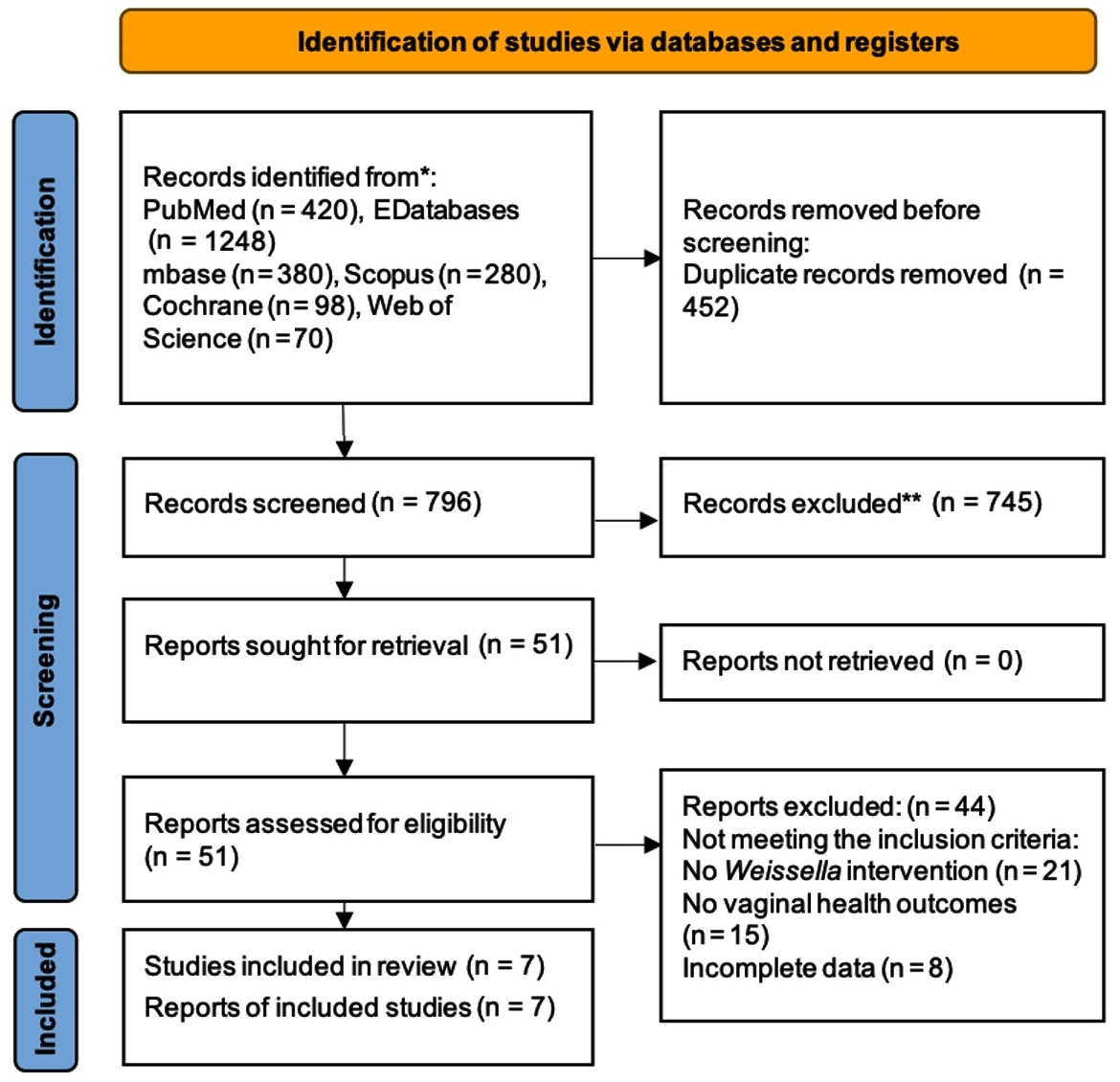
Figure. Workflow of the study selection process using PRISMA 2020
Study characteristics
The systematic review included 7 studies published between 2004-2024, comprising 5 in vitro studies22-24,26,28 and 2 pre-clinical study25,28 investigated different Weissella strains (W. confusa, W. cibaria, W. kimchii, W. paramesenteroides) with varying intervention protocols. Table 1 presents the features of the selected studies, while Table 2 highlights their main results. Overall complete information about the results of the study is mentioned in the Supplementary Material.
Table 1. Data extraction of included studies
Study (Year) |
Experimental Design |
Population/Cell Line |
Weissella Strain |
Intervention Details |
Comparator |
Key Outcomes |
|---|---|---|---|---|---|---|
Lee22 |
In vitro |
C. albicans CCARM14020, Escherichia coli (CCARM 1360), Staphylococcus aureus (CCARM 3703), vancomycin-resistant Enterococcus faecium (VRE; CCARM 5100) and T24 human bladder epithelial cells |
W. confusa PL9001 |
W. confusa PL9001 (1×10⁸ CFU), each pathogen (1×10⁷ CFU), 30 min interference assay |
No probiotic |
Least ↓ E. coli by 3.17% and the highest ↓ S. aureus by 42.43% in interference assay. |
Lee23 |
In vitro |
Candida albicans, E. coli, S. aureus, Streptococcus agalactiae and Vaginal epithelial cells |
W. kimchii PL9023 |
Interference test: W. kimchi (108 CFU/mL), vaginal cells (2 ×10⁴ cells/ml), each pathogen (1-2×10⁶ cells/ml), 30 min adherence time |
No probiotic |
W. kimchi ↓ the adherence of S. aureus at pH 4.4 (P
|
Thamacharoensuk et al.24 |
In vitro |
murine macrophage cell lines J774A.1 |
Weissella spp. (Thai isolate) |
Weissella spp. (10⁸ CFU/mL), J774A.1 cells (2.5 × 10 5 cells per well). 24 hrs incubation |
Lactobacillus acidipiscis SR7-1and Lactobacillus farraginis SL4-1, Lactobacillus plantarum NRIC 1067T |
W. cibraria PC86-2 ↑ IL-12, (PWeissella spp. |
Oh and Lee25 |
Pre-clinical |
Mice NK cells |
W. cibaria JW15 |
Once daily for 14 days via oral gavage |
Lactobacillus rhamnosus GG ATCC 53103 |
↑ NK cell activity (P
|
Amer et al.26 |
In vitro |
Five different pathogens, Bacillus subtilis, S. aureus, E. coli, Pseudomonas aeruginosa, C. albicans (105 cells/ ml) |
W. paramesenteroides MN2C2 filtrate against pathogens, Exopolysaccharides nanoparticles (EPS-NPs) isolated from W. paramesenteroides MN2C2 |
100 µl of filtrate, 1.3 mg/ml for crude nano-EPS, 48 hrs |
No comparator |
Inhibition zone of 25 and 19 mm against B. subtilis and P. aeruginosa, respectively. |
Choi and Yun28 |
Pre-clinical |
CT26 and MC38 cell transplanted mice |
W. cibaria WIKIM28 |
0.1 ml (1×10⁹ CFU ) injected intravenously to the tail of transplanted mice for 12-16 days. |
With control (phosphate-buffered saline) |
Colorectal tumor cells reduction was observed in terms of tumor volume (mm3), against CT26 (P = 0.04969) and MC38 (P = 0.000091) in just 16 and 12 days, respectively. |
Lee et al.29 |
In vitro |
Antifungal activity against C. albicans
|
W. confusa WIKIM51 (Wilac D001) |
1 × 10⁷ CFU of W. confusa suspension for C. albicans inhibition for 24 h. |
Sertaconazole nitrate and Lactobacillus spp. |
Inhibited C. albicans growth (P
|
Table 2. Outcome of included studies
Study (Year) |
Primary Outcomes |
Measurement Method |
Results (Mean ± SD, % and fold Change) |
Secondary Outcomes |
|---|---|---|---|---|
Lee22 |
Pathogen inhibition by interference assay and broth dilution |
MPN Method |
Growth inhibition of pathogens C. albicans (8%) and E. coli (38%) by broth dilution method |
Adherence to T24 cells and coaggregation of C. albicans or E. coli with W. confusa PL9001 |
Lee23 |
C. albicans, E. coli, S. aureus and S. agalactiae inhibition to colonizing vaginal cells at different pH |
pH meter Colony counting |
No SD or percentage values mentioned |
The number of adhered W. kimchi cells to vaginal cells increased at a lower pH |
Thamacharoensuk et al.24 |
IL-12 induction |
ELISA |
IL-12 productivity ↑ (1585.23±7.80 pg/mL) |
↑ cell viability for W. thailandensis PC79-5 and W. confusa MSMC57-2 by 1.85% in acid bile conditions |
Oh and Lee25 |
NK cell activation |
Flow cytometry |
No SD mentioned |
JW15 increased intracellular cytolytic molecules, such as perforin, granzyme B, and IFN-γ |
Amer et al.26 |
Antimicrobial effects |
Diameter measurement |
No SD mentioned |
Anti-cancerous activity against MCF-7 (58%), reduction in DPPH at 39.8 µg /ml Nano crude EPS |
Choi and Yun28 |
Anticancer activity of W. cibaria |
Tumor volume measured |
Reduced tumor volume by 2.4 times for CT26 and 16.3 times for MC38 compared to control |
Composition can be used for the treatment or prevention of various cancer including uterine cancer |
Lee et al.29 |
C. albicans biofilm reduction |
Diameter measurement |
Zone of Inhibition: 11.2 ± 0.3 mm |
↓ C. albicans biofilm (P
|
Microbiological outcomes in terms of pathogen inhibition were assessed in terms of adhesion reduction and biofilm disruption. For instance, W. confusa PL9001 decreased the number of adhered pathogens of E. coli (8.47%), C. albicans (11.54%), S. aureus (58.59%) and VRE (37.88%) to epithelial (T24) cells. In the study, W. confusa PL9001 modulated the vaginal microenvironment by inhibiting the growth of UTI pathogens by 38% of E. coli and 8% with C. albicans.22 W. kimchii PL9023 produces hydrogen peroxide and bacteriocin like substances which can inhibit various pathogens associated with vaginal infections.24 W. confusa WIKIM51 reduced C. albicans with the formation of zone of inhibition with the diameter of 11.2 ± 0.3 (P < 0.001).28
In the outcome of immunomodulatory effects, Weissella spp. increased IL-12 (highest in W. cibaria 1585.23 ± 7.80 pg/mL vs lowest in L. paracasei 430.65 ± 35.02 pg/mL).24 W. cibaria WIKIM28 elevated IL-10 (320±45 pg/mL) while reducing TNF-α (110 ± 15 pg/mL vs 250 ± 30 control) (P < 0.05).28 On the other hand, W. cibaria JW15 enhanced CD69+ NK cells.25 Apart from these, both crude and pure nano-EPS produced from W. paramesenteroides MN2C2 has anti-cancer activity against various cancerous cell lines with highest activity of crude nano-EPS of 1.3 mg/ml (lowest IC50) is recorded to have highest selective index of 6.9 against MCF-7.26
Risk of bias assessment
The risk of bias (RoB) was assessed to the seven studies retrieved, as displayed in Table 3 and Supplementary material. Two in vitro studies Lee et al. and Thamacharoensuk et al.23,24 out of 5, have found some concerns (Cochrane RoB 2) due to unblinded design. On the other hand, two in vitro studies Oh et al.25 and Lee et al.29 were marked as low risk than the other in vitro study.21 Sterne et al.26 and Choi et al.28 were marked as High risk (SYRCLE) for industry-linked patents (Table 3).
Table 3. Risk of bias
Study (Year) |
Randomization |
Blinding |
Incomplete Data |
Selective Reporting |
Other Bias |
Overall |
|---|---|---|---|---|---|---|
Lee22 |
N/A |
✗ |
✓ |
✓ |
! (No strain validation) |
! |
Lee23 |
N/A |
✗ |
✓ |
✓ |
Performed in triplicates |
✓ |
Thamacharoensuk24 |
N/A |
✗ |
✓ |
✓ |
! (Single dose) |
! |
Oh and Lee25 |
N/A |
✓ |
✓ |
✓ |
✓ |
✓ |
Amer et al.26 |
✗ |
✗ |
! |
✗ (Patent) |
✗ (Industry-funded) |
✗ |
Choi and Yun28 |
✗ |
✗ |
✓ |
✗ (Patent) |
✗ |
✗ |
Lee et al.29 |
N/A |
✓ |
✓ |
✓ |
✓ |
✓ |
*(✓ = Low risk, ! = Some concerns, ✗ = High risk)
We have also performed evidence quality on the retrieved studies. It was found that studies from 2021-2024 demonstrate improved methodological rigor (100% cell line validation vs 0% in 2004-2005) and broader outcome measures (biofilm + immunity/adhesion focus).
Study key findings include that strain-specific effects were observed in which W. confusa showed blockage of congregation of C. albicans, while W. cibaria had optimal immunomodulation. There is a dose-response gap in the overall studies, as only a single study tested multiple doses.24 So, furthermore, clinical translation is needed.
While this systematic review identified promising evidence for Weissella probiotics in vaginal health across seven studies (2004-2024), quantitative synthesis through meta-analysis was not feasible due to significant methodological heterogeneity. The included studies varied substantially in design (five in vitro studies, and two pre-clinical studies), outcome measures (ranging from pathogen adhesion rates to cytokine levels), and model systems (cell cultures vs. pre-clinical trials). Outcomes like pH modulation or biofilm reduction were reported by single studies using incompatible methodologies. Additionally, incomplete reporting of standard deviations and varying Weissella strains (W. confusa, W. cibaria, W. kimchii) further precluded statistical pooling. Instead, a qualitative synthesis revealed consistent positive trends, with 100% of studies demonstrating beneficial effects in their respective outcome measures, particularly for W. confusa’s anti-adhesion properties and W. cibaria’s immunomodulation. The review highlights an urgent need for standardized clinical trials measuring comparable endpoints (e.g., Nugent scores across ≥3 studies) to enable future meta-analyses. Currently, the evidence supports narrative integration of mechanisms while underscoring the preliminary nature of these findings due to risk of bias concerns (two high-risk industry-linked studies). Researchers should prioritize replicating key outcomes like biofilm disruption in controlled clinical settings to permit quantitative synthesis.
Despite recently advanced treatment options for vaginal infections, the associated side effects such as loss of beneficial microflora, vaginal dryness, itching, occurrence of secondary infections, render the therapy less effective. Resistance to the standard antibiotics is a major growing concern during the treatment, thereby calling for development of new and effective alternative therapies. Probiotics have been extensively reported for their effect on maintaining normal vaginal flora and, thus promoting vaginal health. Recently, genus Weissella has emerged as a probiotic for their potential role in promoting vaginal health. The present systematic review focuses on the role of different Weissella strains such as W. confusa, W. kimchi, Weissella paramesenteroides in promoting vaginal health. Lee22 reported antimicrobial properties of clinical isolate W. confusa PL9001 against isolated uropathogens. Co-aggregation test also suggested that W. confusa PL9001 prevented adherence of these UTI pathogens. In the study by Lee,23 isolated more than 100 LAB from vagina of healthy females, of which all Weissella spp. produced hydrogen peroxide with W. kimchi PL9023, producing significantly higher volumes of hydrogen peroxide. Weissella also produced lactic acid and bacteriocin-like substance along with hydrogen peroxide, which inhibited the growth of isolated vaginal pathogens C. albicans, S. aureus, E. coli and Streptococcus agalactiae. Lee et al.29 investigated the antifungal activity of W. confusa WIKIM51 (Wilac D001) against C. albicans. The inhibitory effect was not only equivalent to L. reuteri and L. rhamnosus, but it also strongly downregulated the pro-inflammatory cytokines IL-6 and IL-8, which are otherwise increased during infection with C. albicans. Contrarily, the regulation of IL-6 and IL-8 by L. reuteri and L. rhamnosus was not significant.29 Immune modulatory activity of kimchi probiotic Weissella ciberia has reported by Oh and Lee25 which can play an important role in preventing cancer. Their findings indicated consumption of such probiotics will help to reduce inflammation and combat infections, which will enhance vaginal health. Thamacharoensuk et al.24 found that out of all the studied LAB, W. cibaria PC86-2 significantly modulated the production of IL-12 and can prevent cancer by stimulating cell-mediated responses.24 Weissella paramesenteroides MN2C2 isolated from buffalo colostrum was reported by Sterne et al.26 This organism showed resistance to acidic environment and bile salt as well as to pancreatic enzymes. The antimicrobial properties of this bacteria were tested on various microorganisms such as Bacillus subtilis, Pseudomonas aeruginosa, Escherichia coli, Staphylococcus aureus, Streptococcus agalactiae, Aeromonas hydrophila, and Salmonella enterica. In addition, exopolysaccharide derived nanoparticles synthesized from Weissella paramesenteroides MN2C2 were found to have inhibitory effect on MCF-7, Caco-2 and HepG-2 cells. Moreover, these nanoparticles also have antioxidant property. Their study implies that supplementation of probiotics, including Weissella spp., could increase quality of life in post-operative cancer patients. Choi and Yun27 patented a pharmaceutical composition containing Weissella cibaria WIKIM28 for its anti-cancer properties. Additional Weissella strains that were not included in the present review have also been reported to possess potentially beneficial biological properties. Kwon et al.30 did a pilot study to get insights into the impact of probiotic supplementation consisting of nine strains belonging to Lactobacillus and Bifidobacterium spp. in post-operative cancer patients. Their study implies that supplementation of probiotics, increased Weissella spp. along with other beneficial bacteria that could increase quality of life in post-operative cancer patients, suggesting the beneficial importance of Weissella spp. Park et al.31 did a double blinded, randomized, placebo controlled clinical trials on consumption of W. cibaria CMS1 by 90 health individuals for 12 weeks. Data from the study revealed that consumption of W. cibaria CMS1 increased production of salivary immunoglobulin A (sIgA) while decreasing tumor necrosis factor alpha (TNF- α) significantly with P-value, P = 0.046 and P = 0.008 respectively. Their study not reported increase in presence of Lactobacillales, Bacilli, and Streptococcaceae but also reported beta diversity change in oral microbiota by increasing abundance of Furmicutes and Acinetobacter and decreasing abundance of Bacteroidetes and Fusobacteria after consumption of W. cibaria for 12 weeks. Similarly, probiotic intervention of specific Weissella strain might also increase the abundance of beneficial microbes and modulate immune response in vagina and enhance vaginal health.31 The probiotic potential of the vaginal strain Weissella confusa MV0113 was assessed based on genomic analysis, in vitro and pre-clinical studies by Luo et al.32 The cell free supernatant of the Weissella confusa MV0113 strain inhibited the biofilm formation of Candida albicans and Gardnerella vaginalis. In animal models, the administration of Weissella confusa MV0113 resulted in modulations in inflammation responses and the restoration of beneficial Lactobacillus strains. Weissella paramesenteroides UFTM 2.6.1, a bacterial isolate isolated from bovine milk, showed anti-Listeria activity via in silico and in vitro studies.33 Further, in another study, omics-based analysis of the strain Weissella confusa UTNCys2-2 indicated that the bacterial strain can synthesize exopolysaccharides and other bioactive metabolites.7,34 Moreover, the cell free supernatant of Weissella confusa K3 exerted antibacterial effect against uropathogenic bacteria producing extended spectrum β-lactamases.35 However, information on the activity of the aforementioned strains against vaginal pathogens is not available yet.
The present review summarizes the potential probiotic role of Weissella spp. that could improve vaginal health in women by inhibiting adherence and growth of pathogens, immunomodulating cytokines levels, activating NK cells activity, enhancing antioxidant and anticancer properties. However, further large-scale clinical studies are warranted to strengthen the potential of Weissella spp. as promoters of vaginal health in women. Moreover, specific strains, route of administration, optimal dosage, and treatment duration need to be carefully standardized for Weissella spp. to make it a commercial probiotic in the future.
Strengths and limitations
Strengths
To ensure that all relevant research studies could be located, searching was done using several databases and sources, including those in various languages.
Rigorous methodology adhering to PRISMA guidelines with dual independent review at all stages.
Detailed quality assessment using appropriate tools for different study designs.
Transparent reporting through protocol registration and full disclosure of methods.
Limitations
- Heterogeneity in Weissella strains, formulations, and outcome measures.
- Limited long-term data with most included studies having short follow-up periods.
- Potential publication bias with possible underrepresentation of negative results.
- Mechanistic focus of some included studies creating uncertain clinical relevance.
- No clinical studies obtained where Weissella spp. were used as an intervention.
- Language bias with most evidence available in English despite no language restrictions.
This methodology ensured a systematic, transparent, and reproducible synthesis of evidence regarding Weissella probiotics for vaginal health. The approach balanced comprehensiveness with feasibility, employing appropriate tools for quality assessment and data synthesis. These methods minimized bias while providing meaningful conclusions to inform both clinical practice and future research directions.
Weissella spp. offers a promising potential in ameliorating vaginal health in women, particularly in managing conditions such as bacterial vaginosis, candidiasis, and possibly even cancer. Yet, human trials have to be carried out to determine clinical significance through safety, effectiveness, and impacts of Weissella formulations, which will involve randomized control trials. Furthermore, strain-specific characteristics and mechanisms of action need to be studied for prospective clinical application.
Additional file: Supplementary information.
ACKNOWLEDGMENTS
The authors thank Poona College of Pharmacy, Bharati Vidyapeeth (Deemed to be University), for infrastructural support. The author (MB) acknowledges Symbiosis International (Deemed University) (SIU) for supporting through a PhD scholarship.
CONFLICT OF INTEREST
The authors declare that there is no conflict of interest.
AUTHORS’ CONTRIBUTION
RKG conceptualized the study. VV designed the study. MB, SP and AJ performed investigation. MB, VV and AJ performed data analysis. AJ and RKG supervised the study. SP and MB wrote the manuscript. AJ, VV and RKG revised the manuscript. All authors read and approved the final manuscript for publication.
FUNDING
None.
DATA AVAILABILITY
All datasets generated or analyzed during this study are included in the manuscript and/or in the supplementary files.
ETHICS STATEMENT
Not applicable.
- Pendharkar S, Skafte-Holm A, Simsek G, Haahr T. Lactobacilli and their probiotic effects in the vagina of reproductive age women. Microorganisms. 2023;11(3):636
Crossref - Al-Yami AM, Al-Mousa AT, Al-Otaibi SA, Khalifa AY. Lactobacillus species as probiotic: isolation sources and health benefits. J Pure Appl Microbiol. 2022;16(4):2270-2291.
Crossref - Waziri A, Bharti C, Aslam M, et al. Probiotics for the chemoprotective role against the toxic effect of cancer chemotherapy. Anti-Cancer Agents Med Chem. 2022;22(4):654-667.
Crossref - Purkayastha SD, Bhattacharya MK, Prasad HK, et al. Probiotic and cytotoxic potential of vaginal Lactobacillus isolated from healthy northeast Indian women. J Pure Appl Microbiol. 2020;14(1): 205-214.
Crossref - Du Y, Liu L, Yan W, et al. The anticancer mechanisms of exopolysaccharide from Weissella cibaria D-2 on colorectal cancer via apoptosis induction. Sci Rep. 2023;13(1):21117
Crossref - Khider M, El-Readi MZ, Abdalrahim S, et al. Functional low-fat set yogurt enhanced with microbial exo-polysaccharides-mediated anticancer activity. J Pure Appl Microbiol. 2022;16(4):2601-2618.
Crossref - Bochgire M, Pingale S, Kaul-Ghanekar R, Angadi K, Jadhav A. Weissella: A multifaceted genus making the way for next-gen biotherapeutics? Antonie van Leeuwenhoek. 2026;119(5):96.
Crossref - Li YQ, Tian WL, Gu CT. Weissella sagaensis sp. nov., isolated from traditional Chinese yogurt. Int J Syst Evol Microbiol. 2020;70(4):2485-2492
Crossref - Yadav M, Sunita, Shukla P. Probiotic potential of Weissella paramesenteroidesMYPS5.1 isolated from customary dairy products and its therapeutic application. 3 Biotech. 2022;12(1):9.
Crossref - Padonou SW, Schillinger U, Nielsen DS, et al. Weissella beninensis sp. nov., a motile lactic acid bacterium from submerged cassava fermentations, and emended description of the genus Weissella. Int J Syst Evol Microbiol. 2010;60(Pt 9):2193-2198.
Crossref - Snauwaert I, Papalexandratou Z, De Vuyst L, Vandamme P. Characterization of strains of Weissella fabalis sp. nov. and Fructobacillus tropaeoli from spontaneous cocoa bean fermentations. Int J Syst Evol Microbiol. 2013;63(Pt 5):1709-1716
Crossref - Wouters D, Grosu-Tudor S, Zamfir M, De Vuyst L. Bacterial community dynamics, lactic acid bacteria species diversity and metabolite kinetics of traditional Romanian vegetable fermentations. J Sci Food Agric. 2013;93(4):749-60
Crossref - Nisiotou A, Dourou D, Filippousi ME, Banilas G, Tassou C. Weissella uvarum sp. nov., isolated from wine grapes. Int J Syst Evol Microbiol. 2014;64(Pt_11):3885-3890
Crossref - Lakra AK, Domdi L, Hanjon G, Tilwani YM, Arul V. Some probiotic potential of Weissella confusa MD1 and Weissella confusa MD2 isolated from fermented batter. Lwt. 2020;125.
Crossref - Mun SY, Chang HC. Characterization of Weissella koreensis SK isolated from kimchi fermented at low temperature (around 0 °C) based on complete genome sequence and corresponding phenotype. Microorganisms. 2020;8(8):1147
Crossref - Suwannaphan S. Isolation, identification and potential probiotic characterization of lactic acid bacteria from Thai traditional fermented food. AIMS Microbiol. 2021;7(4):431-446.
Crossref - Praet J, Meeus I, Cnockaert M, Houf K, Smagghe G, Vandamme P. Novel lactic acid bacteria isolated from the bumble bee gut: Convivina intestini gen. nov., sp. nov., Lactobacillus bombicola sp. nov., and Weissella bombi sp. nov. Antonie van Leeuwenhoek. 2015;107(5):1337-49.
Crossref - Heo J, Hamada M, Cho H, et al. Weissella cryptocerci sp. nov., isolated from gut of the insect Cryptocercus kyebangensis. Int J Syst Evol Microbiol. 2019;69(9):2801-2806.
Crossref - Lin ST, Wang LT, Wu YC. Weissella muntiaci sp. nov., isolated from faeces of Formosan barking deer (Muntiacus reevesi). Int J Syst Evol Microbiol. 2020;70(3):1578-1584
Crossref - Pereira FL, Dorella FA, Castrejon-Najera J, et al. Comparative polyphasic characterization of Weissella strains isolated from beaked whale and rainbow trout (Oncorhynchus mykiss): confirmation of Weissella ceti sp. nov. and description of the novel Weissella tructae sp. nov. isolated from farmed rainbow trout. Braz J Microbiol. 2022;53(4):2263-2272
Crossref - Joglekar A, Nimonkar Y, Bajaj A, Prakash O. Resolution of inter/intraspecies variation in Weissella group requires multigene analysis and functional characterisation. J Basic Microbiol. 2023;63(2):140-155.
Crossref - Lee, YH. Weissella confusa strain PL9001 inhibits growth and adherence of genitourinary pathogens. J Microbiol Biotechnol. 2004;14(4):680-685.
- Lee Y. Characterization of Weissella kimchii PL9023 as a potential probiotic for women. FEMS Microbiol Lett. 2005;250(1):157-162.
Crossref - Thamacharoensuk T, Taweechotipatr M, Kajikawa A, Okada S, Tanasupawat S. Induction of cellular immunity interleukin-12, antiproliferative effect, and related probiotic properties of lactic acid bacteria isolated in Thailand. Ann Microbiol. 2017;67:511-518.
Crossref - Oh EY, Lee SM. Natural killer cell activation by Weissella cibaria JW15 isolated from Kimchi. J Bacteriol Virol. 2021;51(2):62-73
Crossref - Sterne JA, Savović J, Page MJ, et al. RoB 2: a revised tool for assessing risk of bias in randomised trials. BMJ. 2019;366:14898.
Crossref - Amer M, Eldiwany A, Elgammal E, Atwa N, Dawoud I, Rashad F. Nano-exopolysaccharide from the probiotic Weissella paramesenteroides MN2C2: production, characterization and anticancer activity. Egypt J Chem. 2021;64:7023-7033
Crossref - Choi HJ, Yun MS. Pharmaceutical composition for publication classification preventing or treating cancer, comprising Weissella cibaria wikim28 as active ingredient. 2022:EP3895717B1
- Lee G, You YA, Ansari A, et al. The antifungal effect of Weissella confusa WIKIM51 (Wilac D001) on vaginal epithelial cells infected by Candida albicans. Appl Sci. 2024;14(7):2676.
Crossref - Kwon H, Chae SH, Jung HJ, et al. The effect of probiotics supplementation in postoperative cancer patients: A prospective pilot study. Ann Surg Treat Res. 2021;101(5):281-290.
Crossref - Park MJ, Park S, Kim KJ, Oh B, Kim JY. Effect of the probiotic Weissella cibaria CMS1 on the immune response and the oral microbiome: a randomized, double-blind, placebo-controlled, parallel study. Food Funct. 2024;15(8):4409–4420.
Crossref - Luo C, Dong X, Song J et al. Vaginal Weissella confusa MV0113 suppresses pathogens and restores microbiota to alleviate bacterial vaginosis: integrated genomic and in vivo evidence. BMC Microbiol. 2025;26(1):51.
Crossref - Rocha BM, Sabino YN, de Almeida TC et al. Unlocking probiotic potential: genomic insights into Weissella paramesenteroides UFTM 2.6. 1. Probiotics & Antimicro Prot. 2025;17(6):4764-4777.
Crossref - Tenea GN. Comprehensive genomic and metabolomic profiling of Weissella confusa UTNCys2-2 highlights bioactive potential. Front Microbiol. 2026;17:1779198.
Crossref - El-Mekkawy RM, Hamour NE, Hassanein WA, Allam AA. Evaluation of the antibacterial activity of Weissella confusa K3 cell-free supernatant against extended-spectrum βeta lactamase (ESBL) producing uropathogenic Escherichia coli U60. Saudi J Biol Sci. 2023;30(4):103595.
Crossref
© The Author(s) 2026. Open Access. This article is distributed under the terms of the Creative Commons Attribution 4.0 International License which permits unrestricted use, sharing, distribution, and reproduction in any medium, provided you give appropriate credit to the original author(s) and the source, provide a link to the Creative Commons license, and indicate if changes were made.