

ISSN: 0973-7510
E-ISSN: 2581-690X
 , Mariana Dalmagro1, Isabela Carvalho dos Santos1, Laisa Marina Rosa Rey1, Mariana Carvalho dos Santos2, Francieli Gesleine Capote Bonato1, Caroline Domingues1, Daniela Dib Gonçalves1 and Lidiane Nunes Barbosa1
Healthcare workers’ hands may harbor Staphylococcus spp. with antimicrobial resistance determinants in hospital settings, including pediatric care units. To characterize the antimicrobial susceptibility profile and detect the mecA gene in Staphylococcus spp. isolated from the hands of healthcare workers in maternal and pediatric hospital settings. Hand swab samples were collected from 60 healthcare workers, yielding 24 Staphylococcus isolates. Phenotypic identification, antimicrobial susceptibility testing by disk diffusion, and PCR detection of mecA were performed. Among the 24 isolates, 12 (50.0%) were coagulase-positive and 12 (50.0%) were coagulase-negative; no isolate was confirmed as Staphylococcus aureus. Resistance was highest to oxacillin (18/24; 75.0%), followed by clindamycin (15/24; 62.5%), gentamicin (14/24; 58.33%), sulfamethoxazole-trimethoprim (14/24; 58.33%), cefoxitin (14/24; 58.33%), and norfloxacin (13/24; 54.17%). Cefotaxime resistance was 50.0% and tetracycline resistance was 25.0%. The mecA gene was detected in 16 isolates (66.67%). Staphylococcus spp. recovered from healthcare workers’ hands showed substantial antimicrobial resistance, with mecA detected in two-thirds of isolates. These findings support continued surveillance and infection prevention measures in maternal and pediatric hospital settings.
Antimicrobial Resistance, Methicillin Resistance, Bacterial Carriage, Infection Prevention and Control, Maternal and Pediatric Care
Antimicrobial resistance (AMR) is a growing threat to global health, compromising the effectiveness of antimicrobial treatments and reinforcing the need for surveillance and prevention measures.1 Hospitals are healthcare environments where different types of microorganisms circulate, including highly pathogenic bacteria.2 Healthcare-associated infections (HAIs) include direct transmission of infections between patients and cross-transmission (indirect) through equipment, surfaces, healthcare workers, companions, and the environment itself.3 Although microorganisms found on inanimate surfaces are less likely to transmit an infection, their presence facilitates the process of cross-contamination, especially when the hands of healthcare workers come into contact with them.4,5
Thus, professionals who work daily in these environments may carry microbial strains associated with HAIs6; therefore, both patients and healthcare workers are exposed to biological agents. Considering that one of the main routes of transmission of microorganisms within the hospital environment is through the hands of employees, adherence to good hygiene practices becomes essential to increase the biological safety of the location.2
Hand hygiene is an established measure for reducing the occurrence of HAIs by limiting the transmission of microorganisms; however, different factors that directly influence the efficiency of this process are neglected.7 Through an integrative review, Costa et al.7 reported that the inefficiency of good practices occurs for reasons such as work overload, infrastructure, lack of knowledge, forgetting to carry out the process, lack of incentive, replacing hand hygiene with glove use, and different adherence according to professional classes.
Among Gram-positive bacteria, staphylococci, streptococci, and enterococci stand out as the main agents causing infections, both in hospital environments and in the community in general. With the increasing burden of methicillin-resistant Staphylococcus aureus (MRSA) and other resistant staphylococci, the presence of Gram-positive cocci continues to be a growing threat to public health. Considering the number of patients hospitalized with compromised immune systems, it is extremely important to conduct studies that address the resistance of Staphylococcus spp. to antimicrobials.8
Antimicrobial resistance can arise through genetic elements that move within or between DNA molecules, and through mobile genetic elements transferred between bacterial cells, such as plasmids and integrative conjugative elements.9 In Staphylococcus spp., methicillin resistance is commonly associated with the acquisition of the mecA gene, which encodes PBP2a and reduces susceptibility to beta-lactam antibiotics.10 Characterizing mecA is therefore relevant for understanding the molecular basis of methicillin resistance in isolates recovered from healthcare workers’ hands.
In this context, attention to hand hygiene remains particularly relevant in neonatal and pediatric care, where healthcare workers have frequent contact with vulnerable patients.11,12 The assessment of bacterial carriage on the hands of healthcare workers may therefore complement infection-prevention perspectives by identifying Staphylococcus spp. and resistance determinants that warrant further investigation.
Thus, the objective of the study was to characterize the antimicrobial resistance profile and the presence of the mecA gene in Staphylococcus spp. from the hands of healthcare workers related to the child care sectors of a hospital.
Ethical Aspects, Study Location, and Participants
The study was authorized by the Institution’s Board of Directors on the condition that its identity would remain confidential and that a report would be submitted at the end of the research. The study was approved by the Human Research Ethics Committee (CEPEH) under protocol number 4,418,027 (CAAE 39601220.0.0000.0109).
The study was conducted in the neonatal intensive care unit (NICU), pediatric intensive care unit (PICU), intermediate child care unit (ICCU), and maternity ward (MW) of a hospital. Participants were eligible if they worked in one of the selected sectors, agreed to participate, had no wounds or skin lesions on their hands, and provided individual written informed consent. The target sample was defined based on the total number of professionals assigned to the selected sectors according to their work schedules during the study period. A total of 60 eligible professionals participated in the study. The distribution of participants according to professional category and hospital sector is presented in Table 1.
Table 1. Distribution of participants according to professional category and hospital sector
Number of participants |
Professional category |
Hospital sector |
|---|---|---|
02 |
Pediatric Resident Physicians – R3 |
Neonatal Intensive Care Unit; Pediatric Intensive Care Unit; Intermediate Child Care Unit |
01 |
Gynecology and Obstetrics Resident Physician – R2 |
Maternity Ward |
05 |
Nurses |
Neonatal Intensive Care Unit; Pediatric Intensive Care Unit; Intermediate Child Care Unit |
40 |
Nursing Technicians |
Neonatal Intensive Care Unit; Pediatric Intensive Care Unit; Intermediate Child Care Unit |
06 |
Nursing Technicians |
Maternity Ward |
02 |
Physiotherapists |
Neonatal Intensive Care Unit; Pediatric Intensive Care Unit; Intermediate Child Care Unit |
04 |
Support and Janitorial Service personnel |
Neonatal Intensive Care Unit; Pediatric Intensive Care Unit; Intermediate Child Care Unit |
60 |
Total |
Hand sample collection
Samples were collected at the end of the participants’ work shifts, after routine hand hygiene with soap and water and subsequent hand drying. Sampling was performed on the bare right hand, without gloves. A single sterile Rayon swab containing Amies transport medium supplemented with charcoal, previously moistened with distilled water, was used for sampling. The swab was applied to the interdigital spaces of the right hand, specifically to the vertices between the interdigital spaces. Each interdigital space was sampled using the same swab, with a clockwise rotational movement for 5 seconds at each interdigital space, sequentially moving the swab between the interdigital vertices.
Immediately after collection, the swab was placed in its transport medium and transported in a thermal box at ambient temperature to the Microbiological Analysis Laboratory of the University. All samples were transported and processed on the same day as collection.
Bacterial isolation
Each collected swab was inoculated into 3 mL of Brain Heart Infusion (BHI) broth and incubated at 37 °C for 24 hrs to promote bacterial growth. Following enrichment, the cultures were inoculated onto Mannitol Salt Agar and incubated at 37 °C for an additional 24 hrs. Colonies exhibiting morphological characteristics compatible with Staphylococcus spp. and growing on Mannitol Salt Agar were selected and subcultured repeatedly until isolated colonies were obtained. The isolates were subsequently maintained in 10% glycerol stocks at -20 °C for further microbiological and molecular analyses.
Identification of isolates
The isolates were subjected to conventional phenotypic tests for the characterization of Staphylococcus spp., including microscopic examination, Gram staining, catalase testing, and coagulase testing.13 Gram-positive, catalase-positive cocci were classified according to their coagulase reaction as coagulase-positive staphylococci (CoPS) or coagulase-negative staphylococci (CoNS). CoPS isolates were subsequently subjected to PCR for the identification of Staphylococcus aureus, using a species-specific primer pair. CoNS isolates were classified based on the phenotypic results and were not further identified to the species level.
Antimicrobial susceptibility testing
Antimicrobial susceptibility testing was performed using the disk diffusion method on Mueller–Hinton agar, according to the criteria established by the Clinical and Laboratory Standards Institute (CLSI), 2018 edition.14 Isolated colonies were inoculated into Brain Heart Infusion (BHI) broth and incubated overnight. On the day of testing, the bacterial inoculum was standardized to a 0.5 McFarland turbidity standard and uniformly inoculated onto Mueller–Hinton agar plates using a sterile swab. Sensidisc® antimicrobial disks (DME) were then placed on the inoculated agar surface. The plates were incubated at 37 °C for 18-24 hrs. After incubation, the diameters of the inhibition zones were measured in millimeters and interpreted according to the CLSI criteria as susceptible, intermediate, or resistant. Staphylococcus aureus ATCC 25923 was used as the quality-control strain.
The following antimicrobial agents were tested: cefotaxime (30 µg), cefoxitin (30 µg), clindamycin (2 µg), gentamicin (10 µg), norfloxacin (10 µg), oxacillin (1 µg), sulfamethoxazole/trimethoprim (25 µg), and tetracycline (30 µg).
DNA extraction
Genomic DNA was extracted from Staphylococcus spp. isolates using the PureLink™ Genomic DNA Kit (Invitrogen) according to the manufacturer’s instructions. The extracted DNA was used as the template for PCR assays for identification of Staphylococcus aureus and detection of the mecA gene.
Identification of Staphylococcus aureus
Coagulase-positive Staphylococcus isolates were subjected to polymerase chain reaction (PCR) for identification of Staphylococcus aureus. Genomic DNA was extracted using the PureLink™ Genomic DNA Kit (Invitrogen) according to the manufacturer’s instructions. PCR was performed using the primers Sa442-1 (5′-AAT CTT TGT CGG TAC ACG ATA TTC TTC ACG-3′) and Sa442-2 (5′-CGT AAT GAG ATT TCA GTA GAT AAT ACA ACA-3′), based on the methodology described by Martineau et al.15 Reactions were performed in a final volume of 25 µL, containing 0.5 µL of each primer (10 µM), 20 µL of Supermix, 2 µL of DNA template, and nuclease-free water to a final volume of 25 µL. Amplification was performed using a Veriti™ 96-Well Thermal Cycler (Applied Biosystems) under the following conditions: initial denaturation at 93 °C for 3 min, followed by 40 cycles of denaturation at 95 °C for 1 sec and annealing-extension at 55 °C for 30 sec.
Amplification products were separated by electrophoresis on a 2% agarose gel using a 100 bp DNA ladder and stained with GelRed (Uniscience, Osasco, Paulo, Brazil). The expected amplification product for S. aureus was 241 bp. S. aureus ATCC 25923 was used as the positive control.
Detection of the mecA Gene
PCR was performed on DNA extracted from all Staphylococcus spp. isolates to detect the mecA gene. Genomic DNA was extracted using the PureLink™ Genomic DNA Kit (Invitrogen) according to the manufacturer’s instructions. PCR reactions were performed in a final volume of 25 µL, containing 0.5 µL of each primer (10 µM), 20 µL of Platinum Supermix, and 4 µL of DNA template. The primers mecA1 (5′-AAA ATC GAT GGT AAA GGT TGG-3′) and mecA2 (5′-AGT TCT GCA GTA CCG GAT TTG-3′) were used to amplify a 533 bp fragment, according to the methodology described by Murakami et al.16
Amplification was performed under the following cycling conditions: initial denaturation at 94 °C for 5 min, followed by 40 cycles of denaturation at 94 °C for 30 sec, primer annealing at 55.5 °C for 30 sec, and extension at 72 °C for 1 min. A final extension was performed at 72 °C for 5 min.
Amplification products were analyzed by electrophoresis on a 2% agarose gel, using a 100 bp DNA ladder as the molecular size marker. The amplification products were visualized after staining with GelRed. DNA from a previously characterized mecA-positive Staphylococcus isolate (sample 127), obtained from the laboratory’s sample bank, was used as the positive control, while Staphylococcus aureus ATCC 25923 was used as the negative control. The expected amplification product was 533 bp.
From the 60 hand samples collected from healthcare workers working in the selected hospital sectors, 24 Staphylococcus isolates were recovered (40.0%). The distribution of the samples and isolates according to professional category is presented in Table 2.
Table 2. Distribution of hand samples and Staphylococcus isolates according to professional category
Professionals |
Samples collected |
Staphylococcus isolates |
%a |
|---|---|---|---|
Pediatric Resident Physicians – R3 |
2 |
0 |
0.0 |
Gynecology and Obstetrics Resident Physician – R2 |
1 |
1 |
100.0 |
Nurses |
5 |
2 |
40.0 |
Nursing technicians |
46 |
18 |
39.1 |
Physiotherapists |
2 |
2 |
100.0 |
Support and Janitorial Service Personnel |
4 |
1 |
25.0 |
Total |
60 |
24 |
40.0 |
aPercentages represent the proportion of Staphylococcus isolates among the samples collected from each professional category
Among the 24 Staphylococcus isolates recovered, 18 (75.0%) were obtained from nursing technicians, two (8.33%) from nurses, two (8.33%) from physiotherapists, one (4.17%) from a second-year resident physician (R2), and one (4.17%) from the Support and Janitorial Service personnel. Most isolates were recovered from healthcare workers working in the NICU, whereas the isolate obtained from the R2 resident was associated with the Maternity Ward.
Phenotypic characterization classified 12 isolates (50.0%) as coagulase-positive staphylococci (CoPS) and 12 (50.0%) as coagulase-negative staphylococci (CoNS). Among the coagulase-positive isolates, none was identified as Staphylococcus aureus by PCR.
Antimicrobial susceptibility testing showed the highest resistance rate for oxacillin (75.0%; n = 18), followed by clindamycin (62.5%; n = 15), gentamicin (58.33%; n = 14), sulfamethoxazole–trimethoprim (58.33%; n = 14), and cefoxitin (58.33%; n = 14). Resistance to norfloxacin was observed in 54.17% (n = 13) of the isolates, while 50.0% (n = 12) were resistant to cefotaxime and 25.0% (n = 6) to tetracycline. For sulfamethoxazole–trimethoprim, one isolate (4.17%) showed intermediate susceptibility and nine (37.50%) were susceptible. The complete antimicrobial susceptibility profile is presented in Table 3, and the resistance rates are illustrated in Figure.
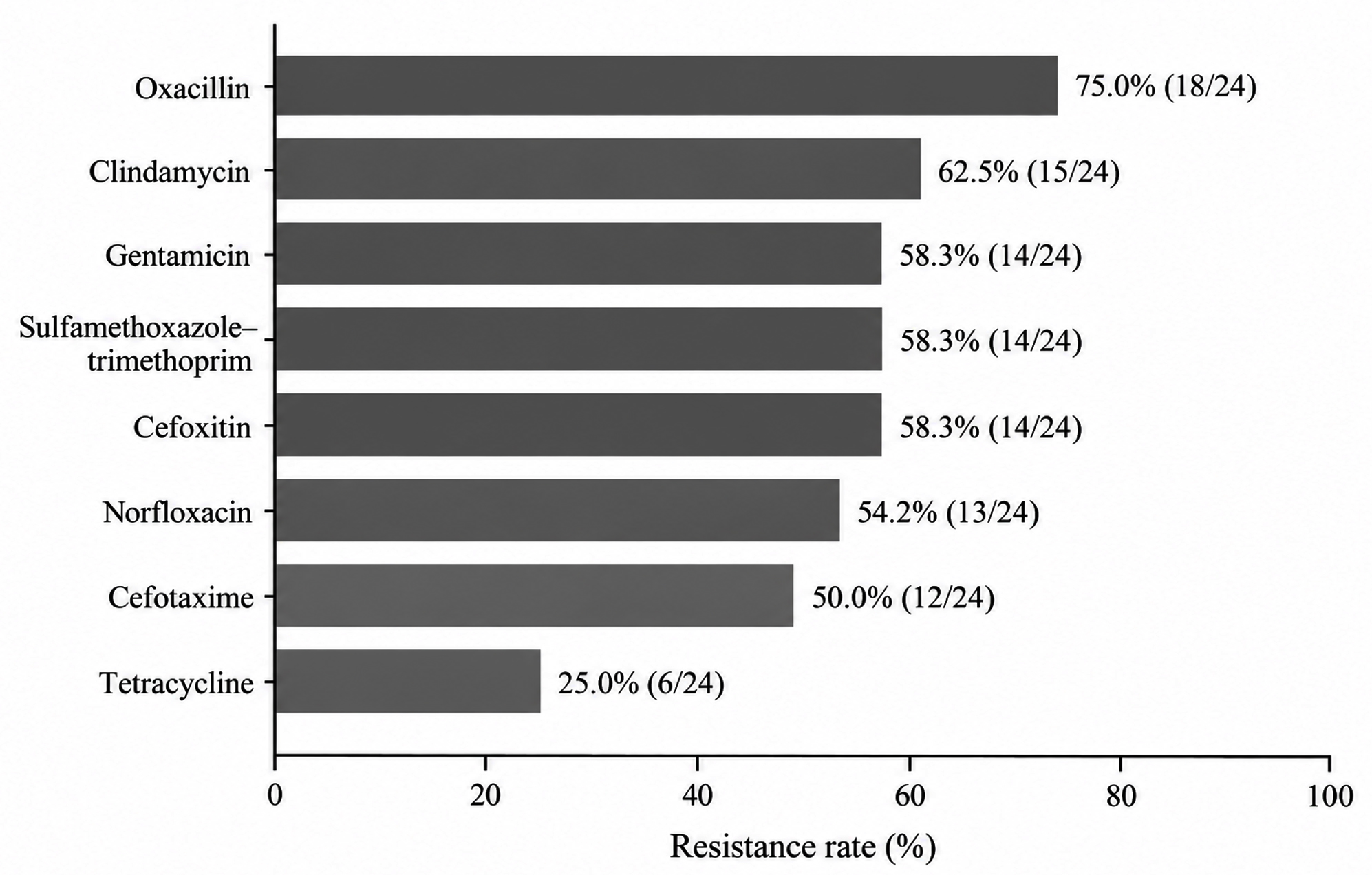
Figure. Antimicrobial resistance profile of Staphylococcus isolates recovered from the hands of healthcare workersd
dValues indicate the percentage of resistant isolates, with the absolute number of resistant isolates in parentheses (n = 24)
Table 3. Antimicrobial susceptibility profile of Staphylococcus isolates recovered from the hands of healthcare workersb
Antimicrobial |
Resistant n (%) |
Intermediate n (%) |
Susceptible n (%) |
|---|---|---|---|
Cefotaxime |
12 (50.00) |
— |
12 (50.00) |
Cefoxitin |
14 (58.33) |
— |
10 (41.67) |
Clindamycin |
15 (62.50) |
— |
9 (37.50) |
Gentamicin |
14 (58.33) |
— |
10 (41.67) |
Norfloxacin |
13 (54.17) |
— |
11 (45.83) |
Oxacillin |
18 (75.00) |
— |
6 (25.00) |
Sulfamethoxazole– trimethoprim |
14 (58.33) |
1 (4.17) |
9 (37.50) |
Tetracycline |
6 (25.00) |
— |
18 (75.00) |
bAntimicrobial susceptibility was interpreted according to the Clinical and Laboratory Standards Institute (CLSI, 2018)14
Regarding the number of antimicrobials to which the isolates were resistant, two isolates (8.33%) were resistant to all eight antimicrobials tested, four (16.67%) to seven, four (16.67%) to six, three (12.50%) to five, two (8.33%) to four, three (12.50%) to three, one (4.17%) to two, and three (12.50%) to one antimicrobial. Two isolates (8.33%) showed no resistance to any of the antimicrobials tested.
The mecA gene was detected in 16 of the 24 isolates (66.67%). Among the 18 oxacillin-resistant isolates, 15 (83.33%) were mecA-positive and three (16.67%) were mecA-negative. Among the six oxacillin-susceptible isolates, one (16.67%) was mecA-positive and five (83.33%) were mecA-negative. The relationship between oxacillin phenotype and mecA detection is presented in Table 4.
Table 4. Association between oxacillin susceptibility phenotype and mecA gene detection among Staphylococcus isolates
Oxacillin phenotype |
mecA- positive n (%)c |
mecA- negative n (%)c |
Total n |
|---|---|---|---|
Resistant |
15 (83.33) |
3 (16.67) |
18 |
Susceptible |
1 (16.67) |
5 (83.33) |
6 |
Total |
16 (66.67) |
8 (33.33) |
24 |
cThe percentages in the first two columns are calculated within each oxacillin phenotype category. Overall, mecA was detected in 16 (66.67%) of the 24 isolates
Regarding the bacterial prevalence on the hands of professionals, it was observed that, of the 60 swabs collected, 24 resulted in the isolation of Staphylococcus, representing a prevalence of 40%. The presence of this bacterium on hands is a well-established concern, as highlighted by previous studies that emphasize the need for rigorous hand hygiene and infection control practices to reduce the risk of healthcare-associated infections.11,12 The interplay between patient carriage, environmental contamination, and hand hygiene among healthcare workers has also been highlighted in recent ICU research, reinforcing the relevance of hand hygiene within infection prevention strategies.17
When analyzing the distribution by category, no Staphylococcus was isolated from R3 resident physicians, while support and janitorial professionals, nursing technicians, and nurses had 25%, 39.1% and 40% of isolations, respectively. All physical therapists and R2 resident physicians surveyed had Staphylococcus on their hands. These findings should be interpreted cautiously because the corresponding professional groups comprised only one or two participants. Most of the professionals carrying bacteria on their hands worked mainly in the NICU. Variation in isolation rates among healthcare workers may be associated with differences in work routines and exposure patterns, although these cannot be established from the present cross-sectional design, highlighting the importance of adherence to specific hand hygiene good practice protocols across all categories to prevent HAIs.18,19
Regarding the isolated Staphylococcus species, both coagulase-positive and coagulase-negative were found in equal proportions (50%), while Staphylococcus aureus was not detected, with no predominance of either group.
Regarding antimicrobial resistance patterns, it was observed that for six of the eight antimicrobials tested, Staphylococcus presented resistance rates above 50%, while cefotaxime showed 50% and tetracycline 25%. It is also noteworthy that the isolates were resistant to different classes of antimicrobials, indicating resistance to multiple antimicrobial agents.
Resistance to oxacillin and clindamycin raises concerns, especially because these agents represent clinically relevant options for the management of staphylococcal infections. The similar resistance to cefoxitin, gentamicin, and sulfamethoxazole-trimethoprim suggests a comparable resistance pattern among these agents, although its clinical significance should be interpreted cautiously because the isolates were recovered from hands rather than clinical infections.
The 54.17% resistance rate to norfloxacin, an antibiotic of the fluoroquinolone class, raises concerns, especially considering that this class is frequently used in the treatment of urinary tract infections and other bacterial infections.20
Resistance to multiple antimicrobial agents can complicate the treatment of bacterial infections. However, because these isolates were obtained from healthcare workers’ hands, the present findings should not be directly extrapolated to clinical treatment outcomes. Antibiotic selection should be guided by the results of sensitivity testing, although the prevalence of resistance may influence treatment strategies.21
It is essential to monitor resistance rates in healthcare settings, as this information highlights the importance of antimicrobial resistance surveillance. Regular monitoring is essential to assess trends over time and adjust antimicrobial prescribing practices as needed.22
The absence of Staphylococcus aureus is an interesting observation, considering its association with more serious infections. Further studies with larger and more balanced groups would be useful to investigate differences in isolation rates across professional categories. The increasing resistance to antimicrobials among Staphylococcus spp. highlights the need for continuous monitoring and strategies for the rational use of these drugs,23 contributing to reducing the selective pressure that drives the emergence of resistance.24
Oxacillin resistance, a phenotypic indicator of methicillin resistance, is particularly relevant.25,26 The relationship between antimicrobial resistance outcomes and antimicrobial prescribing practices in the healthcare institution could be investigated in future studies to better understand the factors affecting resistance.
Assessing these resistance patterns is crucial, taking into account the clinical context, the infection control measures implemented, and the sensitivity of the detection methods used. Furthermore, the use of complementary phenotypic and molecular approaches may improve the characterization of methicillin resistance, particularly in isolates showing discordant phenotypic and genotypic results.27
As for the mecA gene, it plays a crucial role in antibiotic resistance, especially in staphylococci. It is a major determinant of methicillin resistance and is carried on the staphylococcal cassette chromosome mec (SCCmec). The protein encoded by mecA, PBP2a, has reduced affinity for β-lactam antibiotics, contributing to resistance.28
Monitoring and understanding the presence of the mecA gene, along with other antibiotic resistance determinants, is essential to implementing effective infection control strategies and preserving antibiotic efficacy.29 The mecA gene was detected in 16 of the 24 isolates (66.67%), including one isolate that was phenotypically susceptible to oxacillin; this discordance cannot by itself establish whether mecA was expressed. Another interesting finding was that three oxacillin-resistant isolates were mecA-negative, suggesting phenotypic-genotypic discordance that may be associated with other resistance determinants or mechanisms, including genes such as mecC,30 which was not investigated in the present study. The comparison of phenotypic and genotypic methods in healthcare workers has demonstrated the importance of using complementary approaches when characterizing methicillin resistance, particularly when phenotypic results do not fully correspond to molecular findings.10
The data from this research contribute to a better understanding of antimicrobial resistance patterns among Staphylococcus spp. isolated from healthcare workers in the hospital environment, including those working in environmental cleaning sectors. The data are of particular interest, since Staphylococcus species present different virulence factors, which are not restricted to S. aureus. In coagulase-negative Staphylococcus, for example, biofilm production is a virulence factor frequently found in infections caused by these strains, which makes their control even more difficult. According to Pedretti et al.,31 further investigations into the genetic relationship between strains of different origins are useful for epidemiological and monitoring purposes, in addition to enabling the development of new strategies to contain the spread of Staphylococcus spp. not only in the clinical field but also in other related environments.
When it comes to maternal and child care, such as that in which the volunteers in this research worked, the presence of resistant staphylococci on the hands of healthcare workers underscores the importance of infection prevention, particularly because hospitalized patients in these settings may be more vulnerable to infections and complications.
Thus, proper hand hygiene emerges as an effective strategy in preventing hospital infections, contributing to patient safety by reducing the spread of harmful microorganisms. Healthcare workers, who are frequently exposed to pathogens, should therefore maintain consistent hand hygiene practices as part of routine infection prevention measures.32 Evidence from an intervention study further indicates that strengthening hand hygiene practices can be accompanied by a reduction in methicillin-resistant S. aureus carriage among healthcare workers.33
In addition to playing a crucial role in disseminating knowledge about the importance of hygiene, these professionals act as role models by incorporating exemplary practices, fostering adherence among colleagues, and contributing to safer environments.34
Preventing infections not only reduces treatment costs but also prevents extended hospital stays and minimizes negative effects on patients’ quality of life. In this scenario, healthcare workers play a fundamental role in ensuring compliance with regulatory standards, an essential condition for maintaining quality and safety in healthcare services.35
Both healthcare workers and those responsible for cleaning maternal and child wards may represent potential reservoirs for carriage of resistant Staphylococcus within the healthcare environment; however, the cross-sectional design of this study does not allow inference of transmission or direct risk to mothers and newborns. These findings reinforce the need for educational measures and ongoing training for all those involved in the care and maintenance of the hospital environment, as well as the implementation of rigorous surveillance and infection control protocols, especially in critical areas such as the NICU. Furthermore, they highlight the importance of the rational use of antimicrobials as a central strategy in tackling bacterial resistance, currently considered a global public health challenge.
The present study was conducted in a single hospital, with a reduced sample of professionals and a restricted collection period, factors that limit the extrapolation of the findings. The sample was also unevenly distributed across professional categories, and the cross-sectional design, absence of hand hygiene compliance data, and the absence of patient and environmental data in the present analysis limit interpretation of potential sources of carriage. In addition, molecular typing was not performed, and only mecA was investigated, preventing assessment of isolate relatedness and other resistance determinants such as mecC. Given the small subgroup sizes, comparisons among professional categories should be interpreted as descriptive rather than inferential, and transmission between healthcare workers, patients, and the environment cannot be established. Multicenter studies with a larger number of participants and clonal profile analyses are recommended to more accurately track sources of contamination and provide more robust evidence on the spread of resistant microorganisms in hospital settings.
The presence of Staphylococcus spp. on healthcare workers’ hands, associated with high resistance rates to different antimicrobials and the detection of mecA, highlights the relevance of microbiological surveillance in this context and reinforces the need to interpret these findings in an integrated manner. These results contribute to a better understanding of the resistance profile of isolates recovered from healthcare workers’ hands in maternal and pediatric care settings and may support subsequent monitoring and further investigation strategies.
ACKNOWLEDGMENTS
The authors gratefully acknowledge the Coordination for the Improvement of Higher Education Personnel (CAPES), Financing Code 001, for providing scholarship support through the PROSUP program. The authors also thank Universidade Paranaense (UNIPAR) for institutional support. The authors also gratefully acknowledge the healthcare institution for authorizing the conduct of the study and facilitating the collection of data, as well as the healthcare workers who participated in the research.
CONFLICT OF INTEREST
The authors declare that there is no conflict of interest.
AUTHORS’ CONTRIBUTION
SGPS, ICS, LNB, and DDG conceptualized the study. LNB supervised the study and managed the overall project. DDG and LNB performed funding acquisition. LMRR, CD, LNB, and SGPS developed and implemented the methodology. SGPS, LMRR, and LNB conducted the investigation. MD, FGCB, DDG, and LNB performed formal analysis. CD performed visualization. ICS, SGPS, MD, MCS, FGCB, and LNB performed validation. SGPS and LNB were responsible for data curation. SGPS, MD, FGCB, MCS and DDG wrote the original draft. SGPS and LNB contributed to writing, reviewing, and editing the manuscript.
All authors read and approved the final manuscript for publication.
FUNDING
None.
DATA AVAILABILITY
The datasets generated and/or analysed during the current study are available from the corresponding author on reasonable request.
ETHICS STATEMENT
This study was approved by the Human Research Ethics Committee – CEPEH under Opinion number 4,418,027 (CAAE 39601220.0.0000.0109).
INFORMED CONSENT
Written informed consent was obtained from the participants before enrolling in the study.
- World Health Organization. Global antibiotic resistance surveillance report 2025. Geneva: World Health Organization. 2025. https://www.who.int/publications/i/item/9789240116337
- Rozanska A, Romaniszyn D, Chmielarczyk A, Bulanda M. Bacteria contamination of touch surfaces in Polish hospital wards. Med Pr Work Health Saf. 2017;68(4):459-467.
Crossref - Haley RW, Hightower AW, Khabbaz RF, et al. The emergence of methicillin-resistant Staphylococcus aureus infections in United States hospitals. Possible role of the house staff-patient transfer circuit. Ann Intern Med. 1982;97(3):297-308.
Crossref - de Souza SGP, de Santos IC, Bondezan MAD, et al. Bacteria with a potential for multidrug resistance in hospital material. Microb Drug Resist. 2021;27(6):835-842.
Crossref - Santos AB, Batista Silva KS, Santana MMR, Marques MW, Naue CR. Perfil bacteriano das superficies e equipamentos do Bloco Cirurgico de um Hospital Universitario [Bacterial profile of surfaces and equipment in the surgical suite of a University Hospital]. VITTALLE. 2020;32(1):101-107.
Crossref - Tajeddin E, Rashidan M, Razaghi M, et al. The role of the intensive care unit environment and health-care workers in the transmission of bacteria associated with hospital acquired infections. J Infect Public Health. 2016;9(1):13-23.
Crossref - Costa JG, Araujo LDP, Neiva M, et al. Fatores impactantes na pratica da higienizaחדo das mדos [Factors influencing hand hygiene practices]. Recien. 2022;12(38):278-291.
Crossref - Miyahira RF, Santos EA, Leao RS, de Freitas-Almeida AC, Queiroz ML. Antimicrobial susceptibility and enterotoxin-encoding genes in Staphylococcus spp. recovered from kitchen equipment from a University Hospital in Rio de Janeiro, Brazil. Microb Drug Resist. 2018;24(7):995-1001.
Crossref - Partridge SR, Kwong SM, Firth N, Jensen SO. Mobile genetic elements associated with antimicrobial resistance. Clin Microbiol Rev. 2018;31(4):e00088-17.
Crossref - Sisodia K, Anveshi AK, Ranga D, Kumar D, Gaind R. Phenotypic and genotypic characterization of MRSA isolated from health care workers in tertiary care hospital. Indian J Med Microbiol. 2025;56:100871.
Crossref - Allegranzi B, Pittet D. Role of hand hygiene in healthcare-associated infection prevention. J Hosp Infect. 2009;73(4):305-315.
Crossref - Lago PN, Simoes e Silva R, Benedito OK, et al. Seguranca do paciente: higiene das maos como ferramenta para a prevencao de infeccoes relacionadas א assistencia A saude [Patient Safety: Hand hygiene as a tool for preventing healthcare-associated infections]. REMECS. 2021;27:27. Accessed April 6, 2026. https://www.revistaremecs.com.br/index.php/remecs/article/view/679
- Koneman EW, Winn W. Koneman’s Color Atlas and Textbook of Diagnostic Microbiology. 6th ed. Guanabara Koogan; 2008.
- Clinical and Laboratory Standards Institute. Performance Standards for Antimicrobial Susceptibility Testing. 28th ed. CLSI document M100-S28. Clinical and Laboratory Standards Institute. 2018.
- Martineau F, Picard FJ, Roy PH, Ouellette M, Bergeron MG. Species-specific and ubiquitous-DNA-based assays for rapid identification of Staphylococcus aureus. J Clin Microbiol. 1998;36(3):618-623.
Crossref - Murakami K, Minamide W, Wada K, Nakamura E, Teraoka H, Watanabe S. Identification of methicillin-resistant strains of staphylococci by polymerase chain reaction. J Clin Microbiol. 1991;29(10):2240-2244.
Crossref - Yang X, Liu Y, Yang Q, Zu S, Xu Z. The Impact of Environmental Contamination and Carriage of Methicillin-Resistant Staphylococci by Patients on the Hand Hygiene of Healthcare Workers. Nurs Crit Care. 2026;31(1):e70284.
Crossref - Pittet D, Hugonnet S, Harbarth S, et al. Effectiveness of a hospital-wide programme to improve compliance with hand hygiene. Infection Control Programme. Lancet. 2000;356(9238):1307-1312.
Crossref - Sampaio LA, de Silva HC, de Carmo TG. Role of the hospital infection control committee in cases of multi-resistant bacteria. Res Soc Dev. 2023;12(7):e4912742463.
Crossref - Morais AFP, Fabri Tomazini MH, Paula MC, Pedigone MAMC. Resistencia bacteriana em ITU comunitarias: importância da analise periodica da urocultura para tratamento adequado [Antimicrobial Resistance in Community-Acquired Urinary Tract Infections: The Importance of Regular Urine Culture Testing for Appropriate Treatment]. Manuscripta Medica. 2021;4:20-30. https://manuscriptamedica.com.br:443/revista/index.php/mm/article/view/55.
- dos Santos Monteiro RF, dos Santos VRR, Ferreira AACT, de Abreu JRG. The indiscriminate use of antimicrobials for the development of resistant microorganisms. REAS. 2020;53:e3597.
Crossref - Bertuol RF, Rampelotto RF. Antimicrobial resistance due to the indiscriminate use of antibiotics. REVIVA. 2023;2(1). https://revistas.uceff.edu.br/reviva/article/view/260.
- World Health Organization. WHO’s first global report on antibiotic resistance reveals serious, worldwide threat to public health. April 30, 2014. Geneva, Switzerland: World Health Organization; 2014. Accessed March 25, 2026. https://www.who.int/news/item/30-04-2014-who-s-first-global-report-on-antibiotic-resistance-reveals-serious-worldwide-threat-to-public-health
- Garcia JVAS, Comarella L. The indiscriminate use of antibiotics and the increase of bacterial resistance. Sande e Desenvolvimento. 2021;10(18):78-87. https://www.cadernosuninter.com/index.php/saude-e-desenvolvimento/article/view/866/1420.
- Hiramatsu K, Hanaki H, Ino T, Yabuta K, Oguri T, Tenover FC. Methicillin-resistant Staphylococcus aureus clinical strain with reduced vancomycin susceptibility. J Antimicrob Chemother. 1997;40(1):135-136.
Crossref - Cunha HP, Baiense ASR. Use of Vancomycin In The Treatment of Infections Caused by Methicillin-resistant Staphylococcus aureus (MRSA). REASE. 2023;9(4):9242-9258.
Crossref - Duarte FC, Olak APS, Cardim SL, et al. Phenotypic and genotypic characteristics of mecA-positive oxacillin-sensitive Staphylococcus aureus isolated from patients with bloodstream infection in a tertiary hospital in Southern Brazil. Braz J Microbiol. 2024;55(3):2705-2713.
Crossref - Rafif Khairullah A, Rehman S, Agus Sudjarwo S, et al. Detection of mecA gene and methicillin-resistant Staphylococcus aureus (MRSA) isolated from milk and risk factors from farms in Probolinggo, Indonesia. F1000Res. 2022;11:722.
Crossref - Trajano SC, Aragao BB, Silva JG, et al. Ocorrencia de Staphylococcus pseudintermedius resistentes A meticilina isolados do campo operatorio de cadelas submetidas A ovariohisterectomia [Occurrence of methicillin-resistant Staphylococcus pseudintermedius isolated from the surgical field of female dogs undergoing ovariohysterectomy]. Med Vet. 2022;16(2):113-120.
Crossref - Andrzejczuk S, Cygan M, Dluski D, Stepien-Pysniak D, Kosikowska U. Staphylococcal resistance patterns, blaZ and SCCmec cassette genes in the nasopharyngeal microbiota of pregnant women. Int J Mol Sci. 2023;24(9):7980.
Crossref - Pedretti N, Iseppi R, Condo C, et al. Characterization of virulence factors and antimicrobial resistance in Staphylococcus spp. isolated from clinical samples. Folia Microbiol. 2024;69:1043-1052.
Crossref - Silva NK, Lima MKS, Barbosa HCV, et al. Segurança do paciente: mensurando o controle de infeccoes na UTI [Patient Safety: Measuring Infection Control in the Intensive Care Unit (ICU)]. Recien. 2021;11(33):260-269.
Crossref - Alwashaish MM. Impact of a multimodal hand hygiene intervention on methicillin-resistant Staphylococcus aureus carriage among healthcare workers in Libya: a quasi-experimental pre-post study. Antimicrob Resist Infect Control. 2026;15(1):39.
Crossref - Azevedo AP, Medeiros FP, Souto FL, et al. Adhesion of hand hygienization among multidisciplinary teams in intensive care units in a hospital reference in infectology. REAEnF. 2021;9:e5008.
Crossref - Azevedo TT, Souza CJ, Silvino ZR, et al. Good practices for disinfection of bed in intensive care units. REAS. 2023;23(7):e12886.
Crossref
© The Author(s) 2026. Open Access. This article is distributed under the terms of the Creative Commons Attribution 4.0 International License which permits unrestricted use, sharing, distribution, and reproduction in any medium, provided you give appropriate credit to the original author(s) and the source, provide a link to the Creative Commons license, and indicate if changes were made.