

 , T. Sivasankaridevi2 , K. Subrahmaniyan3, K.G. Anitha1, S. Elamathi4, M. Vijayakumar1 and P. Ahila Devi5
Salinity is a major abiotic constraint that significantly limits crop productivity by inducing osmotic stress, ion toxicity, and nutrient imbalance. Conventional strategies such as breeding, chemical amendments, and transgenic approaches are often limited by high cost, long development time, and inconsistent field performance. In this context, microbial endophytes have emerged as promising eco-friendly biostimulants capable of improving plant adaptation to saline environments through coordinated physiological and molecular regulation. This review summarizes the diversity of endophytes and highlights the key mechanisms by which they enhance plant salinity tolerance. Endophytes improve ion homeostasis by modulating Na+/K+ transport systems, including Salt Overly Sensitive 1(SOS1), High-Affinity K+ Transporter 1(HKT1), and Na+/H+ Exchanger (NHX) antiporters, thereby restricting Na+ accumulation and maintaining cellular ionic balance. They help the plant cope with stress by boosting its levels of compatible solutes, such as proline and glycine betaine. At the same time, they enhance the plant’s antioxidant defence system by increasing the activity of glutathione-related enzymes and pathways, thereby reducing reactive oxygen species-induced damage. In addition, endophytes fine-tune phytohormone signalling and lower stress through ACC deaminase activity. Recent multi-omics advances (metagenomics, transcriptomics, and metabolomics) have further revealed endophyte- driven transcriptional reprogramming of stress-responsive genes and pathways. Finally, the review examines the challenges in field translation, including host specificity, formulation stability, and colonization consistency, while outlining prospects such as microbial consortia design and genome-guided strain selection for developing next-generation endophyte-based solutions for climate-resilient agriculture.
Plant-microbe Interaction, Multi-omics, Microbial Consortia, Reactive Oxygen Species
Worldwide agricultural productivity is threatened by abiotic stresses such as drought, salinity, extreme temperatures, heavy metal contamination, and soil pH imbalances, all of which seriously reduce crop yields.1 Among these, soil salinity is a major abiotic stress affecting more than 6% of the global land area, thereby it drastically limits agricultural productivity and food security.2,3 Currently, approximately 20% (62 m ha) of the global irrigated agricultural lands are facing salinity, with projections estimating this figure will rise to over 50% by 2050.2 Salt-affected soils result in annual global crop yield losses estimated at US $27.3 billion, with yield reductions ranging from 20%-50% in severely impacted regions. In India, approximately 6.7 million ha of land area are affected by salinity, accounting for about 2.1% of the country’s total area. This includes approximately 2.95 and 3.77 million ha of saline and sodic soils.4 The upsurge of salt-affected land, caused by improper cultivation practices, along with climate change, limited rainfall, and high evapotranspiration in arid and semi-arid regions, leads to salinization, fertility depletion, and soil erosion.5,6 Negative impacts of salt stress are overcome by adopting various strategies, namely, the development of transgenic plants, application of chemicals and fertilizers, leaching of salt from the rhizosphere zone, and so on.3,7,8 Additional mitigation approaches include physical and chemical methods such as mulching, installation of drainage systems, improved crop rotations, and the use of polyhalite, all of which help to displace salts and improve soil structure.9 Even though these strategies are efficient in eliminating salt stress, their adoption and implementation are restricted due to high costs, time consumption, and limited resource availability.10 Moreover, Chemical inputs may negatively impact soil health. Further, the use of transgenic plants raises several ethical concerns. Alternatively, eco-friendly plant growth-promoting microbes, such as bacterial and fungal endophytes, employ various efficient mechanisms to mitigate the toxic effects of salinity and enhance crop resilience.11 This approach offers a practical and efficient substitute to physical and chemical treatments by targeting the underlying causes of stress. At the same time, it enhances soil health and lowers the need for synthetic agricultural inputs.12 Endophytes are microbes that reside within the intracellular and intercellular spaces of plant tissues, forming a symbiotic relationship with plants. They possess a wide range of metabolic activities that enhance nutrient availability through solubilization, synthesize phytohormones, and withstand environmental stresses, all together supporting plant growth and development.13 These mechanisms encompass not only metabolic but also molecular and signalling pathways that control plant responses to salinity.14
Recent studies further confirm that endophytes enhance plant tolerance to salinity by regulating ion homeostasis, strengthening antioxidant defence systems, modulating phytohormone signalling, and activating stress-responsive genes. For example, the endophytic bacterium Priestia megaterium 170T-4 improves Na+/K+ homeostasis and root growth in soybean under salt stress.15 Among fungal endophytes, Penicillium chrysogenum alleviates osmotic and oxidative stress in wheat, thereby promoting growth and metabolic activation under salinity stress.16 Furthermore, recent reviews have highlighted that fungal endophytes such as Trichoderma spp. and Piriformospora indica confer salinity tolerance through osmotic regulation, hormonal modulation, antioxidant defence, and epigenetic reprogramming. Advances in multi-omics approaches have also provided deeper insights into plant–endophyte interactions; for instance, Priestia megaterium BP01R2 alleviates salinity stress through the production of the metabolite cyclo(L-Ala-Gly) and regulation of multiple stress-response pathways in Arabidopsis.17 Collectively, these findings highlight the potential of endophytes as sustainable and eco-friendly bioinoculants for improving crop productivity in salt-affected soils.
This review explains how microbial endophytes enhance plant tolerance to salinity and support sustainable agriculture. It begins with the impacts of stress on plants and the environment, then outlines endophyte diversity, colonization, and plant–microbe interactions. The main emphasis is on how microbial endophytes alleviate salinity stress through ion regulation, osmotic balance, antioxidant activation, hormone modulation, and stress-responsive gene expression. Furthermore, it highlights key challenges and the use of multi-omics, microbial consortia, and advanced biotechnological tools to develop effective endophyte-based solutions.
Salinity and its effect on the environment
Soil salinization is a major issue for agricultural productivity in the 21st century. Saline soils are soils with an electrical conductivity of the saturation extract (ECe) greater than 4 dS/m, pH less than 8.5, and exchangeable sodium percentage (ESP) less than 15, primarily caused by excessive deposition of soluble salts such as sodium (Na+) and chloride (Cl– ) ions.7,18,19 Soils affected by these issues are characterized by high levels of soluble salts (saline soils) or exchangeable sodium ions (sodic soils), both of which adversely affect the growth of most plants. Such conditions can be found on every continent and in nearly all climates, but they are more widespread in dry and semi-dry regions than in humid ones.20 Excess sodium deteriorates soil structure by reducing water movement, porosity, and aeration, disrupting the microbial communities associated with plant roots.7 Recent estimates show that salinity affects more than one billion hectares of land around the world, which is about 10% of all the land suitable for farming.20 Climate change is accelerating this process through altered precipitation patterns, increased evapotranspiration rates, and sea-level rise, which introduce saline water into coastal agricultural zones. Beyond natural processes, anthropogenic activities significantly contribute to secondary salinization. Repetitive irrigation with saline or brackish water, excessive fertilizer application, and inadequate drainage systems create a positive feedback loop in which salts continuously accumulate in the root zone.21,22 The consequences extend beyond crop yield losses, further deteriorating soil physical properties by dispersing clay particles and disrupting aggregate stability. This results in reduced water infiltration, porosity, and aeration capacity.23 These changes damage soil structure and create oxygen-poor conditions that weaken and hamper root function, disrupting essential biogeochemical processes such as nutrient fixation, organic matter decomposition, and nutrient release.24
Oxygen depletion shifts microbial community composition from aerobic to anaerobic microorganisms, fundamentally altering nutrient cycling. Studies show that increased salinity reduces soil microbial biomass and diversity because many microorganisms struggle to adapt to high osmotic pressure, resulting in diminished biological activity. This disruption in microbial communities affects soil fertility and plant health, highlighting the complex interplay between soil structure, oxygen availability, and microbial dynamics under salinity stress.20,25 Soil salinization not only reduces crop productivity but also erodes the foundation of healthy soil, its structure, microbial networks, and carbon-sequestering capacity.20 Furthermore, about one-third of global soils are moderately to highly degraded due to multiple stressors, including salinization, alkalinization, erosion, organic matter depletion, contamination, and compaction. Together, these issues threaten sustainable agricultural production and ecosystem stability.26 The classification criteria for saline, sodic, and saline–sodic soils based on electrical conductivity, pH, and exchangeable sodium percentage are summarized in Table 1.
Table 1. Criteria For Classification of Soil Salinity
Soil Type |
ECe |
pH |
ESP |
Ref. |
|---|---|---|---|---|
Saline |
>4 dS/m |
27 |
||
Sodic (Alkali Soil) |
>8.5 |
>15 |
27 |
|
Saline–Sodic |
>4 dS/m |
≤8.5 |
>15 |
27 |
What are endophytes?
Endophytes are non-pathogenic microorganisms, including bacteria, fungi, and actinomycetes, that inhabit the internal tissues of plants such as roots, stems, leaves, and reproductive organs without causing disease. The term “endophyte” is derived from the Greek words “endon” (inside) and “phyton” (plant).28 These microorganisms occupy specific internal niches, including apoplastic spaces (intercellular regions), vascular tissues, and, in some cases, intracellular compartments within host cells.29 This internal colonization distinguishes endophytes from epiphytic microbes that remain on plant surfaces. Endophytes generally form mutualistic or commensal associations, supporting plant growth and environmental adaptability without inducing visible symptoms.30 However, endophyte lifestyles can be dynamic, with some species capable of shifting between beneficial, neutral, or even pathogenic modes depending on environmental conditions, plant developmental stage, or host stress levels.31
Endophytes are generally grouped by how they colonize and spread into true (systemic) and transient (non-systemic) types. True endophytes are usually vertically transmitted through seeds and have evolved alongside their host plants, creating stable, helpful relationships that last through generations. On the other hand, transient endophytes are picked up from the environment and can have either beneficial or neutral effects, depending on the plant’s condition and the surrounding environment.32
Types of endophytes
Endophytes can be broadly categorized based on their taxonomic classification and mode of interaction with host plants. The major types include bacterial endophytes, fungal endophytes, actinomycete endophytes, and arbuscular mycorrhizal fungi (AMF), which are sometimes considered endophytic due to their intracellular colonization of root tissues during specific phases of their life cycle.
Bacterial endophytes
Bacterial endophytes are widely known for their potent growth-promoting abilities and their capacity to colonize various internal plant tissues such as roots, flowers, and seeds, etc.33 These beneficial bacteria occupy the apoplast and vascular tissues, forming mutually supportive associations that promote vigour, nutrient uptake, and stress resilience.30 Endophytic bacterial communities are taxonomically diverse, representing major phyla such as Proteobacteria, Firmicutes, and Actinobacteria. Frequently reported genera include Pseudomonas, Bacillus, Enterobacter, Acinetobacter, Streptomyces, Serratia, and Herbaspirillum, many of which contribute directly to plant stress resilience. Bacillus sp., Herbaspirillum sp., Serratia sp., and Enterobacter sp. improve nutrient acquisition through N-assimilation, P solubilization, siderophore production, and degradation of cellulose and hemicellulose, thereby supporting nutrient cycling.34,35 Many strains also synthesize key hormones such as Indole-3-Acetic Acid (IAA), Gibberellic Acid (GA), and cytokinins, promote development, and facilitate resource uptake under saline conditions. Several species possess ACC deaminase, enabling plants to regulate stress-induced ethylene and maintain growth during salinity stress. These combined metabolic and physiological contributions make bacterial endophytes essential partners in improving growth and adaptability to salinity and other abiotic stresses.36
In addition to their physiological roles, bacterial endophytes modulate salinity tolerance through interconnected molecular signalling pathways within the host plant. A central mechanism involves calcium-dependent signalling, which activates the salt overly sensitive (SOS) pathway, regulating the expression of key ion transporter genes, including SOS1, HKT1, and Na+/H+ Exchanger 1 (NHX1), thereby maintaining cellular Na+ /K+ homeostasis by restricting sodium accumulation in shoot tissues and facilitating vacuolar sequestration. Endophytic bacteria further interact with phytohormone signalling networks; abscisic acid (ABA) governs osmotic stress perception and stomatal regulation, while salicylic acid (SA) and jasmonic acid (JA) regulate defence-related gene expression, thereby enhancing the plant’s adaptive response to ionic and osmotic stress. These hormonal signals converge on stress-responsive transcription factors, notably Dehydration-Responsive Element-Binding (DREB), WRKY and Myeloblastosis (MYB), which drive the expression of genes governing osmotic adjustment, reactive oxygen species (ROS) detoxification and antioxidant defence. Collectively, these multilayered molecular interactions demonstrate that bacterial endophytes function not merely as growth promoters but also as key regulators of plant resilience under salinity stress.13,14
Fungal endophytes
Fungal endophytes inhabit internal plant tissues without causing disease, establishing stable and mutually beneficial relationships with their hosts. They colonize various plant tissues, including leaves and bark. Common beneficial genera include Trichoderma, Serendipita (formerly Piriformospora), Penicillium, Aspergillus, Cladosporium, and non-pathogenic Fusarium species. By secreting diverse bioactive compounds and modulating plant physiological processes, these endophytes enhance resistance to phytopathogens and environmental stresses, thereby improving plant performance under saline conditions.37
Broadly classified into balansiaceous (clavicipitaceous) and non-balansiaceous groups. Balansiaceous endophytes, which are commonly associated with grasses, colonize the intercellular spaces of above-ground plant tissues and are transmitted predominantly through seeds via vertical transmission. Non-balansiaceous endophytes, mainly belonging to the phylum Ascomycota, colonize both above-ground and below-ground plant tissues and are transmitted primarily through horizontal or mixed modes of transmission. Certain species also reinforce host resilience by enhancing lignification and strengthening root architecture, thereby improving mechanical stability under stressful environmental conditions.29
Fungal endophytes from groups like Ascomycota, Basidiomycota, and Zygomycota/Mucoromycota assist plants in different but complementary ways. For example, Ascomycota species such as Aspergillus aculeatus, Fusarium species, and Trichoderma harzianum help manage harmful reactive oxygen species and balance hormones like IAA and ABA, supporting root growth and stomatal function. Basidiomycota fungi, like Serendipita indica, improve the plant’s water balance, ion regulation, and root development. Meanwhile, Zygomycota/Mucoromycota endophytes, including Penicillium and Mortierella, quickly colonize roots and boost nutrient availability. Together, these fungi work to improve plant health and resilience under salty environments.37
Actinomycete endophytes
Actinomycetes are filamentous, Gram-positive bacteria belonging primarily to the phylum Actinobacteria. The genus Streptomyces dominates endophytic actinomycete communities, although Micromonospora, Nocardia, and Frankia have also been isolated from plant tissues. These organisms are widely recognized for their ability to produce diverse secondary metabolites. As endophytes, they colonize internal plant tissues and enhance host fitness through multiple mechanisms: synthesis of phytohormones (particularly IAA), phosphate solubilization, nitrogen fixation (in some genera like Frankia), production of ACC deaminase, and biocontrol of phytopathogens. Their enzymatic machinery enables degradation of complex organic polymers, contributing to nutrient mineralization and soil health.38,39
Arbuscular Mycorrhizal Fungi (AMF)
AMF colonize the root cortical cells and form special structures called arbuscules. These arbuscules serve as a major site for nutrient translocation between the fungus and the plant. Although traditionally regarded as soil-borne mycorrhizal symbionts, AMF also exhibit an endophytic lifestyle by extensively colonizing internal root tissues. Beyond their classical role in nutrient exchange, AMF significantly enhance plant uptake of phosphorus, water, and essential micronutrients, making them integral contributors to plant growth and stress resilience. When plants face saline conditions, AMF help by balancing water and ions, stabilizing cell membranes, boosting antioxidant defences, and regulating important genes like NHX, SOS1, and Delta-1-pyrroline-5-carboxylate synthetase (P5CS). All these actions work together to help plants survive and stay productive by protecting them against damage from ROS and the stress caused by excess salt.40
Salinity-induced stress in plants
High-salinity habitats adversely affect plant growth by disrupting essential biochemical and physiological processes.41 Additionally, it leads to reduced root and leaf areas, impairs photosynthesis, and affects water and nutrient uptake.42 Crop growth and development depend on essential nutrients such as nitrogen, phosphorus, potassium, sulphur, iron, manganese, copper, and zinc. In agricultural soils, it disrupts the absorption and movement of those essential nutrients, particularly macronutrients, leading to deficiencies that restrict productivity and biomass accumulation. Based on their tolerance to salinity, plants are classified into halophytes, which thrive in saline environments, and glycophytes, which are generally sensitive to increased salt levels. Most horticultural crops are glycophytes, while cereals and pulses include both halophytes and glycophytes with varying levels of salt tolerance. A plant’s ability to withstand salinity largely depends on its genetic makeup and interactions with surrounding organisms.43
The two primary challenges due to elevated salinity are osmotic and ionic stress. Osmotic stress occurs first, restricting water uptake and creating drought-like conditions within minutes to hours of salt exposure. This is followed by ionic stress over days to weeks due to toxic sodium accumulation, which disturbs the sodium–potassium balance and impairs enzyme activities.44 These biphasic stresses trigger oxidative stress and nutritional imbalances that compromise cellular metabolism and growth.45 During aerobic metabolism, plants naturally produce ROS, including singlet oxygen (1O2), superoxide radical (O2-•), hydroxyl radical (HO•), and hydrogen peroxide (H2O2). Under normal conditions, the production and removal of ROS are balanced, allowing these molecules to act as signals that help regulate growth and responses to stress. But when plants face severe salinity stress, ROS levels increase sharply in chloroplasts, mitochondria, and peroxisomes because the electron transport chains are disrupted. This excess ROS can damage important cell components, such as DNA, proteins, carbohydrates, lipids, and enzymes, and may even trigger programmed cell death.46,47 Excessive accumulation of NaCl ions in tissues induces ionic toxicity, causing leaf burn, chlorosis, necrosis, stunted growth, and eventually plant death. High sodium levels also compete with key nutrients such as Ca2+, Mg2+, and K+, affecting the plant’s nutrient equilibrium and metabolic enzyme activities.45,48,49 Plants detect sodium stress through specialized molecular or protein-based sensors that initiate rapid signalling pathways involving calcium ions, ABA, Mitogen-Activated Protein Kinases (MAPKs), SOS proteins, and ethylene. This signalling is activated within seconds, triggering responses that help the plant to regulate or exclude excess sodium from root tissues within minutes. Interestingly, numerous genes activated by saline stress are similarly induced by osmotic stress, indicating that osmotic sensing is crucial for detecting salinity. Together, these mechanisms allow plants to adapt to saline conditions while maintaining crucial physiological functions.44,50
Plants respond to salt stress through coordinated adaptive mechanisms. Initial responses include stomatal closure to conserve water and the accumulation of compatible solutes, such as proline and soluble sugars, to maintain cellular hydration. As stress persists, plants regulate ionic homeostasis by sequestering excess sodium into vacuoles while maintaining cytosolic potassium levels. Simultaneously, upregulated antioxidant enzyme systems neutralize reactive oxygen species to prevent oxidative damage. These processes are orchestrated by phytohormone networks involving abscisic acid, ethylene, jasmonic acid, and salicylic acid, which also modulate root architecture to optimize water and nutrient acquisition under saline conditions.46 While plants possess these intrinsic tolerance mechanisms, their efficacy is often insufficient under severe or prolonged stress, highlighting the potential value of supplementary approaches such as beneficial microbial partnerships to enhance crop resilience in salt-affected environments.47
Mechanisms of salinity tolerance mediated by endophytes
Plants struggle under salt stress as it disrupts their normal functions. While they have natural defences, these often fall short during severe exposure. Endophytic microbes boost their tolerance by supporting key molecular and physiological processes. The major mechanisms by which endophytes enhance salinity tolerance in plants are illustrated in Figure.
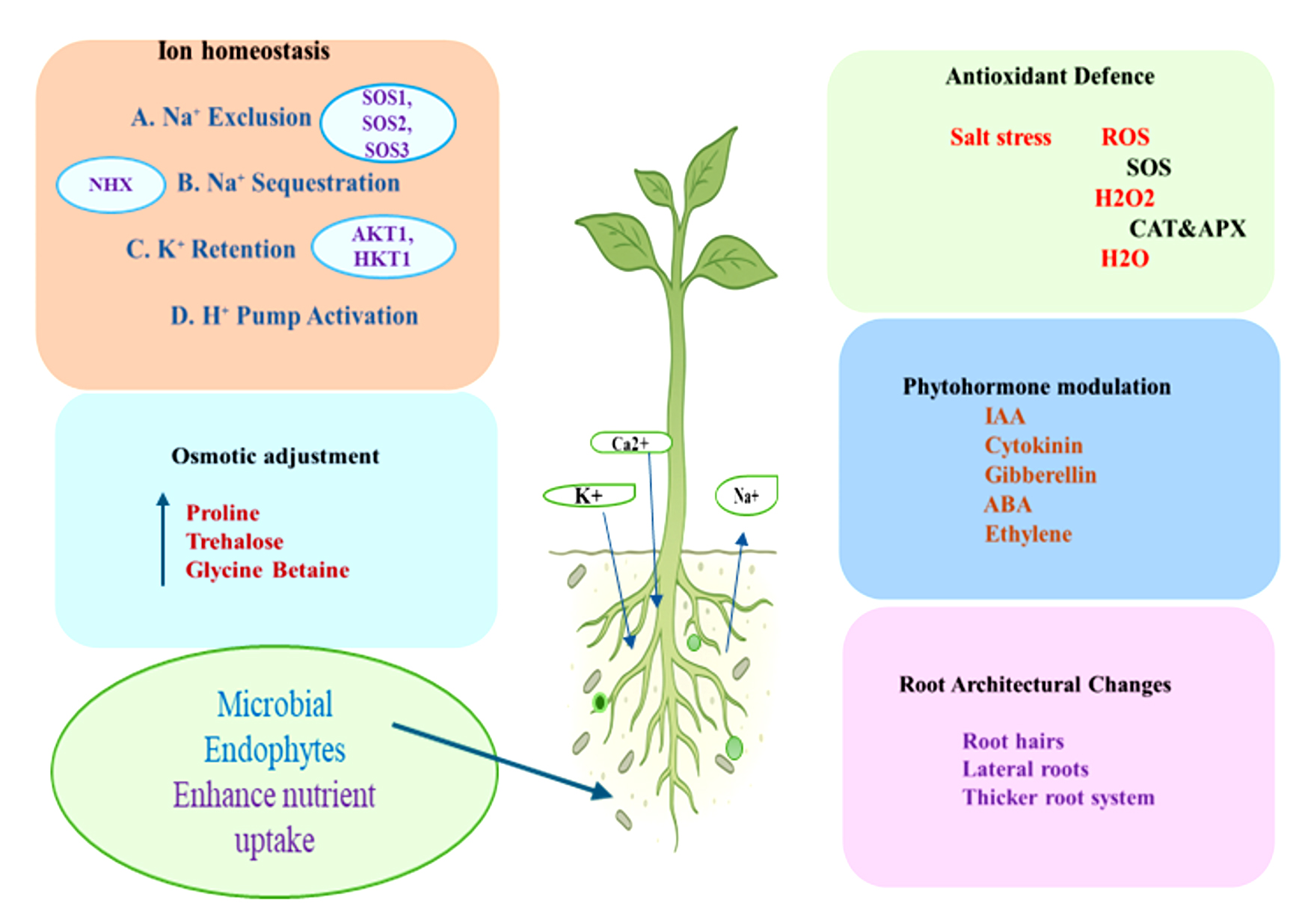
Figure. Conceptual illustration of the interconnected mechanisms employed by microbial endophytes to enhance plant adaptation to saline environments. Endophytes influence multiple physiological, biochemical, and molecular pathways that collectively mitigate salt-induced damage. These interactions strengthen plant resilience by maintaining cellular homeostasis, improving stress perception and signalling, and supporting metabolic adjustments under saline conditions. The coordinated action of these processes ultimately contributes to sustained growth and productivity in salt-affected soils
Regulation of ion homeostasis
Endophytes help plants to maintain ion balance by influencing the activity of root ion-transport proteins. Plants need minerals for their growth, but many soil minerals are insoluble and difficult for them to absorb. To take in essential ions and control their levels, plants use specific transporter proteins in their root epidermal cells. Endophytes modulate the expression and function of these transporters, thereby enhancing the uptake of beneficial ions while limiting the uptake of harmful ones. Through this regulation, endophytes contribute to maintaining stable ion homeostasis.14
Maintaining an optimal cytoplasmic Na+/K+ ratio is essential for plant survival under saline conditions, as excessive sodium disrupts protein synthesis, enzyme function, and photosynthetic efficiency while also inhibiting potassium uptake. High salt levels create an ionic imbalance involving Na+, K+, Ca2+, and Mg2+, ultimately impairing nutrient transport and physiological processes. Endophytic microorganisms help restore this ionic homeostasis by enhancing nutrient assimilation and modulating key ion transport mechanisms, by reducing sodium toxicity and supporting plant growth in saline environments.51
The SOS pathway represents the primary molecular defence against sodium toxicity. Upon salt stress, cytosolic calcium concentrations increase, triggering the calcium-binding protein SOS3 to recruit and activate protein kinase SOS2. The resulting SOS3-SOS2 complex phosphorylates and activates SOS1, a plasma membrane Na+/H+ antiporter that extrudes toxic sodium ions from the cytoplasm to the apoplast.52 Dietzia natronolimnaea STR1 regulates important genes related to ion transport and salt stress tolerance, including those in the SOS pathway and potassium transport. Similarly, Burkholderia phytofirmans activates key ion transporter genes like HKT1, AKT1, NHX1, and SOS1 in salt-stressed Arabidopsis plants. Both bacteria help improve the plant’s ability to manage ion balance under saline conditions.53 In addition to getting rid of sodium through their plasma membranes, plants also store excess Na+ inside their vacuoles. This is done by a transporter called NHX1, which moves sodium into the vacuoles using energy from electrochemical gradients created by an enzyme called vacuolar H+-pyrophosphatase. Endophytic inoculation enhances NHX1 expression and protein activity, facilitating greater vacuolar Na+ accumulation while preserving low cytosolic concentrations. This sequestration strategy mitigates ionic toxicity and contributes to osmotic adjustment by maintaining cell turgor under stress.54
Regulation of osmotic balance
Soil salinity disturbs internal water balance by reducing the water potential inside plant cells, creating immediate osmotic stress that restricts water uptake. To cope with this, plants activate conserved signal transduction pathways that regulate genes involved in osmotic adjustment. A key component of this response is the production and accumulation of compatible osmolytes, such as proline and glycine betaine, which stabilize cellular hydration by balancing internal osmotic pressure with the external saline environment. These Osmoprotectants also stabilize proteins and membranes, ensuring that vital metabolic processes continue under stress. Through this coordinated regulation of osmolyte biosynthesis and water potential adjustment, plants restore osmotic stability and mitigate the initial negative impact of high salt.55
Recent studies show that endophytic microorganisms further enhance osmotic balance by promoting or directly contributing to osmolyte production. Glycine betaine (GB) plays a central role in this process by protecting membrane integrity and maintaining enzyme activity. Certain endophytic bacteria can synthesize GB directly using alternative pathways such as choline dehydrogenase (CDH) or choline oxidase (COX), while others enhance its accumulation by upregulating host Betaine Aldehyde Dehydrogenase (BADH) and choline monooxygenase (CMO) genes, key enzymes in GB biosynthesis.56 Supporting this, halotolerant endophytes such as Staphylococcus sp. MCC 5340 significantly increased proline and GB levels in rice under 125 mM NaCl, improving growth and stress resilience.57 Table 2 illustrates the physiological effects of different endophytes on various crop species under saline stress.
Table 2. Physiological Effects of Endophytes on Plants Under Saline Stress
Endophytes |
Plant varieties |
Physiological functions |
Quantitative indicators of stress mitigation |
Ref. |
|---|---|---|---|---|
Priestia megaterium 170T-4 |
Glycine max |
Improved ion homeostasis, osmotic adjustment, and photosynthetic performance |
Growth up to 6% NaCl; ↑Plant height, ↑Root length, ↑Chlorophyll, improved homeostasis through regulation of stress-responsive genes |
15 |
Pseudomonas fluorescens YsS6 |
Solanum lycoperiscum |
Enhances growth and reduces salt stress |
↑Shoot and root biomass, ↑chlorophyll, ↓Na+ accumulation |
60 |
Enterobacter sp. FD17 |
Zea mays |
Sustained nutrient balance; improved plant development |
↓Xylem Na+ transport, ↑K+/Na+ ratio, ↑plant biomass |
60 |
Bacillus subtilis 10-4 |
Triticum
aestivum |
Mitigates oxidative and osmotic stress; improves water status and plant growth under salinity |
IAA production: 5.8 mg/mL, Siderophore halo: 1.2 cm, Seed germination increased from 84.5% (control) to 98% at 105 CFU/mL |
61 |
Bacillus amyloliquefaciens RWL-1 |
Oryza sativa |
Regulation of internal hormones; control of amino acid levels. |
↑Gibberellins (GA) and IAA, ↓ABA, ↑biomass, and chlorophyll under salt stress |
62 |
Kosakonia radicincitans |
Triticum aestivum |
Promoted growth and nutrient acquisition in saline soil |
IAA production (40.44 µg mL-1), EPS (14.2 g L-1), ‘P’ solubilization (273 mg L-1), ‘K’ solubilization (42.8 µg mL-1); ↑Chlorophyll and grain yield; ↓Proline accumulation |
63 |
Enterobacter hormaechei and Pseudomonas fluorescens |
Oryza sativa |
Enhanced seedling growth and physiological performance under salinity |
Tolerated up to 2.0 M NaCl in vitro; significantly increased seedling growth under 150 mM NaCl and 4 dS m-1 greenhouse salinity; produced IAA, GA, siderophores, proline, and phosphate-solubilizing activity |
64 |
Enhancement of antioxidant defence systems
Salt stress causes the excessive accumulation of ROS. Under normal physiological conditions, plants maintain ROS at controlled levels where they function as signalling molecules. However, when salinity disrupts this balance, ROS accumulate excessively and attack cellular lipids, proteins, and nucleic acids, ultimately damaging membranes and impairing metabolic functions. Endophytic microorganisms help plants counter these destructive effects by strengthening the antioxidant defence system. They enhance the activity of enzymatic antioxidants such as Superoxide Dismutase (SOD), Catalase (CAT), Ascorbate Peroxidase (APX), and Glutathione Reductase (GR), while also boosting non-enzymatic antioxidants like ascorbate, glutathione, and carotenoids. Endophytes improve plant growth better in salty conditions by raising their natural defences, both with and without enzymes. This reduces harmful oxidative stress, maintains cellular balance, and supports overall health.1
Endophytic fungi such as A. terreus and Trichoderma, improve photosynthetic performance and quantum yield, thereby maintaining redox balance and reducing oxidative injury to proteins and lipids under salt stress. The combined action of these antioxidant enzymes, along with osmolytes such as proline, provides effective ROS detoxification and strengthens plant tolerance in species like rice and maize.58
Transcriptional reprogramming and stress-responsive gene expression
Many studies show that endophytes enhance salinity tolerance by enhancing the activity of genes associated with photosynthesis, ROS scavenging, accumulation of protective compounds, nutrient absorption, and plant hormone signalling. At the molecular level, endophytes fine-tune transcriptional profiles to strengthen cellular stability and support overall stress adaptation under saline conditions.14
Salinity triggers widespread gene activation to maintain osmotic balance and protect cell functions. Key genes like CMO and BADH help produce compatible solutes that keep cells hydrated. P5CS boosts proline levels, which protect proteins and membranes from salt damage. Ion balance is controlled by Na+/H+ antiporters SOS1 and NHX, which remove excess sodium and store it safely inside vacuoles. Signal pathways involving ABA and DREB transcription factors switch on many salt-responsive genes that protect membranes and cell integrity. Transcription factors like AP2/ERF, WRKY, NAC, and MYB coordinate these responses for an effective salt stress adaptation.59 Recent transcriptomic analyses show that AMF further boost the expression of classical salt-tolerance genes (NHX, SOS1, P5CS), along with aquaporins, lipid transfer proteins, and additional regulatory genes. By enhancing osmolyte biosynthesis and improving water retention, AMF and other endophytes significantly strengthen plant resilience under saline environments.40 Key regulatory genes influenced by endophytes and their functional roles in salinity tolerance are presented in Table 3.
Table 3. Endophyte-Induced Regulatory Genes in Salinity Tolerance
Endophytes |
Type of endophyte |
Regulatory gene |
Functions |
Ref. |
|---|---|---|---|---|
Piriformospora indica |
Fungi |
HKT1 |
Transporter protein with Na+ ion specificity, maintains ion homeostasis |
13 |
Trichoderma asperelloides T203 |
Fungi |
MDAR |
The gene encoding monodehydroascorbate reductase is upregulated |
13 |
Bacillus amyloliquefaciens |
Bacteria |
HKT1 |
Alleviates sodium toxicity. |
65 |
Bacillus amyloliquefaciens |
Bacteria |
P5CS1 |
An enzyme for proline (Osmoprotectant) synthesis to improve salt tolerance in plants |
65 |
Bacillus safensis BTL5 |
Bacteria |
SERF1 |
Activation of transcription factors that help reduce salt stress. |
66 |
Applications of endophytes in salinity management
The escalating threat of soil salinization poses a major problem to global agriculture, production, and food security. Endophyte-based bioinoculants offer an eco-friendly alternative to chemical amendments, improving plant performance under salinity stress while supporting soil health. Recent field trials and meta-analyses demonstrate that these microorganisms significantly contribute to crop resilience and promote overall growth.67
Successful applications have been recorded across several crop species. Seed coating with the halotolerant endophytic fungus Aspergillus terreus enhanced biomass, leaf water status, and photochemical efficiency in rice and maize exposed to NaCl concentrations ranging from 5-15 dS/m. Similarly, desert-adapted fungal endophytes such as Periconia macrospinosa and Neocamarosporium sp. significantly improved drought and salinity tolerance in tomato and cucumber by increasing proline accumulation and enhancing antioxidant enzyme activities.58 Long-term field trials using fungal endophyte consortia in barley cultivated on saline soils resulted in consistent yield improvements regardless of fertilizer input levels, indicating strong field applicability.68
Effective formulation and delivery strategies are critically important for successfully transitioning endophytic microorganisms from controlled environments to practical applications. Appropriate carrier materials, including talc-based formulations, peat composites, vermiculite suspensions, and liquid inoculant preparations, play essential roles in maintaining microbial viability, ensuring consistent colonization rates, and extending shelf-life stability to facilitate commercial distribution and farmer accessibility.69
Commercial formulations of endophytic microorganisms are being developed in various forms, including liquid inoculants, carrier-based powders, granular preparations, seed-coating formulations, and encapsulated products. These formulations are designed to improve microbial viability, shelf life, ease of application, and successful establishment under field conditions. Recent advances in encapsulation technologies and multi-strain bioformulations have further enhanced the stability and effectiveness of endophyte-based products for agricultural applications.70 Seed coating ensures direct root colonization during germination, facilitating effective endophyte establishment. Incorporating substances such as trehalose and ectoine into the formulation improves microbial viability during storage and promotes tolerance under field conditions.71
Recent advances in cutting-edge omics technologies, such as comparative genomics, environmental metagenomics, transcriptomics for studying gene expression, and proteomics for analysing proteins, have greatly deepened our understanding of their functional abilities at the molecular level. These studies also elucidate communication networks between plants and microbes, as well as specific biochemical processes involved in salinity tolerance. Modern genomic tools now allow us to accurately identify and study the functions of both culturable endophytic strains and the unculturable members of the microbiome that traditional cultivation methods often miss. This progress is helping to uncover exactly how these microbes work and to discover new bioactive compounds.72 For example, by sequencing the whole genome and analysing the biosynthetic pathways of the salt-tolerant bacterial strain Bacillus fexus KLBMP 4941, researchers found previously unknown gene clusters and secondary metabolite pathways linked directly to reducing salinity stress and improving nutrient availability. These insights provide valuable molecular-level understanding of the strain’s potential and open possibilities for selecting and genetically enhancing strains for better performance in salty environments.73
Challenges and future perspectives
Endophytic microorganisms hold great potential for enhancing salinity tolerance and promoting sustainable crop productivity. However, their transition from laboratory research to widespread field application remains constrained by several persistent challenges. A major limitation is the inconsistent performance of endophytes in open-field conditions. Strains that show strong growth-promoting or stress-alleviating effects under controlled environments often produce variable or unpredictable results in real agricultural settings.64 This inconsistency largely reflects the complexity of plant–endophyte–environment interactions, where factors such as plant genotype, developmental stage, and native soil microbial communities strongly influence colonization success and persistence.33
Host–endophyte specificity further complicates the creation of universal inoculants. An endophyte beneficial to one plant species may show minimal or no effect in another. Moreover, achieving early colonization after sowing is particularly difficult under fluctuating field conditions. This necessitates repeated inoculations, which increase both the cost and labour requirements in large-scale applications. Environmental variability adds another layer of complexity. In India, despite extensive research on endophyte diversity and mechanisms, translating this knowledge into practical, farmer-friendly products remains a challenge. This is partly due to insufficient extension support and awareness programs. Formulation and delivery of viable microbial products remain critical challenges. Developing stable inoculants that maintain cell viability during storage, transport, and field application is technically demanding and often costly. The survival of endophytes after application is further challenged by competition with native microbiota and harsh soil conditions.32
Although encapsulation and carrier-based technologies provide some protection, scaling these systems cost-effectively is a key hurdle. Looking forward, integration of multi-omics platforms, encompassing genomics, transcriptomics, proteomics, and metabolomics, combined with CRISPR-based genome editing and AI-driven predictive modelling, offers promising solutions to accelerate the discovery and development of multi-strain, multi-functional microbial consortia that address multiple stresses simultaneously, overcoming limitations of single-strain inoculants. Future research should emphasize long-term, multi-location field trials to evaluate inoculant stability and effectiveness across diverse agroecological zones, focusing on endophyte–host compatibility, microbiome engineering, and synthetic consortium design for broad-spectrum stress tolerance. Integrating endophyte-based technologies with conventional breeding and climate-resilient agricultural practices can further enhance crop performance in salt-affected regions. From a commercialization perspective, efforts must target cost-effective mass production, standardized formulation protocols, and quality-control measures ensuring product consistency and shelf stability. Clear regulatory guidelines, public–private partnerships, and enhanced collaboration among research institutions, biotechnology industries, and farmers are essential to accelerate market adoption. Farmer training, demonstration trials, and extension services should be strengthened to build awareness and confidence in these products.
Ultimately, realizing the full potential of endophytes requires a multidisciplinary approach linking molecular biology, microbiome ecology, agronomy, and bioengineering, supported by robust partnerships to translate laboratory findings into field-ready technologies.
Salinity stress poses a significant threat to global agriculture, adversely affecting crop growth and soil health. While plants have natural mechanisms to cope with high salt levels, these are often insufficient under prolonged stress. Endophytic microorganisms offer an eco-friendly solution by enhancing plant resilience in saline environments. They improve ion balance, maintain osmotic stability, boost antioxidant defences, and modulate key phytohormones that regulate growth and stress responses. Additionally, endophytes alter root structures and activate systemic resistance, enabling plants to manage environmental challenges better. By residing within plant tissues, endophytes form close, long-lasting relationships with their hosts, coordinating physiological and molecular processes that help plants maintain vigour under stress. Utilizing these plant-microbe partnerships aligns with sustainable agriculture practices that prioritize natural resilience over chemical dependence. Studies on crops such as rice, maize, wheat, and tomatoes support the practical value of endophyte-based bioinoculants. However, large-scale applications require selecting effective strains, ensuring host compatibility, stabilizing formulations, and validating long-term field performance. With ongoing research and technological innovation, these beneficial microbes could become a fundamental basis for sustainable farming, reducing reliance on chemical fertilizers and enhancing food production in salt-affected regions, thereby safeguarding global food security.
ACKNOWLEDGMENTS
The authors thank Tamil Nadu Agricultural University and TNSCST-STP Tamil Nadu for their support in writing this review paper.
CONFLICT OF INTEREST
The authors declare that there is no conflict of interest
AUTHORS’ CONTRIBUTION
All authors listed have made a substantial, direct and intellectual contribution to the work, and approved it for publication.
FUNDING
None.
DATA AVAILABILITY
Not applicable.
ETHICS STATEMENT
Not applicable.
- Verma H, Kumar D, Kumar V, et al. The Potential Application of Endophytes in Management of Stress from Drought and Salinity in Crop Plants. Microorganisms.2021;9(8):1729.
Crossref - Asif S, Jan R, Kim N, et al. Halotolerant endophytic bacteria alleviate salinity stress in rice (Oryza sativa L.) by modulating ion content, endogenous hormones, the antioxidant system and gene expression. BMC Plant Biol. 2023;23(1):494.
Crossref - Khan MA, Asaf S, Khan AL, et al. Plant growth-promoting endophytic bacteria augment growth and salinity tolerance in rice plants. Plant Biol (Stuttg). 2020;22(5):850-862.
Crossref - Kumar P, Sharma PK. Soil salinity and food security in India. Front Sustain Food Syst. 2020;4:533781.
Crossref - Liu C, Mao B, Yuan D, Chu C, Duan M. Salt tolerance in rice: Physiological responses and molecular mechanisms. Crop J. 2022;10(1):13-25.
Crossref - Tang H, Du L, Xia C, Luo J. Bridging gaps and seeding futures: A synthesis of soil salinization and the role of plant-soil interactions under climate change. iScience. 2024;27(9):110804.
Crossref - Kumar A, Singh S, Gaurav AK, Srivastava S, Verma JP. Plant growth-promoting bacteria: Biological tools for the mitigation of salinity stress in plants. Front Microbiol. 2020;11:1216.
Crossref - Lubna, Khan MA, Asaf S, et al. Endophytic fungus Bipolaris sp. CSL-1 induces salt tolerance in Glycine max L via modulating its endogenous hormones, antioxidative system and gene expression. J Plant Interact. 2022;17(1):319-332.
Crossref - Daba AW. Rehabilitation of soil salinity and sodicity using diverse amendments and plants: A critical review. Discov Environ. 2025;3(1):53.
Crossref - Khan MA, Hamayun M, Asaf S, et al. Rhizospheric Bacillus spp. rescues plant growth under salinity stress via regulating gene expression, endogenous hormones, and antioxidant system of Oryza sativa L. Front Plant Sci. 2021;12:665590.
Crossref - Acharya BR, Gill SP, Kaundal A, Sandhu D. Strategies for combating plant salinity stress: The potential of plant growth-promoting microorganisms. Front Plant Sci. 2024;15:1406913.
Crossref - Abo-Alkasem MI, Hassan NH, Abo Elsoud MM. Microbial bioremediation as a tool for the removal of heavy metals. Bull Natl Res Cent. 2023;47(1):31.
Crossref - Cui J, Nie F, Zhao Y, et al. A review on plant endophytes in response to abiotic stress. Environ Pollut Bioavailab. 2024;36(1):2323123.
Crossref - Guo X, Peng W, Xu X, Xie K, Yang X. The potential of endophytes in improving salt-alkali tolerance and salinity resistance in plants. Int J Mol Sci. 2023;24(23):16917.
Crossref - Hua S, Liu R, Li Z, et al. Endophytic bacteria Priestia megaterium 170T-4 improves soybean salt tolerance through regulation of ion homeostasis and phytohormone signaling pathways. Front Microbiol. 2025;16:1676456.
Crossref - Dargiri SA, Naeimi S, Nekouei MK. Enhancing wheat resilience to salinity: The role of endophytic Penicillium chrysogenum as a biological agent for improved crop performance. BMC Plant Biol. 2025;25:354.
Crossref - Hung SHW, Yeh PH, Huang TC, et al. A cyclic dipeptide for salinity stress alleviation and the trophic flexibility of endophyte provide insights into saltmarsh plant-microbe interactions. ISME Commun. 2024;4(1):ycae041.
Crossref - Farooq M, Asif S, Jang YH, et al. Effect of different salts on nutrients uptake, gene expression, antioxidant, and growth pattern of selected rice genotypes. Front Plant Sci. 2022;13:895282.
Crossref - Akbaba M, Ozden E. Salt tolerance of endophytic root bacteria and their effects on seed germination and viability on tomato plants. Braz J Microbiol. 2023;54(4):3147-3162.
Crossref - Shokri N, Hassani A, Sahimi M. Multi-scale soil salinization dynamics from global to pore scale: A review. Rev Geophys. 2024;62(4):e2023RG000804.
Crossref - Tarolli P, Luo J, Park E, Barcaccia G, Masin R. Soil salinization in agriculture: Mitigation and adaptation strategies combining nature-based solutions and bioengineering. iScience. 2024;27(2):108830.
Crossref - Mazhar S, Pellegrini E, Contin M, Bravo C, De Nobili M. Impacts of salinization caused by sea level rise on the biological processes of coastal soils: A review. Front Environ Sci. 2022;10:909415.
Crossref - Zhang X, Zuo Y, Wang T, Han Q. Salinity effects on soil structure and hydraulic properties: Implications for pedotransfer functions in coastal areas. Land. 2024;13(12):2077.
Crossref - Otlewska A, Migliore M, Dybka-Stepien K, et al. When salt meddles between plant, soil, and microorganisms. Front Plant Sci. 2020;11:553087.
Crossref - Zhang G, Bai J, Zhai Y, et al. Microbial diversity and functions in saline soils: A review from a biogeochemical perspective. J Adv Res. 2024;59:129-140.
Crossref - Smith P, Poch RM, Lobb DA, et al. Status of the world’s soils. Annu Rev Environ Resour. 2024;49(1):73-104.
Crossref - Richards LA, ed. Diagnosis and Improvement of Saline and Alkali Soils. US Government Printing Office; 1954.
- Kandel SL, Joubert PM, Doty SL. Bacterial Endophyte Colonization and Distribution within Plants. Microorganisms. 2017;5(4):77.
Crossref - Ameen M, Mahmood A, Sahkoor A, Zia MA, Ullah MS. The role of endophytes to combat abiotic stress in plants. Plant Stress. 2024;12:100435.
Crossref - Madbouly AK. Endophytic fungi as sources of novel natural compounds. In: Rashad YM, Baka ZAM, Moussa TAA, eds. Plant Mycobiome. Springer; 2023:339-373.
Crossref - Liao C, Doilom M, Jeewon R, et al. Challenges and update on fungal endophytes: Classification, definition, diversity, ecology, evolution and functions. Fungal Divers. 2025;131(1):301-367.
Crossref - Sena L, Mica E, Vale G, Vaccino P, Pecchioni N. Exploring the potential of endophyte-plant interactions for improving crop sustainable yields in a changing climate. Front Plant Sci. 2024;15:1349401.
Crossref - Compant S, Cambon MC, Vacher C, Mitter B, Samad A, Sessitsch A. The plant endosphere world-bacterial life within plants. Environ Microbiol. 2021;23(4):1812-1829.
Crossref - Sharma D, Gahtyari NC, Chhabra R, Kumar D. Role of microbes in improving plant growth and soil health for sustainable agriculture. In: Yadav AN, Rastegari AA, Yadav N, Kour D, eds. Advances in Plant Microbiome and Sustainable Agriculture: Diversity and Biotechnological Applications. Microorganisms for Sustainability. Vol 19. Springer; 2020:207-256.
Crossref - Gupta C, Prakash D, Bakar MFA, Kitdamrongtham W. Omic route to utilize endophytes and their functional potentials in plant growth advancement. In: Chhabra S, Prasad R, Maddela NR, Tuteja N, eds. Plant Microbiome for Plant Productivity and Sustainable Agriculture. Microorganisms for Sustainability. Vol 37. Springer; 2023:289-311.
Crossref - Forni C, Duca D, Glick BR. Mechanisms of plant response to salt and drought stress and their alteration by rhizobacteria. Plant Soil. 2017;410(1-2):335-356.
Crossref - Ramatsitsi N, Manyevere A. Roles of endophytic fungi in plant resilience under abiotic stress: A mechanistic review with implications for climate-smart agriculture. Plant Signal Behav. 2025;20(1):2578712.
Crossref - Vurukonda SSKP, Giovanardi D, Stefani E. Plant growth promoting and biocontrol activity of Streptomyces spp. as endophytes. Int J Mol Sci. 2018;19(4):952.
Crossref - Singh R, Dubey AK. Diversity and applications of endophytic actinobacteria of plants in special and other ecological niches. Front Microbiol. 2018;9:1767.
Crossref - Boyno G, Danesh YR, Cevik R, et al. Plant-fungus synergy against soil salinity: The cellular and molecular role of arbuscular mycorrhizal fungi. iScience. 2025;28(9):111020.
Crossref - Trusca M, Gadea S, Vidican R, et al. Exploring the research challenges and perspectives in ecophysiology of plants affected by salinity stress. Agriculture. 2023;13(3):734.
Crossref - Mizumura K, Gon Y. Iron-regulated reactive oxygen species production and programmed cell death in chronic obstructive pulmonary disease. Antioxidants (Basel). 2021;10(10):1569.
Crossref - Vaishnav A, Shukla AK, Sharma A, Kumar R, Choudhary DK. Endophytic bacteria in plant salt stress tolerance: Current and future prospects. J Plant Growth Regul. 2019;38(2):650-668.
Crossref - Fu H, Yang Y. How plants tolerate salt stress. Curr Issues Mol Biol. 2023;45(7):5914-5934.
Crossref - Demiroglu Topçu G, Tenikecier HS, Ates E. Macro-mineral uptake, relative water content, retention capability, and tolerance index of sunn hemp (Crotalaria juncea L.) under salinity stress at early seedling stage. Agronomy. 2024;14(4):823.
Crossref - Liu C, Jiang X, Yuan Z. Plant responses and adaptations to salt stress: A review. Horticulturae. 2024;10(11):1221.
Crossref - Ahmad I, Zhu G, Zhou G, et al. Integrated approaches for increasing plant yield under salt stress. Front Plant Sci. 2023;14:1215343.
Crossref - Atta K, Pal AK, Jana K. Effects of salinity, drought and heavy metal stress during seed germination stage in ricebean [Vigna umbellata (Thunb.) Ohwi and Ohashi]. Plant Physiol Rep. 2021;26(1):109-115.
Crossref - Atta K, Mondal S, Gorai S, et al. Impacts of salinity stress on crop plants: improving salt tolerance through genetic and molecular dissection. Front Plant Sci. 2023;14:1241736.
Crossref - Ketehouli T, Carther KFI, Noman M, Wang FW, Li XW, Li HY. Adaptation of plants to salt stress: Characterization of Na+ and K+ transporters and role of CBL gene family in regulating salt stress response. Agronomy. 2019;9(11):687.
Crossref - Kharwar RN, Prajapati P, Sinha S. Endophytic fungi mediated alleviation of salinity stress in crop plants: An insight and future prospect. Symbiosis. 2025;96(1):1-28.
Crossref - Ali A, Petrov V, Yun DJ, Gechev T. Revisiting plant salt tolerance: Novel components of the SOS pathway. Trends Plant Sci. 2023;28(9):1060-1069.
Crossref - Ramasamy KP, Mahawar L. Coping with salt stress-interaction of halotolerant bacteria in crop plants: A mini review. Front Microbiol. 2023;14:1077561.
Crossref - Iqbal UN, Moin A, Alam M. Salinity-induced stress in plants vis-a-vis endophytic microorganisms: Searching for a sustainable solution to feed the future world. Phytochem Rev. 2025;24(5):4825-4851.
Crossref - Fan D, Subramanian S, Smith DL. Plant endophytes promote growth and alleviate salt stress in Arabidopsis thaliana. Sci Rep. 2020;10(1):12740.
Crossref - Chen J, Zhang J, Liu Y, Zhang K, Zhu F, Xie Y. Advances in the biosynthetic regulation and functional mechanisms of glycine betaine for enhancing plant stress resilience. Int J Mol Sci. 2025;26(16):7971.
Crossref - Ghosh SK, Ghosh PK, Pal P, et al. Halotolerant Staphylococcus sp. MCC 5340 confers salinity tolerance in rice through the regulation of ion homeostasis and stress-responsive genes. Int Microbiol. 2025;28(8):3015-3037.
Crossref - Siddiqui ZS, Wei X, Umar M, et al. Scrutinizing the application of saline endophyte to enhance salt tolerance in rice and maize plants. Front Plant Sci. 2022;12:770084
Crossref - Zhu Y, Fu Q, Zhu C, et al. Review on physiological and molecular mechanisms for enhancing salt tolerance in turfgrass. Grass Res. 2024;4:e024.
Crossref - Ali B, Hafeez A, Javed MA, et al. Role of endophytic bacteria in salinity stress amelioration by physiological and molecular mechanisms of defense: A comprehensive review. S Afr J Bot. 2022;151:33-46.
Crossref - Lastochkina O, Pusenkova L, Yuldashev R, et al. Effects of Bacillus subtilis on some physiological and biochemical parameters of Triticum aestivum L. (wheat) under salinity. Plant Physiol Biochem. 2017;121:80-88.
Crossref - Shahzad R, Khan AL, Bilal S, Waqas M, Kang SM, Lee IJ. Inoculation of abscisic acid-producing endophytic bacteria enhances salinity stress tolerance in Oryza sativa. Environ Exp Bot. 2017;136:68-77.
Crossref - Ali AA, El-Kholy AS. Isolation and characterization of endophytic Kosakonia radicincitans to stimulate wheat growth in saline soil. J Adv Microbiol. 2022;22(11):115-126.
Crossref - Imtiyaz T, Earanna N, Kale N. Influence of bacterial endophytes on salinity stress tolerance and growth promotion in rice (Oryza sativa L.). Mysore J Agric Sci. 2023;57(1):387-400.
- Liu S, Hao H, Lu X, et al. Transcriptome profiling of genes involved in induced systemic salt tolerance conferred by Bacillus amyloliquefaciens FZB42 in Arabidopsis thaliana. Sci Rep. 2017;7(1):10795.
Crossref - Chen L, Liu Y, Wu G, et al. Induced maize salt tolerance by rhizosphere inoculation of Bacillus amyloliquefaciens SQR9. Physiol Plant. 2016;158(1):34-44.
Crossref - Tufail MA, Bejarano A, Shakoor A, et al. Can Bacterial Endophytes Be Used as a Promising Bio-Inoculant for the Mitigation of Salinity Stress in Crop Plants?—A Global Meta-Analysis of the Last Decade (2011–2020). Microorganisms. 2021; 9(9):1861.
Crossref - Moghaddam MS, Safaie N, Soltani J, Hagh-Doust N. Desert-adapted fungal endophytes induce salinity and drought stress resistance in model crops. Plant Physiol Biochem. 2021;160:225-238.
Crossref - Murphy BR, Doohan FM, Hodkinson TR. From Concept to Commerce: Developing a Successful Fungal Endophyte Inoculant for Agricultural Crops. J Fungi. 2018; 4(1):24.
Crossref - Khan A, Singh AV, Gautam SS, et al. Microbial bioformulation: A microbial assisted biostimulating fertilization technique for sustainable agriculture. Front Plant Sci. 2023;14:1270039.
Crossref - Szymańska S, Sikora M, Hrynkiewicz K, et al. Choosing source of microorganisms and processing technology for next generation beet bioinoculant. Sci Rep. 2021;11(1):2829.
Crossref - Verma V, Srivastava A, Garg SK, Singh VP, Arora PK. Incorporating omics-based tools into endophytic fungal research. Biotechnol Notes. 2024;5:1-7.
Crossref - Wang TT, Ding P, Chen P, et al. Complete genome sequence of endophyte Bacillus flexus KLBMP 4941 reveals its plant growth promotion mechanism and genetic basis for salt tolerance. J Biotechnol. 2017;260:38-41.
Crossref
© The Author(s) 2026. Open Access. This article is distributed under the terms of the Creative Commons Attribution 4.0 International License which permits unrestricted use, sharing, distribution, and reproduction in any medium, provided you give appropriate credit to the original author(s) and the source, provide a link to the Creative Commons license, and indicate if changes were made.