


CRISPR gene-editing technology has revolutionized modern genetics, offering precise and efficient modifications across multiple domains, including human medicine, agriculture, and veterinary science. This study explores the diverse applications of CRISPR, highlighting its role in treating genetic disorders such as sickle cell anemia and Duchenne muscular dystrophy, advancing cancer immunotherapies, and developing CRISPR-based antiviral therapies for HIV and COVID-19. In agriculture, CRISPR has facilitated the development of disease-resistant livestock, enhanced crop yields, and improved food sustainability. Additionally, CRISPR is being integrated with artificial intelligence (AI) and bioinformatics to optimize gene-editing accuracy, predict off-target effects, and accelerate drug discovery. Despite these advancements, CRISPR faces significant challenges, including ethical dilemmas surrounding germline editing, regulatory inconsistencies across countries, high costs of gene therapies, and concerns about genetic inequality. The legal and social implications of CRISPR remain complex, requiring global cooperation to establish standardized regulations and ensure equitable access to genetic therapies. Emerging innovations such as base editing, prime editing, and epigenetic modifications offer promising solutions to improve CRISPR’s precision and safety. Looking ahead, CRISPR’s long-term success will depend on responsible scientific advancements, ethical oversight, and public acceptance. With the continued refinement of gene-editing techniques and AI-driven CRISPR optimizations, this technology holds the potential to revolutionize medicine, agriculture, and environmental conservation. However, careful implementation and transparent discussions are essential to navigate the ethical, legal, and societal challenges that accompany CRISPR’s rapid development.
CRISPR, Gene Editing, Artificial Intelligence, Bioinformatics, Genetic Medicine
Modern biotechnology has achieved a major breakthrough through gene editing tools that enable scientists to precisely modify genetic material in living organisms.1,2 The modification of DNA sequences has been a focus of genetic research since researchers developed recombinant DNA technology in the 1970s.3 Through this technique scientists could transfer foreign genetic material into living organisms which led to important developments in genetic engineering and genetically modified organism (GMO) production.4,5 Researchers developed gene-editing methods known as zinc finger nucleases (ZFNs) and transcription activator-like effector nucleases (TALENs) during the 1990s through the early 2000s.6 The DNA modification process through these techniques provided precise control but involved expensive equipment and required challenging protein engineering procedures.7,8 Their restrictions established basic principles that helped researchers develop future gene-editing systems. In 2012, scientists led by Emmanuelle Charpentier and Jennifer Doudna announced the discovery of clustered regularly interspaced short palindromic repeats (CRISPR) with its Cas9 protein to create an advanced gene-editing technology.9 CRISPR technology developed through observations of how bacteria use CRISPR sequences to protect themselves from viral DNA attack.10,11 Previous studies claimed that CRISPR technology assists in developing a universal DNA editing approach which made biological research more affordable and accurate in multiple fields including human, animal and plant sciences.12 The discovery of CRISPR-Cas9 led to its rapid deployment across biomedical research and agricultural applications and synthetic biological programs.
The gene-editing system CRISPR-Cas9 presents an efficient and accurate method to modify targeted DNA sequences through its programmable mechanism.13 CRISPR-Cas9 contains two fundamental elements consisting of the guide RNA (gRNA) that points Cas9 toward a precise DNA target and the Cas9 protein that functions as DNA-cutting molecular scissors for exact DNA sequence manipulation.14 Cellular repair systems activate after DNA cut to accomplish gene alterations through NHEJ and HDR processes.15 CRISPR-Cas9 demonstrates important advantages through its straightforward implementation and high efficiency while enabling broad usage.16,17 CRISPR offers distinct advantages over ZFNs and TALENs by using guide RNAs instead of custom protein engineering for sequence targeting which reduces operational costs and simplifies the process.18 Multiplexing capabilities of CRISPR have transformed genetic research and therapeutics development while enabling targeted simultaneous alteration of multiple genes.19 The scientific revolution known as CRISPR affects diverse disciplines including medicine and agriculture at a significant level.20-22
CRISPR technology is now used to develop disease-resistant crops and livestock, significantly reducing the reliance on antibacterial medicines and chemical additives by enhancing natural host defenses. These genetic modifications typically work by disrupting viral entry receptors, such as CD163 in pigs for PRRSV resistance, or by bolstering innate immune pathways, resulting in reduced pathogen replication and disease severity. While these edits confer substantial protection, it is important to note that they do not provide absolute immunity; rather, they establish a heightened state of resistance or resilience that lowers disease incidence under field conditions. This distinction is critical for accurately communicating the capabilities and limitations of CRISPR-based genetic improvements. Islam et al.23 reported that CRISPR technologies has now been used to develop stronger crops together with improved characteristics in livestock for increased farming productivity. Alternative applications of CRISPR in veterinary medicine focus on treating hereditary conditions in animals along with stopping disease transmissions between animal and human populations.24 Although CRISPR holds massive potential it creates a series of ethical issues together with security concerns. The singular use of CRISPR technology faces problems with unexpected genetic modifications (off-target effects) and opposition to altering human germ cells and struggles to regulate modified genetic organisms. The continued research into CRISPR technology development will bring more benefits than limitations to medical fields along with agriculture and biotechnology which positions it as a leading scientific breakthrough during the 21st century.25,26
The biological basis of the CRISPR system was discovered through earlier studies investigating adaptive immune mechanisms in bacteria and archaea. Initial observations of clustered regularly interspaced short palindromic repeats (CRISPR) were reported in the late 1980s and subsequently recognized as components of a microbial adaptive immune system. A major breakthrough occurred in 2012 when Emmanuelle Charpentier and Jennifer Doudna demonstrated that the CRISPR-Cas9 system could be reprogrammed using a synthetic guide RNA to direct sequence-specific DNA cleavage. This landmark discovery established CRISPR-Cas9 as a versatile and programmable genome-editing platform, laying the foundation for its widespread applications in medicine, agriculture, biotechnology, and basic biological research.
The main purpose of this review is to analyzes how CRISPR-based gene editing has revolutionized disease resistance and medical treatment development across human and animal domains. Recent advances in genetic medicine are powered by CRISPR technology through its creation of novel approaches to mend inherited disorders and design cancer-specific medicines and tackle infectious diseases. CRISPR-based gene editing has transformed animal health practices by creating disease-resistant livestock which also helped better veterinary medicine and protected wildlife populations. The reports on CRISPR’s rapidly evolving status while discussing its future possibilities to spread awareness about this groundbreaking technology among scholars and policy makers alongside society at large.
Literature Search Strategy and Selection Criteria
This review was conducted as a narrative review to provide a comprehensive overview of the recent advances and applications of CRISPR-based gene editing technologies in human health, animal health, and biotechnology. Relevant literature was identified through systematic searches of major scientific databases, including PubMed, Web of Science, Scopus, and Google Scholar. The literature search was performed using combinations of keywords such as “CRISPR”, “CRISPR-Cas9”, “gene editing”, “base editing”, “prime editing”, “gene therapy”, “cancer therapy”, “infectious diseases”, “animal health”, “livestock gene editing”, “veterinary medicine”, “gene drives”, and “CRISPR ethics”.
Priority was given to peer-reviewed research articles, clinical studies, reviews, and regulatory reports published primarily between 2015 and 2025, although seminal studies published earlier were also included to provide historical context and foundational knowledge. Articles were selected based on their scientific relevance, methodological quality, novelty, and contribution to the advancement of CRISPR technologies and their applications. Studies with insufficient scientific evidence, duplicate reports, non-English publications, and publications lacking direct relevance to the scope of this review were excluded. The final selection of literature was made to provide a balanced and comprehensive overview of current developments, challenges, ethical considerations, and future perspectives of CRISPR-based technologies.
Mechanism of CRISPR-Cas9 gene editing
Structure and function of CRISPR-Cas9
The gene-editing tool CRISPR-Cas9 originates from the natural defense system bacteria and archaea use to protect themselves.27 CRISPR sequences working together with Cas9 proteins enable bacteria to defend against viral infections in their natural habitat.28 Bacteria capture viral DNA fragments to produce CRISPR sequences which function as viral recognition tools to counter future infections.29 This natural defense system has now been adapted for precise genome editing across multiple species which includes both human and animal lifeforms.30 Two core components make up the CRISPR-Cas9 system: gRNA and Cas9 protein.31 A guide RNA functions as a carefully engineered RNA sequence that specifically binds to DNA targets found in the genome.32 The guide RNA uses complementary pairing to identify and guide Cas9 to its targeted DNA location. The enzyme endonuclease Cas9 serves as DNA scissors to generate precise double-strand breaks at specific targeted DNA locations. The cellular repair mechanisms start working automatically to fix the cut DNA. Cellular repair mechanisms enable genetic modification through gene knockout disruptions and precise DNA sequence insertions that lead to gene correction or replacement. The high specificity and efficiency rates of CRISPR-Cas9 operations make it the standard tool for genetic modifications both in research and therapeutic applications.33-36
Steps in CRISPR gene editing
With its precise genome modification abilities CRISPR-Cas9 completes distinct programming steps to reach targeted genomic positions. Researchers begin the process by choosing specific DNA sequences which they aim to modify as their first step. The target DNA sequence requires both a precise protospacer adjacent motif (PAM)37 localization and placement next to the desired genomic region. CRISPR-Cas9 depends on this step to accurately locate and modify specific genetic areas while protecting the rest of the genome from unintended alteration. Guide RNA synthesis comes next after the design process. Scientists develop single-guide RNA (sgRNA) by uniting a Cas9-binding scaffold sequence with DNA-targeting sequence information that guides Cas9 toward its destination DNA area. Scientists introduce synthesized RNA molecules with Cas9 proteins into target cells as shown in Figure 1. The final step requires the delivery of CRISPR-Cas9 components to target cells. The choice of delivery method for CRISPR-Cas9 depends on both the targeted organism type and the application requirements. Multiple delivery methods assist CRISPR component transport into cells through viral vectors and lipid nanoparticles alongside electroporation. The guide RNA finds its matching DNA sequence inside the cellular environment and triggers Cas9 to produce double-strand breaks at that location. DNA repair constitutes the fourth fundamental stage in the CRISPR-Cas9 process. Following Cas9’s DNA incision, the cells activate their built-in DNA repair systems. Two main cellular pathways exist to fix DNA double-strand breaks: non-homologous end joining (NHEJ) and homology-directed repair (HDR).38,39
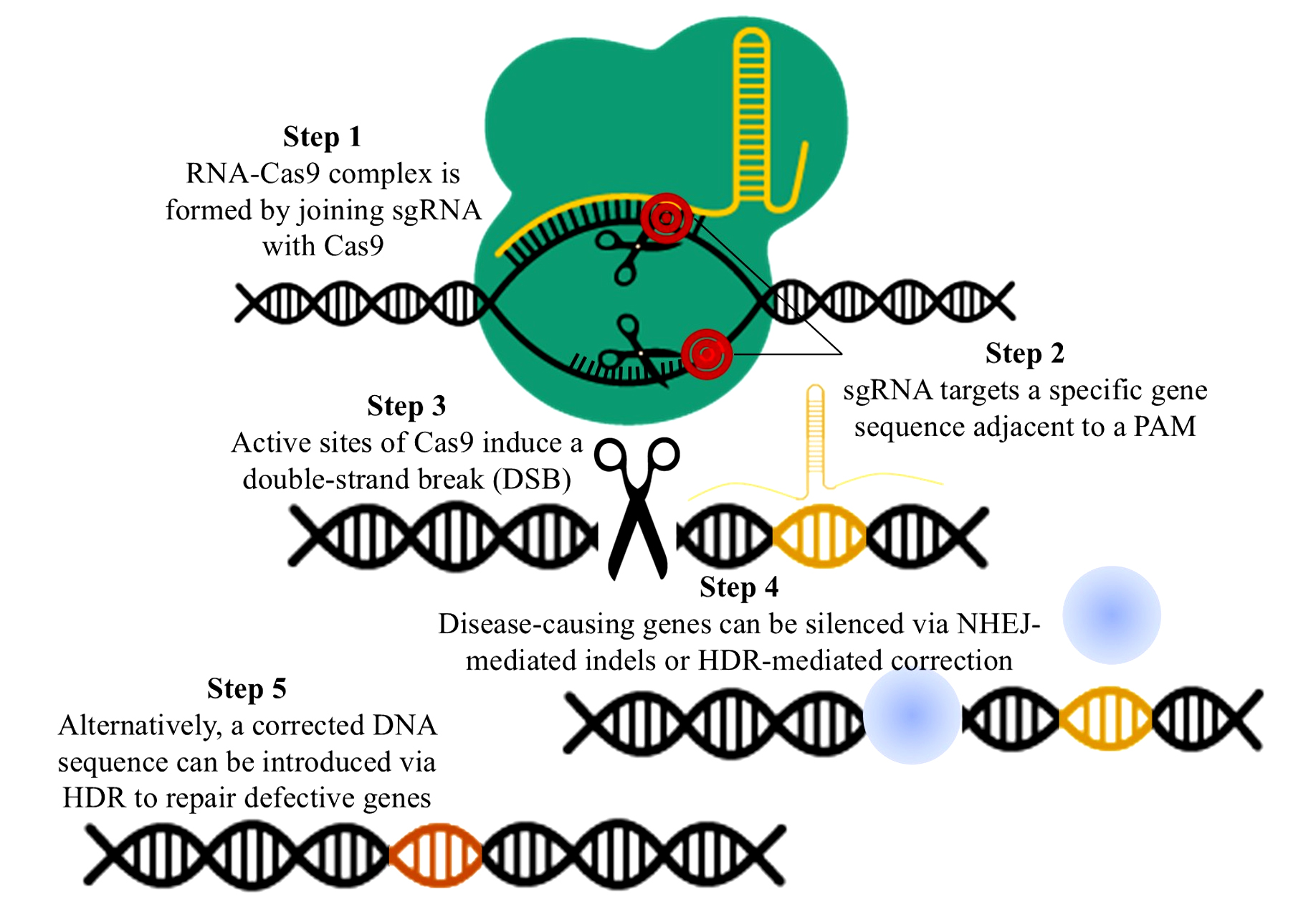
Figure 1. Schematic representation of the CRISPR-Cas9 gene-editing mechanism. The process begins with the formation of a ribonucleoprotein complex by joining the single-guide RNA (sgRNA) with the Cas9 endonuclease (Step 1). The sgRNA then targets a specific genomic sequence through complementary base pairing, guided by the presence of a protospacer adjacent motif (PAM) (Step 2), directing the Cas9 enzyme to the intended editing site. The catalytic domains of Cas9, often referred to as molecular scissors, induce a double-strand break (DSB) in the DNA (Step 3). This activates cellular DNA repair pathways, allowing for gene silencing or modification of disease-causing genes via non-homologous end joining (NHEJ) or homology-directed repair (HDR) (Step 4). Finally, when a homologous repair template is provided, a corrected DNA sequence can be introduced to repair or replace defective genes, enabling precise genetic modifications (Step 5). This technique is widely used in genetic research, medicine, and biotechnology for gene therapy and functional genomics
Through error-prone non-homologous end joining repair mechanisms DNA ends bind together yet this process commonly generates small insertions or deletions (indels) which produce gene disruptions. Scientists conduct gene knockout procedures using this technique to deactivate target genes. The precision-based HDR repair system utilizes a homologous DNA template to deliver exact DNA break repair. Scientists deploy synthetic DNA templates with CRISPR-Cas9 to enable cells to implement specific genetic changes as they mend their DNA. Scientists employ HDR technology to execute gene correction or replacement therapies that fix disease-causing genetic mutations. Following the completion of repairs scientists perform verification checks to ensure the successful edits have taken effect. Scientific research uses methods like PCR along with sequencing and fluorescence markers to ensure researchers can verify that their desired DNA modifications were properly integrated. Optimization steps are implemented to achieve higher efficiency while reducing undesirable impacts when required.40-42
DNA repair mechanisms following CRISPR-induced double-strand breaks
Through CRISPR-Cas9 gene editing systems cells create double-strand breaks (DSBs) within DNA to activate their intrinsic repair pathways.43 The DNA repair mechanisms that process double-strand breaks control the final result of the gene-editing process. The repair of DNA relies on two main repair mechanisms known as Non-Homologous End Joining (NHEJ) and Homology-Directed Repair (HDR) (Figure 2).44 These repair mechanisms determine the final genetic outcome of CRISPR experiments by controlling knockouts and precise edits and insertions in DNA.
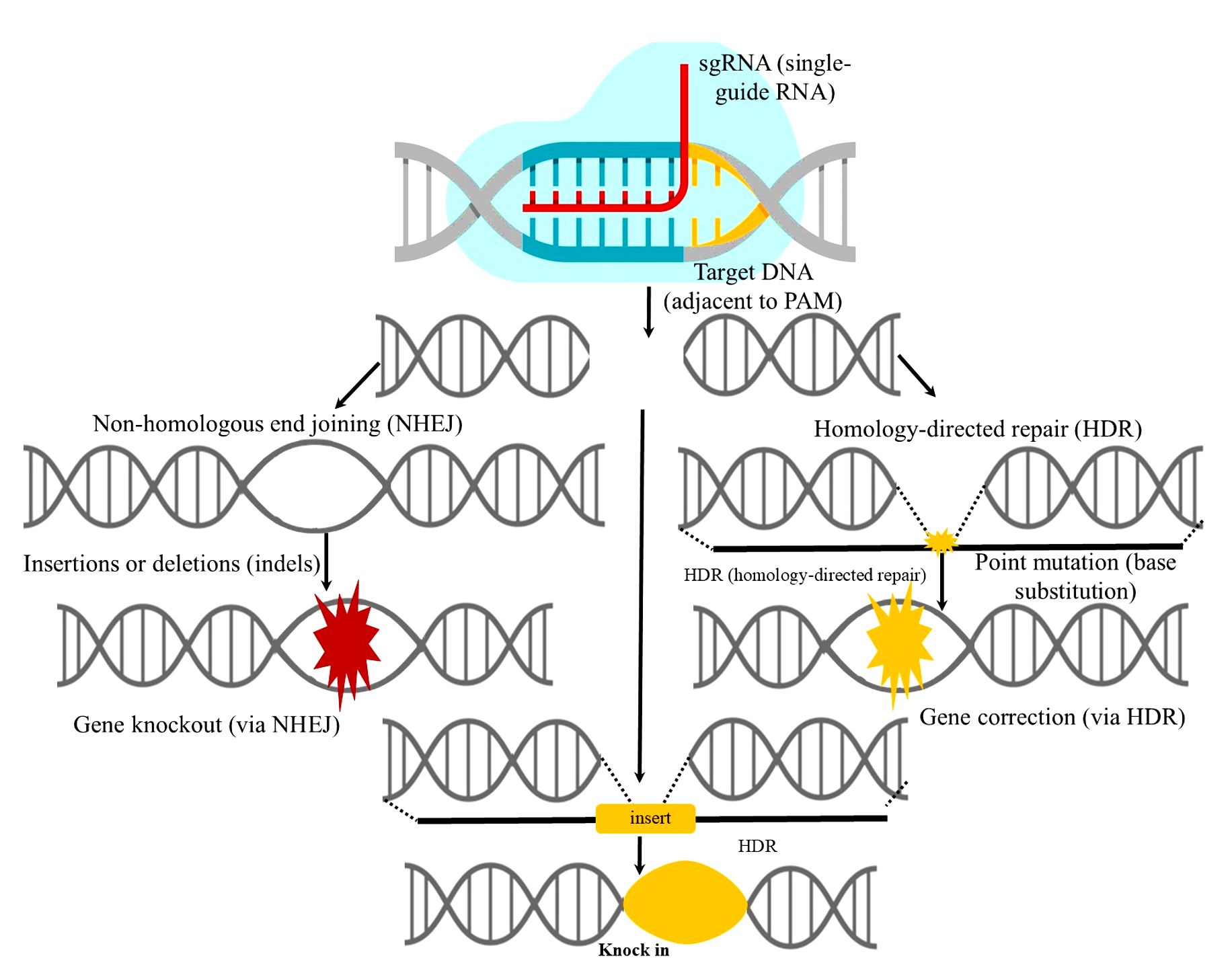
Figure 2. DNA repair mechanisms following CRISPR-Cas9-induced double-strand breaks (DSBs). The CRISPR-Cas9 system introduces targeted DSBs in the DNA, guided by the sgRNA to a specific target sequence adjacent to a PAM. The cell then employs distinct DNA repair pathways to resolve the break. The two primary repair mechanisms are non-homologous end joining (NHEJ) and homology-directed repair (HDR). NHEJ is an error-prone, template-independent process that frequently introduces insertions or deletions (indels), leading to gene knockout. In contrast, HDR is a high-fidelity, template-dependent pathway that utilizes a homologous DNA template to achieve precise gene correction, insertion, or replacement
Non-homologous end joining (NHEJ) functions as an error-prone DNA repair system leading to gene knockouts
The speed and template-free nature of NHEJ repair makes it the leading DNA repair process in most cells. The DNA ends are bound together directly through NHEJ to repair double-strand breaks. DNA repair through this pathway produces inaccurate results that create either small insertions or deletions (indels) at the site where the break occurred. Scientists take advantage of NHEJ’s error-prone repair process to generate gene knockouts through DNA sequence interruptions which can alter gene coding sequences into useless proteins or stop signals. Scientists use this technique for two main purposes: breaking harmful genes or pathogenic sequences in diseases and regulatory elements. The absence of template requirements allows NHEJ to operate at maximum efficiency within both dividing and non-dividing cells. The imprecision of NHEJ prevents it from working well in applications which need precise sequence modifications.45,46
Homology-directed repair (HDR) as a precise pathway for gene correction and insertions
HDR serves as the precise DNA repair pathway that requires homologous DNA sequences for accurate genetic modifications. The repair process operates through either native chromatin strands or added exogenous DNA which contains the target sequence. The precise correction of genes and targeted insertion or functional replacement tasks depend on HDR. Through HDR scientists create therapeutic gene modifications which enable disease-correcting mutations and functional gene insertions together with protein research tagging applications. The efficiency of HDR remains significantly lower than NHEJ because it only happens during the S and G2 phases of the cell cycle while homologous recombination machinery actively operates. HDR efficiency can be improved by delivering repair templates with CRISPR complexes while blocking NHEJ protein activity and using chemical agents like SCR7 and RS-1.47,48 Standard approaches have not solved the challenge of HDR efficiency in somatic gene therapy because cells in this context typically do not divide.
Applications for DNA repair mechanisms in CRISPR-based editing
A particular gene-editing approach needs either NHEJ or HDR to achieve its genetic modifications. NHEJ stands as the preferred DNA repair mechanism for gene knockouts since it operates with high effectiveness throughout all cell types. Successful implementation of disease-mutating therapies or gene insertion requires HDR, but scientists must overcome its current limited effectiveness. Scientists are researching prime editing and base editing approaches to overcome the limitations of NHEJ and HDR.49 The newer methods avoid double-strand breaks which enables them to be more specific and decreases the probability of harmful mutations occurring. CRISPR technology development will require better control of DNA repair processes to progress both genetic treatment methods and agricultural applications.
Advantages of CRISPR over traditional gene-editing methods
The CRISPR-Cas9 system surpasses previous gene-editing methods ZFNs and TALENs because of its unique benefits.50,51 The core advantage of CRISPR stems from its basic nature. Gonzalez et al.52 reported that CRISPR technology differs from ZFNs and TALENs because it needs short RNA synthesis instead of custom protein design for sequence-targeting. CRISPR provides enhanced utility and performance that enables faster and less expensive biological modification applications.53 According to Li et al.,54 the primary advantage of CRISPR technology is its high precision performance combined with its operational efficiency. The guide RNA lets Cas9 find specific DNA sequences with precision which minimizes potential errors in targeting. The precision of CRISPR-based genetic modifications improves through scientific developments in modified Cas9 versions that create fewer errors during application. Multiplexed CRISPR systems demonstrates multiple applications through its ability to edit several genetic sites at once.55 CRISPR provides significant value for diseases and traits research because it enables scientists to modify multiple genes simultaneously.56
The successful application of CRISPR in bacterial, plant, animal and human cells has resulted in transformative scientific breakthroughs throughout medicine alongside agriculture and synthetic biology research. CRISPR demonstrates exceptional flexibility which enables its use in numerous genetic applications. Scientists have shown with CRISPR that it can modify genes directly inside living organisms through in vivo gene editing approaches.57 This technology demonstrates promising potential for genetic disorder treatment and infectious disease and cancer therapy by eliminating the requirement for extensive ex vivo cell modification. Former gene-editing methods worked predominately within ex vivo or in vitro frameworks which needed cells to undergo exterior body modifications before human reintroduction.58 CRISPR technology faces attributes despite offering these benefits. Gene editing technology faces several crucial challenges including genetic side effects together with immune system reactions and moral dilemmas.59 Technological advancements in CRISPR continue to boost its safety along with effectiveness through the development of highly precise editing systems such as base editors and prime editors.
CRISPR in human health
CRISPR-based gene editing has emerged as a transformative tool in human medicine, offering the potential to correct genetic disorders (Figure 3), develop targeted cancer therapies, and combat infectious diseases. The precision and efficiency of CRISPR-Cas9 (Table 1) have accelerated research in genetic medicine, paving the way for revolutionary treatments that were previously unimaginable. Scientists and clinicians are actively exploring CRISPR’s potential in treating monogenic and polygenic disorders, enhancing cancer immunotherapy, and controlling viral and bacterial infections. While CRISPR-based therapies are still in the experimental and clinical trial phases, early successes suggest that this technology could significantly improve human health in the coming decades.60
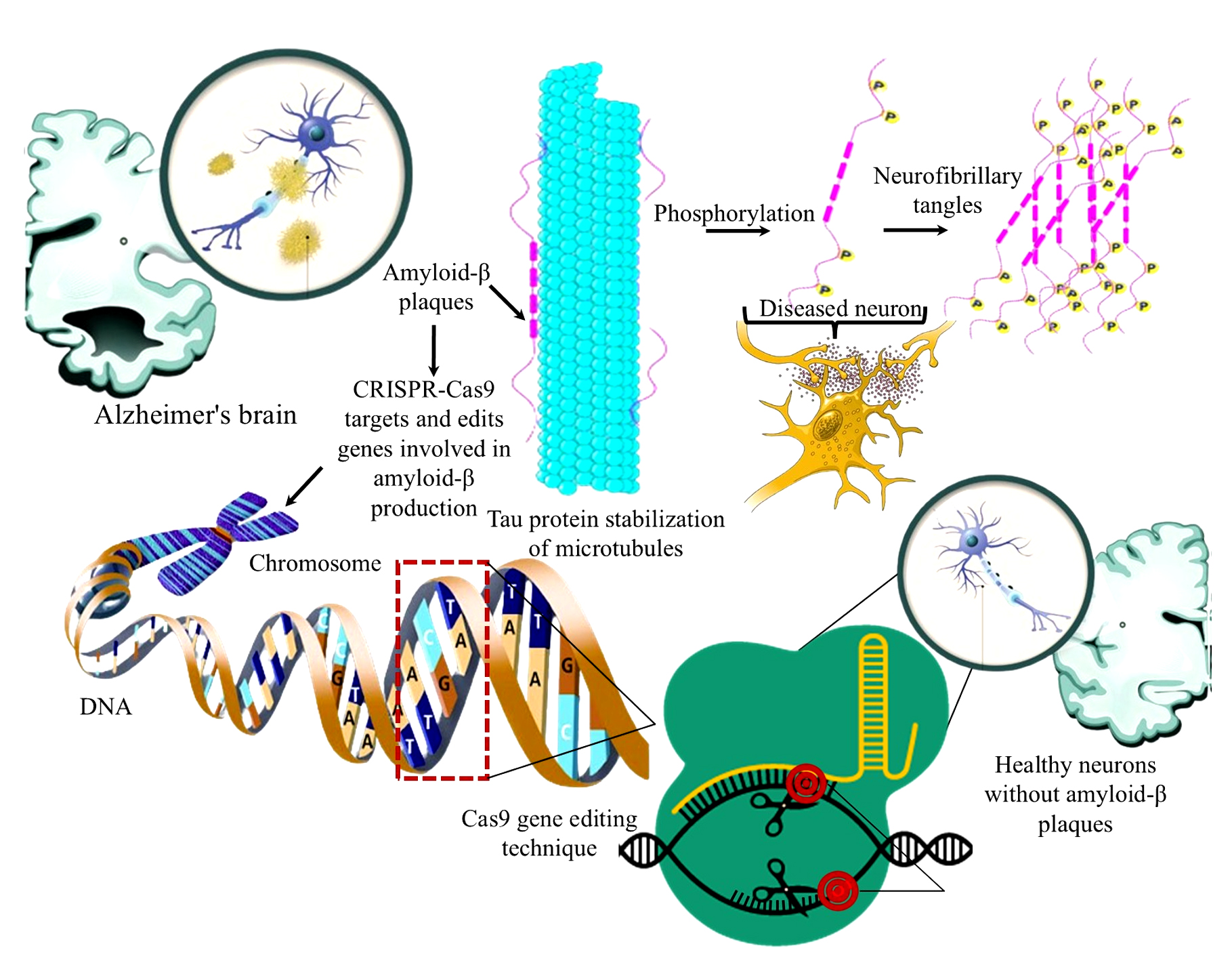
Figure 3. CRISPR-Cas9 gene-editing approach for Alzheimer’s disease treatment. The diagram illustrates the pathological mechanisms of Alzheimer’s disease, highlighting the formation of amyloid-β plaques and neurofibrillary tangles due to tau protein phosphorylation. The accumulation of amyloid-β plaques leads to neuronal damage and cognitive decline. The CRISPR-Cas9 gene-editing technique is depicted as a potential therapeutic approach, targeting genes responsible for amyloid-β production to prevent plaque formation. By modifying these genes at the DNA level using Cas9 and sgRNA, CRISPR-Cas9 may help stabilize microtubules, reduce neurodegeneration, and restore normal neuronal function
Table 1. Summarizes the role of CRISPR in combating human diseases
| Application Area | Disease/Condition | Target Gene(s) | CRISPR Strategy | Delivery Method | Challenges & Limitations | Ref. |
|---|---|---|---|---|---|---|
| Genetic Disorders | Sickle Cell Anemia | HBB | Gene correction or fetal hemoglobin reactivation | Ex vivo editing of hematopoietic stem cells | Delivery efficiency, ethical concerns | 70 |
| Cystic Fibrosis | CFTR | Correction of CFTR gene mutations | Viral or lipid nanoparticle delivery | Targeting lung cells, delivery challenges | 71,72 | |
| Duchenne Muscular Dystrophy | DMD | Exon skipping or gene repair | Adeno-associated virus (AAV) delivery | Immune response, large gene size | 73,74 | |
| Huntington’s Disease | HTT | Knockdown of mutant huntingtin protein | CRISPR-based gene silencing | Off-target effects, neuron targeting | 75,76 | |
| Hemophilia | F8 (Hemophilia A), F9 (Hemophilia B) | Gene replacement or correction | Liver-targeted delivery via AAV | Immune reactions, gene dosage control | 77 | |
| Beta-Thalassemia | HBB | Gene correction in hematopoietic stem cells | Ex vivo CRISPR editing | Long-term safety, transplantation risks | 78 | |
| Fragile X Syndrome | FMR1 | Silencing of expanded CGG repeats | Neural stem cell delivery | Gene expression control, neuron targeting | 79 | |
| Spinal Muscular Atrophy | SMN1 | Gene replacement therapy | AAV-based delivery | Long-term gene stability | 80,81 | |
| Cancer Therapy | Leukemia | CD19, CD22 | CRISPR-enhanced CAR-T therapy | T-cell modification (ex vivo) | Side effects, cytokine storm risk | 82 |
| Lymphoma | CD20, CD22 | CRISPR-modified immune cells | Ex vivo CAR-T therapy | Long-term effects, tumor escape | 83 | |
| Prostate Cancer | AR, PTEN | Knockout of androgen receptor | Nanoparticle-mediated delivery | Tumor resistance mechanisms | 84 | |
| Pancreatic Cancer | KRAS, TP53 | CRISPR-mediated oncogene suppression | Direct tumor injection | Delivery challenges, tumor heterogeneity | 85,86 | |
| Ovarian Cancer | BRCA1, BRCA2 | CRISPR-enhanced DNA repair | Lipid nanoparticle therapy | Immune evasion, gene integration risks | 87-89 | |
| Infectious Diseases | HIV/AIDS | CCR5, HIV provirus | Gene knockout of HIV receptor | CRISPR-based ex vivo editing | Complete virus eradication, safety concerns | 90,91 |
| Hepatitis B | HBV cccDNA | CRISPR-based viral DNA cleavage | Lipid nanoparticle-mediated delivery | Off-target risk, viral escape | 92 | |
| COVID-19 | SARS-CoV-2 genome | CRISPR-based RNA targeting (Cas13) | Direct antiviral therapy | Delivery, immune response | 93 | |
| Zika Virus | ZIKV genome | CRISPR-based RNA targeting | Mosquito gene drive technology | Ecological impact, viral mutation risk | 94,95 | |
| Ebola | EBOV genome | CRISPR-mediated viral genome cleavage | Intravenous CRISPR antiviral therapy | Immune response, biosafety concerns | 96 | |
| Dengue Fever | DENV genome | CRISPR-based mosquito sterilization | Gene drive technology | Resistance development, ecological effects | 97 | |
| Antibiotic Resistance | Klebsiella pneumoniae | Carbapenemase genes | CRISPR-based phage therapy | Lytic bacteriophage delivery | Bacterial adaptation, off-target risks | 98,99 |
| Neurodegenerative Diseases | Alzheimer’s Disease | APP, PSEN1 | Gene silencing or repair | Blood-brain barrier-targeting vectors | Neuroinflammation, long-term effects | 100,101 |
| Parkinson’s Disease | LRRK2, SNCA | Correction of disease-causing mutations | AAV-based delivery | Neuron targeting efficiency | 102 | |
| Multiple Sclerosis | IL-2RA, HLA-DRB1 | Gene modification to regulate immune response | CRISPR-modified immune cells | Autoimmune regulation challenges | 103 | |
| Metabolic Disorders | Diabetes (Type 1 & 2) | INS, PDX1 | Beta-cell regeneration or gene correction | Stem-cell derived therapy | Autoimmune response, safety | 104 |
| Gaucher Disease | GBA1 | Gene correction for lysosomal enzyme production | CRISPR-modified stem cells | Long-term gene expression control | 105 | |
| Rare Genetic Disorders | Rett Syndrome | MECP2 | CRISPR-mediated gene activation | CNS-targeted gene therapy | Neuron-specific targeting, gene balance | 106 |
| Marfan Syndrome | FBN1 | Gene editing to repair fibrillin production | AAV-based systemic delivery | Delivery to connective tissues, immune risks | 107 |
Sickle cell anemia and beta-thalassemia
Mutations in the HBB gene resulting from sickle cell anemia and beta-thalassemia cause severe inherited blood disorders that interfere with hemoglobin production.61 Frangoul et al.62 performed a landmark clinical trial where CRISPR-Cas9 modified hematopoietic stem cells (HSCs) to reactivate fetal hemoglobin (HbF). The therapy’s edited cells demonstrated their effectiveness by reducing disease symptoms in patients and enabling patients to avoid receiving blood transfusions after administration. The treatment yielded enduring benefits because fetal hemoglobin maintained its elevated levels through 18 months after treatment completion. Kalkan et al.63 employed base editing to accurately modify HBB genes without creating DNA double-stranded breaks. Approaches based on this method offer safer genetic therapy options by reducing potential adverse effects.
A major milestone in the clinical translation of CRISPR technology has been achieved with the regulatory approval of Casgevy (exagamglogene autotemcel), the first CRISPR/Cas9-based gene-editing therapy approved for human use. In December 2023, the United States Food and Drug Administration (FDA) approved Casgevy for the treatment of sickle cell disease (SCD) with recurrent vaso-occlusive crises in patients aged 12 years and older, followed by approval for transfusion-dependent beta-thalassemia (TDT). Casgevy utilizes CRISPR-Cas9-mediated editing of autologous hematopoietic stem cells to disrupt the erythroid-specific enhancer of the BCL11A gene, thereby increasing fetal hemoglobin (HbF) production and alleviating disease symptoms. Similarly, the European Medicines Agency (EMA) has authorized Casgevy for the treatment of eligible patients aged 12 years and older with sickle cell disease and transfusion-dependent beta-thalassemia under specified clinical criteria. These approvals represent a landmark achievement in precision medicine and demonstrate the successful transition of CRISPR technology from experimental research to clinically approved therapeutic applications.
Cystic fibrosis
Cystic fibrosis (CF) represents a fatal inherited condition that stems from CFTR gene mutations which generate excessive mucus buildup both in lungs and digestive organs. Researchers from Debczynski et al.64 demonstrated how CRISPR-Cas9 technology repaired CFTR mutations within patient-derived lung organoids which in turn restored typical protein function. Researchers believe CRISPR technology represents a potential long-term approach to treat cystic fibrosis because it allows direct correction of genetic abnormalities in lung epithelial cells.65 The major hurdle for CF gene therapy research lies in finding effective delivery methods for lung cell therapy. Researchers explore CRISPR delivery through lipid nanoparticles and viral vectors to enhance feasibility in treatment development.
Duchenne muscular dystrophy (DMD)
Genetic abnormalities in the DMD gene leading to dystrophin protein deficiency result in the development of the severe DMD muscle-wasting condition.66 Studies by Long et al.67 achieved Dystrophin protein expression recovery in DMD mouse models through CRISPR treatment of abnormal exons. Research pointed to CRISPR’s capacity for restoring muscle function which enhanced both animal movement and survival expectancy. The recent scientific achievement of Agrawal et al.68 employed prime editing as an enhanced CRISPR framework which precisely repaired DMD mutations while minimizing unwanted genetic byproducts. The experimental approach has reached a phase where researchers evaluate it for potential human clinical trial applications.
Huntington’s Disease (HD)
The HTT gene’s excessive CAG repeats create Huntington’s disease by making neurons build toxic proteins that damage them. Scientists at Sen and Thummer.69 employed CRISPR interference (CRISPRi) techniques to achieve targeted repression of the mutant HTT allele followed by a subsequent decrease in neuronal tissue deterioration within HD models. Studies demonstrated CRISPR technology’s potential to stop disease progression in disorders that affect the nervous system.
CRISPR for cancer therapy
Traditional cancer treatment approaches including chemotherapy and radiation therapy alongside targeted therapies generate major side effects together with drug resistance and restricted long-term treatment outcomes. The CRISPR-based gene editing technology has transformed cancer medicine through its capability for accurate genetic modification that boosts immunotherapy while targeting oncogenes straight on or reactivating tumor suppressor genes and increasing chemotherapy responsiveness. Several preclinical and clinical research trials have shown that CRISPR holds revolutionary potential for transforming cancer treatment approaches for patients facing treatment-resistant tumor cells.108
CRISPR-enhanced immunotherapy
The development of immunotherapy has reshaped cancer treatment through its ability to activate patients’ immune response against tumor cells.109 Ramos and Dotti110 reported that Engineered T cells through chimeric antigen receptor (CAR)-T cell therapy become capable of targeting specific cancer markers to destroy them. The development of CAR-T cell therapy has been enhanced through CRISPR technology which deletes the immune checkpoint genes PD-1 and CTLA-4 that tumors commonly utilize to avoid immune surveillance. Stadtmauer et al.111 initiated the first clinical human trial employing CRISPR-edited CAR-T cells for multiple myeloma, sarcoma, and melanoma treatment which showed that these CRISPR-modified T cells survived within patients for months and performed effectively against tumors. Study results demonstrated that CRISPR enhanced CAR-T cells survival while improving their capability to destroy tumor cells. Han et al.112 employed CRISPR to alter tumor-infiltrating lymphocytes (TILs) by disabling the CISH gene which controls immune system suppression. CRISPR-modified TILs demonstrated superior tumor-fighting abilities in lung cancer experiments thus indicating potential CRISPR usage in solid tumors which previously did not respond to CAR-T therapy.
Targeting oncogenes with CRISPR
Oncogenes represent mutated genetic material that leads cells to divide without restraint and create cancerous tumors.113 Multiple cancers initiate from distinct oncogenic mutations including the KRAS mutation affecting pancreatic and colorectal cancers and the MYC mutation targeting breast and colon cancer and the EGFR mutation responsible for lung cancer development.114,115 Genetic manipulation through CRISPR enables researchers to eliminate harmful mutations in tumors resulting in complete tumor growth suppression. Preclinical studies have demonstrated that CRISPR-Cas9-mediated disruption of oncogenes can significantly inhibit tumor growth in animal models. For instance, Weng et al.116 used CRISPR to disrupt mutant KRAS in pancreatic cancer xenograft models, achieving substantial tumor volume reduction and prolonged survival in treated mice. Similarly, Wan et al.117 and Yi et al.118 showed that CRISPR-mediated knockout of the MYC oncogene in breast and colorectal cancer cell lines led to reduced cell proliferation, enhanced apoptosis, and impaired tumorigenicity in vitro and in mouse models117 and Yi et al.118 CRISPR shows promise as a precise genetic therapy for cancer because it aims at actively removing cancer-causing mutations while maintaining cell integrity.
Reactivating tumor suppressor genes
Tumor suppressor genes like p53 and RB1 together with BRCA1 maintain essential control over DNA damage and unbounded cell cycles. Research suggests that cancers usually begin because loss-of-function mutations in tumor suppressor genes enable uncontrolled cell proliferation. Researchers investigate CRISPR technology to reactivate essential genes that restore tumor-suppressing functions in cells. Ding et al.119 demonstrated that p53 gene expression in lung cancer cells via CRISPR activation (CRISPRa) which restored cell death functions and constrained tumor growth. Several studies including He et al.120 and Feng and Jasin 121 conducted successful BRCA1 and BRCA2 gene reactivation through CRISPR-based therapy to restore DNA repair mechanisms which enhanced breast and ovarian cancer cells’ response to standard PARP inhibitor treatment. The analysis of CRISPR technology demonstrates its effectiveness in recovering the body’s natural cancer defense system which allows new approaches to fighting tumors without functional tumor suppressors.
Overcoming chemotherapy resistance with CRISPR
The main obstacle in cancer treatment emerges from chemotherapy resistance as cancer cells find ways to escape the therapeutic effects of drugs used to fight tumors. Researchers employ CRISPR methods to counter drug resistance through gene modification of metabolism-related pathways and DNA repair functions alongside apoptosis control processes. Norouzi-Barough et al.122 employed CRISPR to eliminate ABC transporter genes that actively remove chemotherapy drugs from cancer cells leading them to become drug-resistant. The study documented success when researchers used transporter disablement to improve cancer cell response to standard chemotherapy treatments in lung and ovarian cancers. Begagic et al.123 showed that CRISPR-evolved glioblastoma cells without the MGMT gene became more responsive to standard treatment drug temozolomide (TMZ). Research indicates how CRISPR can make tumors more receptive to chemotherapy drugs to enable more successful and enduring treatment outcomes.
CRISPR-based cancer therapy needs to overcome multiple obstacles before becoming a common clinical practice in medical settings. The main issue with CRISPR-based cancer therapy is the occurrence of unintended genetic changes known as off-target effects which could create new mutations or produce secondary cancer cells according to Chehelgerdi et al.124 The development of high-fidelity Cas9 variants as well as alternative gene-editing methods like base editing and prime editing aims to improve precision in order to reduce this risk. Executively delivering CRISPR presents difficulties because researchers must achieve precise delivery to tumor cells without altering healthy cells. Gomes-da-Silva et al.125 used nanoparticles together with viral vectors coupled with lipid-based delivery systems but they each present specialized benefits and technical boundaries. Careful management of the immune response to CRISPR components becomes necessary to stop the body from rejecting the therapy. CRISPR therapy for cancer treatment encounters serious obstacles related to both technological solutions and ethical guidelines.126 Later generations might face unexpected long-term outcomes from permanent human gene modification especially in cases of germline editing. The use of CRISPR on somatic cells for testing continues while public discussions persist about the moral limitations of genetic alterations. The FDA together with European Medicines Agency (EMA) maintain strict oversight of clinical trials to guarantee safety standards and both effectiveness and ethical adherence.
Infectious disease control
The global health system faces two major challenges stemming from viral diseases and antibiotic-resistant bacterial infections.127 Traditional antiviral medications encounter three major challenges which include drug resistance and reduced effectiveness and unwanted side effects while antibiotic resistance continues to render bacterial infections untreatable.128 CRISPR technology functions as an advanced biomedical solution to manage infectious diseases through mechanisms that edit viral genomes and develop swift diagnostic tools and bacteriophage-based therapeutic methods against drug-resistant bacterial strains. Multiple recent research findings illustrate how CRISPR functions to prevent HIV, COVID-19, hepatitis B and bacterial infections while offering prospects for efficient disease management.
CRISPR as an antiviral tool (HIV, COVID-19, Hepatitis B)
The ability of viruses to replicate inside host cells prevents them from being treated effectively by typical medical approaches.129 The CRISPR-based gene editing method shows promise for eliminating viral DNA and RNA in infected cells which halts viral replication and presents new possibilities for treating persistent viral infections (Figure 4). The groundbreaking CRISPR application in virology emerged when Zhu et al.130 first demonstrated how CRISPR could eliminate latent HIV DNA from infected cells. The integration of HIV genetic material into host DNA makes it exceptionally challenging to eliminate this pathogen. CRISPR technology demonstrated its ability to eliminate HIV from infected cells by precisely removing integrated DNA and resulting in minimal viral spread and preventing active viral multiplication. The researchers achieved a significant milestone toward developing effective HIV treatment by showing how this discovery could help eliminate HIV from affected patients who would no longer need continuous antiretroviral therapy. Future implementation of CRISPR-based HIV therapies in clinical practice requires successful resolution of three principal challenges including off-target effects and viral escape mutations with effective vivo delivery systems.
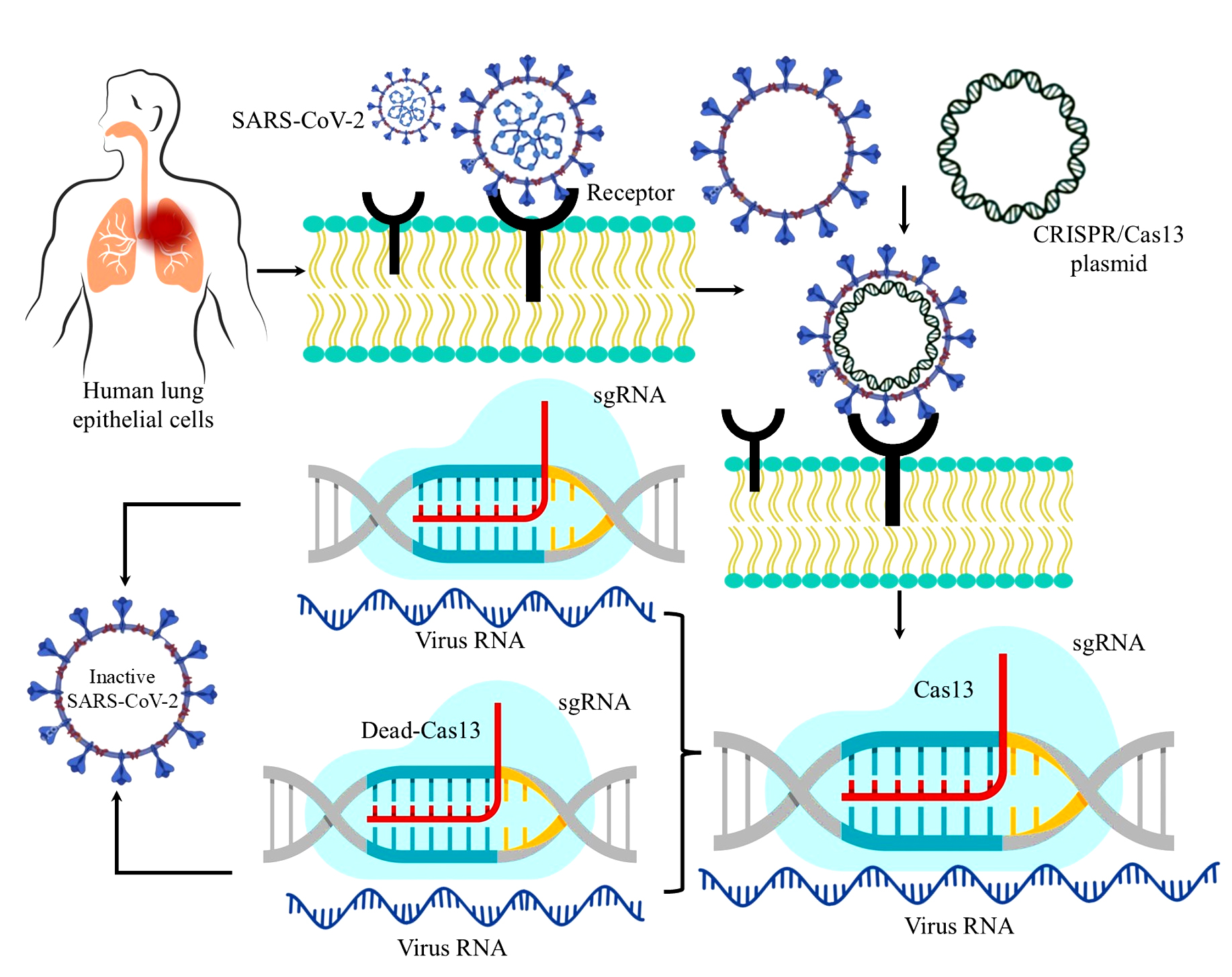
Figure 4. CRISPR-Cas13-based antiviral strategy targeting SARS-CoV-2. The diagram illustrates the mechanism by which CRISPR-Cas13 can be used to degrade the RNA genome of SARS-CoV-2 within human lung epithelial cells. SARS-CoV-2 enters host cells by binding to specific cell surface receptors, where it releases its viral RNA to initiate replication. A CRISPR-Cas13 plasmid is introduced into the infected cells, enabling the Cas13 enzyme to specifically target and cleave viral RNA guided by complementary sgRNA sequences. The cleavage of viral RNA leads to inactivation of the virus, preventing further replication and infection. Additionally, the use of catalytically dead Cas13 (dCas13) is shown as a method to bind and block viral RNA expression without degrading it
Healthcare researchers speeded up the creation of CRISPR-based detection platforms during the COVID-19 pandemic to identify SARS-CoV-2 with rapid and precise results. Although still under development, the SHERLOCK131 and DETECTR CRISPR-based diagnostic platforms132 employ Cas13 enzymes that detect and break down viral RNAs. The tests showed fast SARS-CoV-2 identification in patient samples while requiring basic laboratory equipment which makes them appropriate for remote and resource-scarce testing locations. These successful CRISPR-based diagnostic developments lead to new possibilities for detecting upcoming viral pathogens while improving worldwide pandemic preparedness systems.
Hepatitis B virus (HBV) infection continues to be a global health priority since it creates pathways for chronic liver disease that can result in hepatocellular carcinoma.133 The virus maintains persistence inside infected cells through covalently closed circular DNA (cccDNA) that functions as an HBV reservoir. The research team at Martinez et al.134 investigated how CRISPR could eliminate HBV cccDNA to suppress viral activity and restore liver functioning within HBV-infected cell lines and animal models. CRISPR research now shows promise as a novel therapeutic technique that could eliminate ongoing HBV infections even though the medical community lacks definite treatment options. The successful use of CRISPR therapy to fight viral infections depends on overcoming barriers involving delivery methods and immunological responses as well as the management of unintentional genetic changes.
CRISPR-based phage therapy for antibiotic resistance
Medically advanced bacteria that resist antibiotics have become a critical concern which requires new treatment options for fighting bacterial infections. Public health on a global scale faces threats because multidrug-resistant pathogens create infections that challenge medical treatment while leading to elevated mortality statistics. Bacteriophage (phage) therapy with CRISPR technology shows promise as a selective weapon against antibiotic-resistant bacteria which spares valuable microbiota. An initial discovery from Palacios et al.135 showed CRISPR-improved bacterial phages that targeted antibiotic-resistant bacterial genes resulted in destruction of multidrug-resistant bacteria while eliminating the need for standard antibiotics. Research scientists developed engineered bacteriophages to transfer CRISPR-Cas9 components into bacterial cells for precise gene cutting which restored antibiotic susceptibility or led to bacterial cell death. Researchers introduced this innovative treatment to fight infections of methicillin-resistant Staphylococcus aureus (MRSA), Klebsiella pneumoniae, and Pseudomonas aeruginosa inside hospitals.
Researchers have developed CRISPR-based phage therapy to target bacterial biofilms as biofilms protect bacteria from antibiotics and immune reactions. Saeed et al.136 achieved successful antibiotic-resistant bacterial population destruction through their development of CRISPR-based phage systems for both urinary tract infections (UTIs) and lung infections in preclinical trials. Doctors are currently testing this strategy as a potential therapeutic option against drug-resistant hospital bacteria. The utilization of CRISPR-based phage therapy137 delivers two main benefits through its ability to target specific harmful bacteria while safeguarding beneficial microbiota and its reduced potential for developing resistance compared with standard antibiotics. Research faces hurdles for large-scale phage manufacturing as well as the development of stable human body delivery methods and protective strategies against immune reactions.
CRISPR in animal health
Scientists employ CRISPR technology to transform genetic engineering for animal health through disease resistance while advancing productivity and creating better animal care standards (Figure 5). The occurrence of livestock diseases generates substantial economic and public health threats because they trigger extensive losses in agricultural production and prompt antibiotic overuse thus facilitating antimicrobial resistance (AMR). Through CRISPR research scientists have created gene-edited animals that hold immunity to viral and bacterial pathogens therefore eliminating requirements for vaccines and antibiotics.138
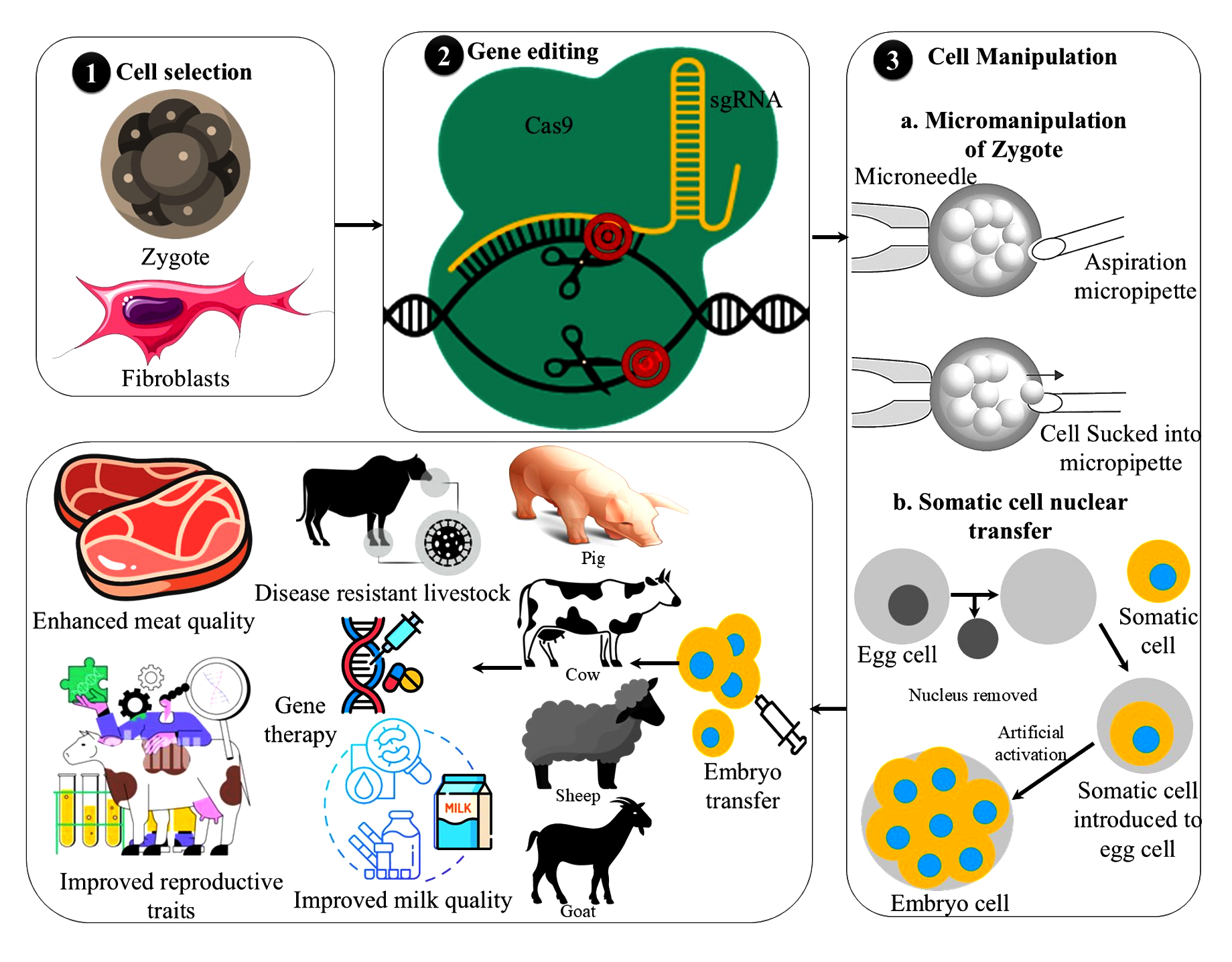
Figure 5. CRISPR-Cas9 gene editing in livestock for improved traits and disease resistance. The diagram illustrates the step-by-step process of CRISPR-based genetic modifications in farm animals to enhance productivity and resilience, including the use of Cas9, sgRNA, and HDR/NHEJ repair mechanisms
Enhancing disease resistance in livestock
Global food security faces significant challenges from livestock diseases attributed to viral and bacterial and parasitic infection containment. The current disease control methods featuring vaccination and biosecurity protocols together with antibiotic treatments are expensive to maintain and require considerable human labor yet show limited success in disease prevention. CRISPR-Cas9 technology brings revolutionary enhancements to animal disease resistance while permanently altering genes responsible for infections.139 According to Yuan et al.,140 effective zygote editing with both cytosine and adenine base editors (ABE) has resulted in the production of animal models. Scientists achieved gene editing success with pigs, cows and chickens alongside fish which resulted in disease-resistant strains that lowered death rates while boosting farm yield (Table 2).
Table 2. CRISPR applications in livestock disease resistance, including targeted diseases, pathogens, gene-editing strategies
Livestock |
Target Disease |
Pathogen |
CRISPR Strategy |
Targeted Gene(s) |
Expected Outcome |
Ref. |
|---|---|---|---|---|---|---|
Pigs |
PRRS (Porcine Reproductive and Respiratory Syndrome) |
PRRS Virus |
Deletion of viral entry receptor to prevent infection |
CD163 |
Complete resistance to PRRS virus without affecting normal immune function |
147 |
Cows |
Bovine Tuberculosis (bTB) |
Mycobacterium bovis |
Enhancement of immune response to prevent bacterial survival |
NRAMP1 |
Increased resistance to tuberculosis, reduced bacterial load in infected animals |
148 |
Chickens |
Avian Influenza |
Influenza virus |
Blocking viral replication by modifying host dependency factor |
ANP32 |
Reduced viral replication, increased survival after exposure to influenza |
149 |
Cows |
Mastitis |
Staphylococcus aureus |
Enhancing antibacterial activity in milk-producing tissues |
LYZ2 |
Higher resistance to mastitis, reduced antibiotic use in dairy farming |
150 |
Goats |
Johne’s Disease (Paratuberculosis) |
Mycobacterium avium subsp. paratuberculosis |
Enhancement of immune response in gut-associated lymphoid tissue |
SLC11A1 |
Increased resistance to chronic intestinal infection, lower disease transmission |
151 |
Sheep |
Scrapie (Prion Disease) |
Prions |
Modification of prion protein genes to reduce misfolding |
PRNP |
Reduced susceptibility to prion infections, preventing neurodegeneration |
152 |
Cattle |
Foot-and-Mouth Disease (FMD) |
Foot-and-Mouth Disease Virus (FMDV) |
Insertion of viral resistance gene into cattle genome |
IFITM3 |
Improved resistance to FMDV, reduced economic losses due to outbreaks |
153 |
Pigs |
African Swine Fever (ASF) |
African Swine Fever Virus (ASFV) |
Modification of host immune response genes to prevent viral spread |
REL-A |
Reduced ASFV replication, increased survival rates in infected pigs |
154 |
Salmon |
Infectious Hematopoietic Necrosis Virus (IHNV) |
IHNV |
Knockout of viral receptor gene to prevent entry |
Tlr9 |
Higher survival rates in farmed salmon populations |
155 |
Pigs |
Classical Swine Fever (CSF) |
Classical Swine Fever Virus (CSFV) |
Editing host genes to block viral replication |
OAS1 |
Reduced viral replication and transmission |
156 |
Chickens |
Salmonella Infection |
Salmonella enterica |
Enhancing gut immunity and resistance to bacterial colonization |
ACE2 |
Reduced bacterial shedding, lower risk of foodborne transmission |
157 |
Cows |
Bovine Respiratory Disease (BRD) |
Mannheimia haemolytica |
Modifying host immune response genes to reduce lung inflammation |
IL6 |
Lower severity of respiratory infections, reduced antibiotic use |
158,159 |
Cows |
Bovine Leukemia Virus (BLV) |
BLV |
Gene-editing to prevent viral integration and spread |
CCR5 |
Increased resistance to persistent viral infection |
160 |
Pigs |
Nipah Virus |
Nipah Virus |
Disrupting host receptor gene required for viral entry |
Ephrin-B2 |
Reduced susceptibility to deadly zoonotic virus |
161 |
Gene-edited animals resistant to viral/bacterial infections
CRISPR technology has now been also used to systematically insert advantageous mutations into livestock which grants them protection against particular disease-causing agents. The method shows great potential for controlling diseases that spread rapidly and cause extensive economic harm because typical preventive measures prove ineffective. The investigation of CRISPR for viral resistance in livestock stems principally from the fast transmission rates coupled with the severe economic effects of viral diseases.141 Schultz III and colleagues142 achieved great success by developing pigs that resist Porcine Reproductive and Respiratory Syndrome (PRRS) through CRISPR engineering resulting in billions of dollars in savings for the global pork industry. PRRSV causes PRRS through binding with CD163 receptors on immune cells to infect pigs. By employing CRISPR technology Zhang and Guo143 eliminated the CD163 receptor from pig cells so these animals became immune to PRRSV while their fundamental immune responses remained intact. Gene-edited pigs underwent testing by Burkard et al.144 which revealed complete resistance to PRRSV infection thus demonstrating CRISPR’s ability to eradicate one of the most destructive swine diseases in agricultural farms.
Another viral disease that threatens livestock is avian influenza, which causes severe outbreaks in poultry farms worldwide. Researchers have successfully used CRISPR to modify the ANP32 gene in chickens, a crucial protein that influenza viruses rely on for replication. Studies conducted by Staller et al.145 have shown that CRISPR-edited chickens exhibit reduced susceptibility to influenza infections, offering a sustainable approach to preventing viral outbreaks in poultry farms. Bacterial resistance in livestock is another major focus of CRISPR research, especially in combating zoonotic pathogens that pose a threat to both animal and human health. Bovine tuberculosis (bTB) is a chronic bacterial disease caused by Mycobacterium bovis, which affects cattle worldwide and can also infect humans. The disease leads to huge economic losses due to culling and trade restrictions. Yuan et al.146 have used CRISPR to enhance natural resistance to tuberculosis in cows by modifying the NRAMP1 gene, a key regulator of the immune response to mycobacterial infections. In a study conducted by Islam et al.,23 gene-edited cows showed significant resistance to Mycobacterium bovis infection, offering a potential genetic solution to one of the most persistent livestock diseases. Similarly, mastitis, an inflammation of the mammary gland in dairy cows caused by bacterial infections such as Staphylococcus aureus, lead to reduced milk production and increased antibiotic use. Researchers have used CRISPR to enhance resistance to mastitis by modifying key immune-related genes, such as LYZ2, which improves the ability of cows to fight bacterial infections. Singh and Ali et al.138 demonstrated that CRISPR-edited cows exhibited higher resistance to mastitis, reducing the reliance on antibiotics and improving animal welfare.
A significant translational milestone in livestock genome editing was achieved in 2025 when the U.S. Food and Drug Administration (FDA) approved genetically engineered pigs carrying the CD163ִE7 modification for resistance to Porcine Reproductive and Respiratory Syndrome Virus (PRRSV). According to the FDA Freedom of Information (FOI) summary for New Animal Drug Application (NADA) 141-609, the approved genetic alteration consists of the deletion of exon 7 of the CD163 gene (CD163ִE7), generated using CRISPR-Cas9 genome editing technology. This modification prevents PRRSV infection while preserving the essential physiological functions of the CD163 receptor. The approval applies to homozygous pigs carrying the CD163ִE7 allele and represents one of the first major regulatory approvals of a CRISPR-engineered disease-resistant livestock trait. This landmark achievement demonstrates the successful translation of genome editing technologies from experimental animal studies to regulatory acceptance and commercial agricultural applications, highlighting the transformative potential of CRISPR for improving animal health, reducing economic losses, and minimizing antibiotic use in livestock production.
Improving animal welfare and productivity
The application of CRISPR gene editing in livestock extends beyond disease resistance to enhancing animal welfare and productivity. Genetic modifications have been explored to reduce disease burden, improve growth rates, enhance reproductive efficiency, and minimize environmental impact. While these advancements offer significant benefits to farmers, consumers, and global food security, they also raise ethical concerns regarding animal welfare, biodiversity, and potential unintended consequences.138,162
Reducing disease burden and improving growth rates
The main objective of CRISPR technology application within livestock production is to eliminate diseases which lead to both animal welfare problems and economic waste.163 The requirement for antibiotic treatments and medical procedures in farm animals leads to increased production expenses while generating antimicrobial resistance (AMR).164 CRISPR can establish disease-resistant genes permanently which means animals need fewer medical treatments.
Case study: Heat-resistant and stress-tolerant cattle
The effects of heat stress pose major challenges to cattle management throughout tropical areas and subtropical zones. Heat stress leads to reduced growth rates, fertility and milk production which results in major economic losses on farms. Scientists have implemented CRISPR techniques to transfer heat-resistance genes from Brahman cattle to dairy Holstein breeds for higher milk output. Contreras-Correa et al.165 altered the SLICK gene that controls hair length thus producing short-haired Holstein dairy cows that demonstrate enhanced heat tolerance without compromising their milk output. The adapted technique leads to reduced heat-related illnesses and creates improved productivity alongside far better animal wellness. Cattle showing accelerated growth patterns and enhanced feed utilization efficiency were developed through CRISPR genome editing according to Wani et al.162 More sustainable livestock farming becomes possible because these upgrades lead to decreased greenhouse gas emissions across meat production quantities.
Case study: Disease-resistant dairy cows
Dairy farming faces a significant challenge from udder bacterial infections known as mastitis which causes pain to cows together with decreased milk production and increased antibiotic usage. Scientific research utilizing CRISPR technology modified the LYZ2 gene of milk to improve its antibacterial defense mechanisms thus enhancing dairy cows’ ability to resist mastitis infections. Neculai-Valeanu and Ariton166 discovered that genetically modified dairy cows suffered fewer udder infections thus reducing antibiotic consumption while enhancing milk quality.
Ethical considerations in livestock gene editing
CRISPR applications for livestock genetic modification have generated substantial ethical concerns among scientists and society.163 Gene editing offers significant potential to enhance disease resistance combined with increased productivity and decreased environmental impact, yet these benefits come with animal welfare challenges as well as concerns about genetic diversity along with potential unintentional consequences and public reception. Scientific progress needs ethical examination to make sure it upholds social principles as well as adheres to environmental standards and moral obligations.167
Animal welfare and well-being
The ethical dilemma regarding livestock gene editing centers on its effects on animal welfare conditions.168 Several CRISPR modifications aim to resist diseases and decrease stress in livestock but different gene edits can lead to increased animal productivity at the cost of their wellbeing.169 Through MSTN gene (myostatin) knockout methods CRISPR technology enhanced muscle development to create double-muscled livestock that include pigs and cattle.170 These modified meat-producing animals manage to create more food from each portion of feed, yet they face several problems including restricted movement along with breeding complications and heightened metabolic stress levels. The genetic modification of dairy cows for increased milk output results in elevated metabolic pressure which heightens their susceptibility to mastitis while increasing lameness risks and reproductive complications. The ethical debate regarding genetic modification centers on animal well-being because animal rights advocates promote pain reduction over greater productivity. CRISPR technology has successfully implemented disease-resistant characteristics throughout livestock including PRRS resistance in pigs23 and tuberculosis resistance in cows146 yet scientists need to scrutinize modifications which introduce detrimental biological changes to prevent adverse effects on animal wellness.
Unintended genetic consequences and long-term risks
The precise nature of CRISPR gene editing tools causes ongoing concern about unexpected genetic changes and unintended genetic mutations.25 Small unintended genetic alterations generated by gene-editing technologies create the risk of health issues alongside reduced immunity together with reproductive complications in livestock.171 CRISPR-modified traits retain their modified genes across multiple generations which creates ongoing risks that unwanted mutations accumulate and harm the health of affected species. The uniformity created within genetically modified livestock populations by CRISPR modifications creates susceptibility to new diseases while diminishing their ability to adapt to threats because of low genetic diversity. Progressive techniques by scientists in the field such as prime editing approaches with high-fidelity Cas9 variants work to reduce unwanted genetic modifications that occur outside target sites.172 The tracking of how gene-edited modifications affect hereditary traits requires sustained genetic monitoring of populations across extended periods (Table 3).
Table 3. Ethical, Legal, and Social Implications (ELSI) of CRISPR, covering key issues, implications, and current approaches to address these challenges
Category |
Key issue |
Description |
Implications |
Current approaches |
|---|---|---|---|---|
Ethical Concerns |
Off-target effects |
Unintended genetic modifications due to CRISPR imprecision. |
May cause unexpected mutations leading to health risks in humans and animals. |
Development of high-fidelity CRISPR variants (e.g., Cas9-HF1, prime editing). |
Ethical Concerns |
Germline editing |
Permanent genetic modifications passed on to future generations. |
Raises concerns about unintended consequences and designer babies. |
Most countries have banned germline editing in humans. |
Ethical Concerns |
Animal welfare |
Gene editing to enhance productivity may cause stress or suffering. |
Double-muscled cattle and faster-growing livestock may have health complications. |
CRISPR should prioritize welfare improvements over productivity. |
Ethical Concerns |
Gene drives in wildlife |
Using CRISPR to spread genetic changes through wild populations. |
Could disrupt ecosystems and permanently alter biodiversity. |
Ongoing studies on reversible gene drives to mitigate risks. |
Legal Challenges |
Regulation of gene-edited food |
Different countries have varying policies on CRISPR-modified crops and animals. |
Creates trade barriers and consumer skepticism. |
Harmonization efforts by WHO, FAO, and FDA. |
Legal Challenges |
CRISPR in human medicine |
Unclear regulatory pathways for CRISPR-based therapies. |
Slows down clinical approval despite potential benefits. |
FDA and EMA require extensive safety trials. |
Legal Challenges |
Intellectual property disputes |
Patent conflicts between different research institutions. |
Limits accessibility and increases treatment costs. |
CRISPR patent licensing agreements in development. |
Social Implications |
Public acceptance of gene editing |
Concerns about safety, ethics, and long-term consequences. |
Lack of trust in biotech companies and regulatory agencies. |
Public engagement and transparent communication about CRISPR risks and benefits. |
Social Implications |
Equitable access to CRISPR therapies |
Expensive treatments could be accessible only to wealthy individuals or countries. |
Worsens global health inequality. |
Initiatives to provide affordable gene therapies in low-income regions. |
Social Implications |
Genetic discrimination |
Potential misuse of CRISPR to create genetic superiority or eugenics programs. |
Raises ethical concerns about genetic inequality. |
Implementation of strict ethical guidelines by bioethics organizations. |
Social Implications |
CRISPR-modified food perception |
Misinformation about CRISPR and GMOs affecting consumer choices. |
May lead to rejection of gene-edited food products. |
Regulatory bodies advocating clear labeling and public education. |
Environmental Implications |
Impact on biodiversity |
CRISPR-based modifications could unintentionally affect ecosystems. |
Loss of natural genetic diversity and ecological imbalances. |
Strict environmental risk assessments before releasing gene-edited organisms. |
Environmental Implications |
Gene editing in conservation |
Using CRISPR to reintroduce lost genetic traits in endangered species. |
Could help revive populations but may interfere with natural evolution. |
Studies on controlled genetic restoration techniques. |
Economic Impact |
CRISPR in agriculture |
Gene-edited crops and livestock may provide economic advantages. |
Potential monopolization of food production by biotech companies. |
Encouraging open-source CRISPR research to promote fair use. |
Economic Impact |
Cost of gene therapies |
CRISPR-based treatments require high investment for R&D and approval. |
Could make life-saving therapies unaffordable. |
Efforts to lower production costs and increase accessibility. |
Economic Impact |
Workforce impact |
Automation and CRISPR in agriculture may reduce traditional farming jobs. |
Raises concerns about employment in rural areas. |
Investment in biotech education and workforce transition programs. |
Loss of genetic diversity and ecosystem disruption
Livestock genetic diversity stands vital for protecting herds from diseases and securing their capability to cope with environmental alterations. Mass deployment of genetically modified animals which share uniform traits will decrease environmental biodiversity leading to weakened protection against diseases together with ecological changes.173 CRISPR-edited high-yield dairy cow adoption by many dairy farms endangers traditional livestock breeds therefore eliminating essential genetic characteristics like heat tolerance and parasite resistance and drought adaptability.138 Homogeneous genetic populations face long-term threats to food security along with livestock sustainability due to their lack of natural diversity protection which diverse genetic pools provide. The implementation of CRISPR modifications in sustainable breeding programs requires complementary methods to maintain the preservation of genetic diversity.174 Governments alongside regulatory agencies need to promote the use of gene editing, so it supports instead of disruptive to the existing natural genetic mixtures found in livestock communities.
Environmental and sustainability concerns
Through gene editing of livestock scientists believe it presents an opportunity to decrease agricultural resource requirements while optimizing animal efficiency. CRISPR researchers have developed cattle genetics with reduced methane production which evaluates as a significant greenhouse gas emission from livestock.25 Gene editing technology enables animals to reach maturity more efficiently while using reduced amounts of food which results in lower requirements for land and water. The ethical dilemma emerges since genetic modifications put efficiency before preserving ecological equilibrium. The widespread adoption of genetically modified animals would introduce environmental risks because escaped gene-edited creatures could lead to problematic ecological disturbances when mating with wild family members. Opponents believe the appropriate application of gene editing technology involves using it alongside sustainable farming methods and responsible animal husbandry practices. Ethical decision making requires an assessment of whether CRISPR systems should be used to adapt factory farming systems or farms should transition toward better accommodating animal health and well-being.175 The ongoing discussion demonstrates how vital it is to unite genetic progress with comprehensive sustainable approaches.
Applications for veterinary medicine
The field of veterinary medicine benefits considerably from CRISPR gene editing through innovative treatments of inherited diseases in pets alongside conservation efforts for wildlife species and disease prevention campaigns.176 Scientists obtain precise control over DNA through new techniques which help create therapies for inherited animal diseases and allow them to study genetic methods to protect endangered species and fight infectious diseases affecting wildlife populations. These technological breakthroughs oversee how veterinary science will evolve by establishing better animal health outcomes alongside biodiversity preservation initiatives.177
Gene therapy for inherited disorders in pets
Traditional veterinary medicine struggles to address numerous inherited animal diseases which occur in dogs and cats along with other companion animals. Through direct genetic mutation fixings CRISPR gene therapy establishes potential treatments for these inheritable diseases.178 The treatment of Duchenne muscular dystrophy in dogs serves as a promising example of CRISPR gene therapy179 since the canine version of the disease matches human DMD and results in muscle degeneration which leads to diminished mobility and premature death. A team of researchers achieved a breakthrough in the field by using CRISPR-Cas9 to fix the DMD gene mutation in dogs which led to elevated dystrophin protein activity while resulting in enhanced muscle function. The discovery has potential therapeutic applications for treating DMD in dogs while providing a basis for human interventions.
Progressive retinal atrophy (PRA) in dogs and cats represents an inherited disease that CRISPR technology aims to treat by targeting the genetic condition which causes blindness. Researchers employed CRISPR-based methods to repair mutations in CEP290 and RPGR genes which cause PRA.180 The studies show that CRISPR demonstrates its ability to fix hereditary mutations in retinal cells thereby offering hope to restore vision in animals affected by these mutations. The trial treatments show great promise for veterinary medicine by potentially enabling the prevention or reversal of inherited blindness among companion animals.
CRISPR in wildlife conservation and disease control
CRISPR technology now finds application in protecting endangered species while minimizing threats from diseases that harm these populations. The technology of genetic editing brings scientists a powerful ability to boost endangered species survival when habitats vanish and climate change drives extinction alongside infectious diseases. Scientists use CRISPR technology to save the black-footed ferret which suffered depletion of its population due to genetic constraints while showing severe vulnerability to diseases. Scientific researchers employ CRISPR techniques to expand ferret genetic variety which improves their disease resistance capabilities and protects them from extinction.181 Conservationists use CRISPR technology to combat white-nose syndrome which causes significant damage to bat populations across North America.182 Scientists examine ways to strengthen bat immune defenses through genetic alterations while seeking to minimize pathogenic fungal virulence through gene editing. Researchers are studying CRISPR-based strategies to fight chytridiomycosis which causes amphibian population declines worldwide. Through CRISPR-mediated disease resistance enhancements in at-risk species conservationists aim to lessen these ruinous outbreaks and protect biodiversity.
Scientists explore CRISPR applications for management of invasive species and disease-causing organisms. The CRISPR-based genetic engineering method called gene drives enables fast distribution of beneficial genetic traits across natural populations.183 Researchers investigate gene drives as potential tools to reduce and control mosquito populations spreading malaria as well as dengue and Zika viruses thereby decreasing disease incidences in specific areas.184 Scientists are developing similar strategies to manage invasive rodent populations on islands that endanger local wildlife. Gene drives demonstrate potential for ecological management yet generate serious ethical and ecological issues when used for wild population alteration.
Future perspectives and challenges
Researchers have utilized CRISPR gene-editing technology to revolutionize medicine and agriculture and biotechnology while new possible applications continue emerging. The ongoing development of CRISPR techniques together with artificial intelligence integration and bioinformatics research along with regulatory compliance and ethical requirements alongside economic feasibility will determine how gene editing progresses in the future.185 This part examines potential future developments in CRISPR technology and the hurdles scientists must solve as well as the envisioned long-term medical and agricultural roles for CRISPR technology.
Advancements in CRISPR technology (e.g., base editing, prime editing)
CRISPR researchers make considerable progress by developing gene-editing techniques which achieve enhanced precision while remaining efficient.186 The traditional CRISPR-Cas9 method generates double-stranded DNA breaks but base editing and prime editing represent advanced methods which produce fewer unwanted genetic mutations.187 Base editing represents a significant advancement over traditional CRISPR-Cas9, enabling direct, irreversible nucleotide conversions (e.g., C•G to T•A or A•T to G•C) without inducing double-strand breaks (DSBs).172 This system employs a catalytically impaired Cas9 nickase (nCas9) fused to a deaminase enzyme, along with a guide RNA that directs the complex to the target site. By avoiding DSBs, base editing minimizes the risk of unintended insertions or deletions (indels) and chromosomal rearrangements, making it particularly valuable for correcting point mutations responsible for diseases such as sickle cell anemia, cystic fibrosis, and Tay-Sachs disease.188 However, base editing is limited to transition mutations and cannot perform transversions, insertions, or deletions. The breakthrough method known as prime editing premiered in 2019 to broaden CRISPR capabilities. To overcome these limitations, prime editing was introduced in 2019 as a more versatile “search-and-replace” genome-editing technology.187 Prime editing employs a catalytically impaired Cas9 nickase (nCas9) fused to a reverse transcriptase, guided by a prime editing guide RNA (pegRNA) that contains both the target sequence and the desired edit template. This system enables direct installation of substitutions, small insertions (up to ~44 bp), and small deletions (up to ~80 bp) at the target locus without requiring a DSB or exogenous donor DNA template. By avoiding DSBs and homology-directed repair dependency, prime editing offers superior precision and safety compared to conventional CRISPR-Cas9, making it a promising tool for correcting a wide range of genetic mutations, including those that are not amenable to base editing. Collectively, these next-generation CRISPR tools are expanding the scope and safety of gene therapy applications across human medicine, veterinary science, and agriculture. Researchers successfully demonstrated Prime editing’s potential through successful demonstrations in human cells, mice and plant models for medical and agricultural applications. CRISPR’s safety and wide applicability across different fields depends heavily on constant research to develop more precise and effective gene-editing technologies. Additional CRISPR innovations will lead to self-regulating CRISPR systems, epigenetic CRISPR tools, and RNA-targeting CRISPR variants which will open new opportunities in genetic modification.189
Integration of AI and bioinformatics in gene editing
The combination of artificial intelligence systems with bioinformatics has led to revolutionary advancements in CRISPR application within research institutions together with medical clinics.190 The combination of artificial intelligence algorithms enables scientists to anticipate unwanted side effects and enhance CRISPR performance while shortening the time needed to find new genes leading to more exact and available gene editing technologies.191 The use of artificial intelligence enables researchers to develop more efficient guide RNAs needed to direct CRISPR toward precise DNA targets. AI models analyze extensive genomic data to discover unexpected changes in the DNA which results in reduced adverse effects during gene treatment. Three AI platforms called Deep CRISPR developed by Chuai et al.,192 CRISPR-Net by Lin et al.,193 and DeepSpCas9 by Kim et al.194 enable researchers to predict results before testing through their advancements in CRISPR tool precision and efficiency. Bioinformatics technologies analyze patient genetic data to detect disease mutations that diagnose diseases. Through genomic sequencing integration with machine learning methodology scientists possess the capability to develop customized CRISPR therapies for specific patient requirements. Microbial engineering through precision medicine yields maximum results when treating cancer in addition to rare genetic diseases and neurodegenerative disorders. The integration of artificial intelligence and bioinformatics has sped up the genetic enhancement programs for both crops and livestock species in agricultural studies. Genetic analysis of plants and animals leads researchers to discover genes that boost resistance to disease, tolerance to drought and yield performance so they can expedite both breeding and CRISPR modifications. AI-CRISPR technology shows potential in environmental science through application development of carbon-sequestering plants and bacteria that resist pollution.185 Improvements in AI technology will enable its integration with CRISPR to create more efficient and extensive gene editing processes that can be used by diverse researchers across multiple industries.
Deep learning methods adopted for CRISPR-based gene editing have resulted in better accuracy while increasing both efficiency and scalability of genome modifications.195 Artificial intelligence through deep learning technology processes huge genetic information collections to find patterns that support enhanced CRISPR applications.196 Through deep learning models scientists gained the power to detect off-target effects and design efficient guide RNAs (gRNAs) and study genomic interactions which propelled CRISPR into better medical treatment and agricultural utilization and synthetic biological applications. Deep learning models enable researchers to enhance CRISPR methods by reducing errors and enhancing the therapeutic advantages. AI-driven models have improved gene therapy and drug discovery and functional genomics research through their advancements (Table 4).
Table 4. Application of AI in current development
Application area |
AI/Bioinformatics role |
Key technologies used |
Benefits |
Challenges |
Current developments |
|---|---|---|---|---|---|
CRISPR Guide RNA Design |
AI algorithms optimize guide RNA sequences to enhance specificity and efficiency. |
DeepCRISPR,192 CRISPR-Net,193 CRISPRon,195 DeepSpCas9194 |
Reduces off-target effects, improves editing accuracy, increases success rates. |
AI models need extensive training datasets; potential biases in model predictions. |
CRISPR-ML is being developed to predict and minimize unintended edits. |
Prediction of Off-Target Effects |
Machine learning models analyze genetic data to predict unintended edits before experiments. |
CIRCLE-Seq,196 GUIDE-Seq,197 DeepCas9198 |
Prevents harmful mutations, enhances CRISPR safety for clinical applications. |
False positives/negatives still occur; models require continuous refinement. |
DeepSpCas9 has been shown to improve targeting efficiency in human cells. |
Genomic Data Analysis |
AI-driven tools assist in identifying disease-related mutations from large-scale genomic datasets. |
AlphaFold,199 DeepVariant,200 Google DeepMind’s AI for genomics |
Accelerates disease gene discovery, enabling faster development of gene therapies. |
Computationally expensive; requires high-quality genetic databases. |
AI models are now used in personalized medicine to detect rare genetic disorders. |
Precision Medicine |
AI customizes CRISPR-based treatments for individual patients by analyzing their genetic profile. |
IBM Watson Genomics,201 DeepBio,202 Envision Genomics203 |
Reduces trial-and-error in treatments, enabling tailored therapies for genetic diseases. |
Data privacy concerns; AI models require vast genetic datasets. |
CRISPR-Cas9 therapies for sickle cell disease and cystic fibrosis are integrating AI-driven customization. |
Drug Discovery and CRISPR Screening |
AI analyzes CRISPR-based genetic screens to identify drug targets for disease treatment. |
CRISPR-Drug204 |
Speeds up identification of potential drugs, reducing cost and development time. |
AI-generated drug predictions require extensive validation through clinical trials. |
AI-CRISPR screening has identified new cancer immunotherapy targets. |
Epigenetic Editing and CRISPR-Based Gene Regulation |
AI models predict optimal CRISPR-based modifications to control gene expression. |
Deep CAGE,205 EpiCRISPR,206 DeepM6A207 |
Allows for reversible gene editing, reducing the risks of permanent modifications. |
Understanding complex epigenetic interactions remains a challenge. |
AI-CRISPR epigenetic tools are being developed for treating neurological disorders. |
CRISPR and Synthetic Biology |
AI-driven models assist in designing synthetic gene circuits and engineered biological systems. |
SynBioML208 |
Enhances the ability to create bioengineered tissues and synthetic microorganisms. |
Challenges in integrating AI-designed biological systems into real-world applications. |
AI-assisted synthetic biology is being used to create carbon-capturing bacteria. |
Agricultural Genomics and CRISPR |
AI predicts which genes should be edited in crops and livestock for improved traits. |
CropML,209 AgriAI,210 Livestock Genomics AI |
Enhances crop yield, disease resistance, and stress tolerance in agricultural species. |
Concerns over unintended ecological consequences and regulatory barriers. |
AI-CRISPR applications are improving drought resistance in wheat and rice. |
AI-Guided CRISPR in Neuroscience |
AI models analyze neuronal gene expression to identify targets for gene therapy. |
Deep Brain AI,211 SynapseNet212 |
Advances treatments for neurodegenerative diseases such as Alzheimer’s and Parkinson’s. |
Brain gene networks are complex; AI predictions require experimental validation. |
AI-CRISPR studies are being conducted for repairing synaptic dysfunctions in ALS. |
Optimizing CRISPR efficiency through deep learning
Deep learning algorithms now optimize guide RNA through extensive DNA target analysis that determines optimal sequences for each target. The development of Deep CRISPR and CRISPR-Net and DeepSpCas9 platforms has improved gRNA selection efficiency through prediction of optimal guide sequences for genetic modification purposes.192,193 Complex genomic data analysis using these models produces enhanced CRISPR strategies which results in more accurate gene modification outcomes. Researchers use machine learning and neural networks to predict unanticipated mutations therefore reducing the number of errors that develop during gene editing procedures. Applied AI in CRISPR functions to cut down genetic sequence identification time which enables faster treatment of genetic medical conditions while advancing individualized care.194
Deep learning for off-target prediction and safety improvements
The major obstacle in CRISPR gene editing appears through off-target effects that lead to unwanted genetic modifications. Despite their capability to predict off-target errors CIRCLE-Seq GUIDE-Seq alongside DeepCas9 need large genetic datasets to execute accurate analysis of genetic sequences.196 The DNA sequences undergo AI-powered sequence analysis for identifying regions prone to unexpected mutations thus enabling scientists to optimize CRISPR target selection strategies. The integration of deep learning technology into off-target effect prediction enhanced the safety characteristics of CRISPR-based therapies during genetic disorder and cancer treatments and neurodegenerative disease therapy. Predictive models developed through AI-assisted tools help scientists evaluate CRISPR-based therapeutics for human trials by verifying their accuracy as well as safety before clinical use according to Bhardwaj et al.197
Case study: AI-driven CRISPR therapy for sickle cell disease
A single point mutation in the HBB gene causes sickle cell disease (SCD) to result in defective production of hemoglobin. AI-powered models including DeepSpCas9 and CRISPR-ML have successfully identified optimal CRISPR targets for correcting the mutation according to Wang et al.198-200 The application of deep learning methods allowed scientists to design precise CRISPR edits combined with effective off-target protection which improves the treatment potential for sickle cell disease patients. Experimental research shows AI-assisted CRISPR methods have boosted the gene correction frequency rates using stem cells derived from patients to create possible clinical applications.201-203
Case study: AI-enhanced CRISPR for cancer immunotherapy
The development of chimeric antigen receptor (CAR)-T cell therapy received extensive application from CRISPR-based gene editing methods for cancer immunotherapy. The CRISPR-Drug204 and Deep CAGE205 platforms driven by AI have proven successful in locating ideal gene targets that increase T-cell cancer cell fighting ability. By analyzing extensive genomic data through deep learning models scientists determine which CRISPR modifications lead to enhanced tumor destruction capabilities with minimal immune response effects. AI-assisted CRISPR screening helped researchers develop better cancer treatments that demonstrate improved patient survival rates per research conducted by Khoshandam et al.206,207
Case study: AI-guided CRISPR modifications for Alzheimer’s disease
The accumulation of amyloid-beta plaques and tau protein tangles in Alzheimer’s disease patients causes progressive neurodegeneration since their destruction destroys brain cells.208-210 Scientists are investigating CRISPR as a therapeutic approach to quiet genes that cause plaque development while promoting neuronal survival. NeuroCRISPR along with SynapseNet211,212 implement deep learning techniques to study gene regulatory patterns in order to forecast the best genetic changes to fight neurodegeneration.213,214 Recent developments in CRISPR gene editing through AI-based methods have resulted in successful transformations of neuronal cells in laboratory cultures setting the path for possible treatments of neurodegenerative conditions through genetic modification strategies.
CRISPR Delivery Platforms: Approaches and Translational Barriers
Despite remarkable advances in CRISPR technology, delivery of gene-editing components to target cells or tissues remains one of the most significant barriers to clinical and veterinary translation. The ideal delivery system must achieve high editing efficiency, target specificity, minimal immunogenicity, and durable expression, while also being scalable and cost-effective. No single platform fulfills all these criteria, and the choice of delivery method must be tailored to the specific application and target tissue.215,216
Ex vivo ribonucleoprotein (RNP) electroporation is the leading approach for hematopoietic stem cells (HSCs) and immune cells, as exemplified by the FDA-approved Casgevy therapy for sickle cell disease and beta-thalassemia, as well as CRISPR-edited CAR-T cells for cancer immunotherapy.217-219 This method offers high editing efficiency, avoids viral integration, and reduces immunogenicity. However, it faces significant limitations, including high costs, complex GMP manufacturing, transplantation burden from conditioning regimens, and restricted applicability to ex vivo-accessible tissues.
Adeno-associated virus (AAV) vectors are the gold standard for muscle, retinal, and central nervous system (CNS) applications, including Duchenne muscular dystrophy and inherited retinal dystrophies. AAV offers proven clinical safety and long-term expression in post-mitotic tissues. Key limitations include the ~4.7 kb packaging capacity, which is insufficient for full SpyCas9, necessitating smaller Cas9 orthologs or dual-AAV strategies; high prevalence of pre-existing neutralizing antibodies; immunogenicity at high doses; and inability to re-dose due to immune responses. Additionally, large-scale GMP production remains expensive and capacity-limited.220
Lipid nanoparticles (LNPs) have emerged as a promising non-viral platform, particularly for liver-targeted therapies such as transthyretin amyloidosis and hepatitis B, by delivering Cas9 mRNA and sgRNA. LNPs offer transient expression, reduced off-target effects, scalability, and repeat dosing capability. However, systemic administration predominantly targets the liver, with limited tropism for other organs. Endosomal entrapment, innate immune activation, hepatotoxicity at high doses, and payload capacity constraints remain major challenges.221
Embryo or zygote microinjection is the standard approach for generating gene-edited livestock lines, including PRRSV-resistant pigs and tuberculosis-resistant cattle. This method enables high editing efficiency, germline transmission, and cost-effective trait propagation through natural breeding once founder lines are established. However, challenges include mosaicism, transmission of off-target mutations, long generation times for large animals, and substantial ethical, regulatory, and public acceptance concerns regarding germline editing in food-producing animals.
In summary, delivery remains a critical translational bottleneck. Future innovations-including tissue-specific LNP formulations, engineered AAV capsids with reduced immunogenicity, non-viral integrative systems, and direct in vivo RNP delivery-hold promise for overcoming these barriers. Continued investment in delivery science, alongside rigorous safety and efficacy testing, will be essential to unlock the full therapeutic and agricultural potential of CRISPR-based gene editing.
CRISPR technology brought revolutionary changes to genetic engineering because it provides exceptional prospects for medical disease treatments and agricultural developments alongside conservation techniques for wildlife preservation. CRISPR-based therapeutic approaches demonstrate potential to cure inherited diseases and develop superior cancer immunotherapies and novel antiviral treatment solutions for humans. Veterinary experts have discovered new ways to create disease-resistant farm animals and improve livestock productivity which benefits the environment through sustainable food production systems. The application of AI and bioinformatics systems improves CRISPR precision by enabling efficient guide RNA optimization and decreases harmful side effects and quickens drug discovery. CRISPR remains restricted in its total capabilities because it faces multiple important obstacles. Ongoing ethical talks and regulatory control are essential for addressing the bioethical issues surrounding germline editing together with designer genetics and genetic side-effects. The diversity of legal regulations between different regions causes a slowdown of global genetic edits implementation while establishing trade limitations for crops and farm animals. The high development expenses combined with limited accessibility threaten to create new health inequalities that would prompt concerns about equitable access to CRISPR-based medical treatments. Prime editing and epigenetic modifications alongside other gene-editing technique advancements will probably enhance both the efficacy and safety qualities of CRISPR applications. The adoption of artificial intelligence tools in bioinformatics will allow scientists to make more accurate genetic predictions, maximize gene therapy benefits and extend CRISPR capabilities to new fields including synthetic biology together with environmental sustainability. The ethical enactment of CRISPR depends on united efforts between worldwide scientists and policymakers in association with regulatory bodies. CRISPR demonstrates the ability to transform genetic medicine as well as food security practices and biodiversity conservation through an appropriate blend of innovation and ethical standards.
ACKNOWLEDGMENTS
None.
FUNDING
None.
DATA AVAILABILITY
All datasets generated or analyzed during this study are included in the manuscript.
ETHICS STATEMENT
Not applicable.
- Gupta SK, Shukla P. Gene editing for cell engineering: trends and applications. Crit Rev Biotechnol. 2017;37(5):672-684.
Crossref - Rozas P, Kessi-Perez EI, Martinez C. Genetically modified organisms: adapting regulatory frameworks for evolving genome editing technologies. Biol Res. 2022;55(1):31.
Crossref - Weiner C. Relations of science, government and industry: The case of recombinant DNA. In: Teich AH, Thornton R, ed. Science, Technology, and the Issues of the Eighties. Routledge, New York. 2020:71-97.
Crossref - Tiedje JM, Colwell RK, Grossman YL, et al. The planned introduction of genetically engineered organisms: ecological considerations and recommendations. Ecology. 1989;70(2):298-315.
Crossref - Council NR, Earth Do, Studies L, Sciences BoL, Organisms CoBCoGE. Biological confinement of genetically engineered organisms. National Academies Press. 2004.
- Franic D, Dobrinic P, Korac P. Key achievements in gene therapy development and its promising progress with gene editing tools (ZFN, TALEN, CRISPR/CAS9). Mol Exp Biol Med. 2019;2(1):1-9.
Crossref - Singh AK, Ramalingam S, Rao DN, Chandrasegaran S. Genome editing revolution in life sciences. Resonance. 2021;26(7):971-998.
Crossref - Cai Y, Bak RO, Mikkelsen JG. Targeted genome editing by lentiviral protein transduction of zinc-finger and TAL-effector nucleases. Elife. 2014;3:e01911.
Crossref - Ledford H, Callaway E. Pioneers of CRISPR gene editing win chemistry Nobel. Nature. 2020;586(7829):346-347.
Crossref - Bikard D, Hatoum-Aslan A, Mucida D, Marraffini LA. CRISPR interference can prevent natural transformation and virulence acquisition during in vivo bacterial infection. Cell Host Microbe. 2012;12(2):177-186.
Crossref - Westra ER, Levin BR. It is unclear how important CRISPR-Cas systems are for protecting natural populations of bacteria against infections by mobile genetic elements. Proc Natl Acad Sci USA. 2020;117(45):27777-27785.
Crossref - Lander ES. The heroes of CRISPR. Cell. 2016;164(1):18-28.
Crossref - Liu C, Zhang L, Liu H, Cheng K. Delivery strategies of the CRISPR-Cas9 gene-editing system for therapeutic applications. J Control Release. 2017;266:17-26.
Crossref - Broeders M, Herrero-Hernandez P, Ernst MP, van der Ploeg AT, Pijnappel WWMP. Sharpening the molecular scissors: advances in gene-editing technology. Iscience. 2020;23(1):100789.
Crossref - Yeh CD, Richardson CD, Corn JE. Advances in genome editing through control of DNA repair pathways. Nat Cell Biol. 2019;21(12):1468-1478.
Crossref - Liu Q, Yang F, Zhang J, et al. Application of CRISPR/Cas9 in crop quality improvement. Int J Mol Sci. 2021;22(8):4206.
Crossref - Wang H-X, Li M, Lee CM, et al. CRISPR/Cas9-based genome editing for disease modeling and therapy: challenges and opportunities for nonviral delivery. Chem Rev. 2017;117(15):9874-9906.
Crossref - Li JM, Huang J, Liao Y, Hu T, Wang CL, Zhang WZ, Huang CW. Gene and RNA Editing: Revolutionary Approaches to Treating Diseases. MedComm. 2025; 6(10): e70389.
Crossref - McCarty NS, Graham AE, Studena L, Ledesma-Amaro R. Multiplexed CRISPR technologies for gene editing and transcriptional regulation. Nat Commun. 2020;11(1):1281.
Crossref - Steinkamp MW, Maehr ML. Affect, ability, and science achievement: A quantitative synthesis of correlational research. Review of Educational Research. 1983;53(3): 369-396.
Crossref - Aman Mohammadi M, Maximiano MR, Hosseini SM, Franco OL. CRISPR-Cas engineering in food science and sustainable agriculture: recent advancements and applications. Bioprocess Biosyst Eng. 2023;46(4):483-497.
Crossref - Barrangou R, Doudna JA. Applications of CRISPR technologies in research and beyond. Nat Biotechnol. 2016;34(9):933-941.
Crossref - Islam MA, Rony SA, Rahman MB, et al. Improvement of disease resistance in livestock: application of immunogenomics and CRISPR/Cas9 technology. Animals. 2020;10(12):2236.
Crossref - Bartova E. Epigenetic and gene therapy in human and veterinary medicine. Environmental Epigenetics. 2024;10(1):dvae006.
Crossref - Piergentili R, Del Rio A, Signore F, Umani Ronchi F, Marinelli E, Zaami S. CRISPR-Cas and its wide-ranging applications: From human genome editing to environmental implications, technical limitations, hazards and bioethical issues. Cells. 2021;10(5):969.
Crossref - Furrow BR. The CRISPR-Cas9 tool of gene editing: Cheaper, faster, riskier. Annals of Health Law. 2017;26(2):33.
- Tahir T, Ali Q, Rashid M, Malik A. The journey of CRISPR-Cas9 from bacterial defense mechanism to a gene editing tool in both animals and plants. Biol Clin Sci Res J. 2020;2020(10.54112).
Crossref - Garcia-Robledo JE, Barrera MC, Tobon GJ. CRISPR/Cas: from adaptive immune system in prokaryotes to therapeutic weapon against immune-related diseases: CRISPR/Cas9 offers a simple and inexpensive method for disease modeling, genetic screening, and potentially for disease therapy. Int Rev Immunol. 2020;39(1):11-20.
Crossref - Marraffini LA. CRISPR-Cas immunity in prokaryotes. Nature. 2015;526(7571):55-61.
Crossref - Khalil AM. The genome editing revolution. Journal of Genetic Engineering and Biotechnology. 2020;18(1):68.
Crossref - Filippova J, Matveeva A, Zhuravlev E, Stepanov G. Guide RNA modification as a way to improve CRISPR/Cas9-based genome-editing systems. Biochimie. 2019;167:49-60.
Crossref - Hudson WH, Ortlund EA. The structure, function and evolution of proteins that bind DNA and RNA. Nat Rev Mol Cell Biol. 2014;15(11):749-760.
Crossref - Yao R, Liu D, Jia X, Zheng Y, Liu W, Xiao Y. CRISPR-Cas9/Cas12a biotechnology and application in bacteria. Synth Syst Biotechnol. 2018;3(3):135-149.
Crossref - Hossain MA. CRISPR-Cas9: a fascinating journey from bacterial immune system to human gene editing. In: Progress in Molecular Biology and Translational Science. Vol 178. Elsevier; 2021:63-83.
Crossref - Lone BA, Karna SKL, Ahmad F, Shahi N, Pokharel YR. CRISPR/Cas9 system: a bacterial tailor for genomic engineering. Genet Res Int. 2018;2018(1):3797214.
Crossref - Charpentier E. CRISPR-Cas9: how research on a bacterial RNA-guided mechanism opened new perspectives in biotechnology and biomedicine. EMBO Mol Med. 2015;7(4):363-365.
Crossref - Rawashdeh O, Rawashdeh RY, Kebede T, Kapp D, Ralescu A. Bio-informatic analysis of CRISPR protospacer adjacent motifs (PAMs) in T4 genome. BMC Genomic Data. 2022;23(1):40.
Crossref - Yang H, Ren S, Yu S, et al. Methods favoring homology-directed repair choice in response to CRISPR/Cas9 induced-double strand breaks. Int J Mol Sci. 2020;21(18):6461.
Crossref - Lieber MR. The mechanism of double-strand DNA break repair by the nonhomologous DNA end-joining pathway. Annu Rev Biochem. 2010;79(1):181-211.
Crossref - Liu W, Zhu X, Lei M, et al. A detailed procedure for CRISPR/Cas9-mediated gene editing in Arabidopsis thaliana. Science Bulletin. 2015;60(15):1332-1347.
Crossref - Jacobi AM, Rettig GR, Turk R, et al. Simplified CRISPR tools for efficient genome editing and streamlined protocols for their delivery into mammalian cells and mouse zygotes. Methods. 2017;121-122:16-28.
Crossref - Xiang X, Li C, Chen X, Dou H, Li Y, Zhang X, et al. CRISPR/Cas9-mediated gene tagging: a step-by-step protocol. In: Luo Y, ed. CRISPR Gene Editing. Methods in Molecular Biology. Vol 1961. Humana Press; 2019:255-269.
Crossref - Liu S-C, Feng Y-L, Sun X-N, et al. Target residence of Cas9-sgRNA influences DNA double-strand break repair pathway choices in CRISPR/Cas9 genome editing. Genome Biol. 2022;23(1):165.
Crossref - Zaboikin M, Zaboikina T, Freter C, Srinivasakumar N. Non-homologous end joining and homology directed DNA repair frequency of double-stranded breaks introduced by genome editing reagents. PLoS One. 2017;12(1):e0169931.
Crossref - Burma S, Chen BP, Chen DJ. Role of non-homologous end joining (NHEJ) in maintaining genomic integrity. DNA Repair. 2006;5(9-10):1042-1048.
Crossref - He X, Tan C, Wang F, et al. Knock-in of large reporter genes in human cells via CRISPR/Cas9-induced homology-dependent and independent DNA repair. Nucleic Acids Research. 2016;44(9):e85.
Crossref - Jayavaradhan R. Optimization of Gene Editing Approaches for Human Hematopoietic Stem Cells. University of Cincinnati. 2019.
- He X. High-Efficiency Knock-In of Large Reporter Genes in Human ESCs via CRISPR/Cas9-Induced Homology-Independent DNA Repair. The Chinese University of Hong Kong (Hong Kong). 2016.
Crossref - Saber Sichani A, Ranjbar M, Baneshi M, Torabi Zadeh F, Fallahi J. A review on advanced CRISPR-based genome-editing tools: base editing and prime editing. Mol Biotechnol. 2023;65(6):849-860.
Crossref - Gupta RM, Musunuru K. Expanding the genetic editing tool kit: ZFNs, TALENs, and CRISPR-Cas9. J Clin Invest. 2014;124(10):4154-4161.
Crossref - Bhagtaney L, Sundarrajan P. An overview of tools for genome editing: ZFNs, mega nucleases, and TALENs. In: CRISPR/Cas-Mediated Genome Editing in Plants. 1st ed. Apple Academic Press; 2023:1-28.
Crossref - Gonzalez Castro N, Bjelic J, Malhotra G, Huang C, Alsaffar SH. Comparison of the feasibility, efficiency, and safety of genome editing technologies. Int J Mol Sci. 2021;22(19):10355.
Crossref - Afzal S, Sirohi P, Singh NK. A review of CRISPR associated genome engineering: application, advances and future prospects of genome targeting tool for crop improvement. Biotechnol Lett. 2020;42(9):1611-1632.
Crossref - Li H, Xie Y, Chen F, et al. Amplification-free CRISPR/Cas detection technology: challenges, strategies, and perspectives. Chem Soc Rev. 2023;52(1):361-382.
Crossref - Minkenberg B, Wheatley M, Yang Y. CRISPR/Cas9-enabled multiplex genome editing and its application. In: Progress in Molecular Biology and Translational Science. Vol 149. Elsevier; 2017:111-132.
Crossref - Glazier AM, Nadeau JH, Aitman TJ. Finding genes that underlie complex traits. Science. 2002;298(5602):2345-2349.
Crossref - Hirakawa MP, Krishnakumar R, Timlin JA, Carney JP, Butler KS. Gene editing and CRISPR in the clinic: current and future perspectives. Biosci Rep. 2020;40(4):BSR20200127.
Crossref - Bhattacharjee G, Gohil N, Khambhati K, et al. Current approaches in CRISPR-Cas9 mediated gene editing for biomedical and therapeutic applications. J Control Release. 2022;343:703-723.
Crossref - Gyngell C, Douglas T, Savulescu J. The ethics of germline gene editing. J Appl Philos. 2017;34(4):498-513.
Crossref - He Y, Hu Q, San S, et al. CRISPR-based biosensors for human health: A novel strategy to detect emerging infectious diseases. Trends Anal Chem. 2023;168:117342.
Crossref - Thein SL. Genetic basis and genetic modifiers of β-thalassemia and sickle cell disease. In: Malik P, Tisdale J, eds. Gene and Cell Therapies for Beta-Globinopathies. Advances in Experimental Medicine and Biology. Vol 1013. Springer; 2017:27-57.
Crossref - Frangoul H, Altshuler D, Cappellini MD, et al. CRISPR-Cas9 gene editing for sickle cell disease and -thalassemia. N Engl J Med. 2021;384(3):252-260.
Crossref - Kalkan BM, Kala EY, Yuce M, Alpaslan MK, Kocabas F. Development of gene editing strategies for human b-globin (HBB) gene mutations. Gene. 2020;734:144398.
Crossref - Debczynski M, Mojsak D, Minarowski L, Maciejewska M, Lisowski P, Mroz RM. Genome-engineering technologies for modeling and treatment of cystic fibrosis. Adv Med Sci. 2023;68(1):111-120.
Crossref - Colemeadow J, Joyce H, Turcanu V. Precise treatment of cystic fibrosis-current treatments and perspectives for using CRISPR. Expert Rev Precis Med Drug Dev. 2016;1(2):169-180.
Crossref - Duan D, Goemans N, Takeda Si, Mercuri E, Aartsma-Rus A. Duchenne muscular dystrophy. Nat Rev Dis Primers. 2021;7(1):13.
Crossref - Long C, Amoasii L, Mireault AA, et al. Postnatal genome editing partially restores dystrophin expression in a mouse model of muscular dystrophy. Science. 2016;351(6271):400-403.
Crossref - Agrawal P, Harish V, Mohd S, et al. Role of CRISPR/Cas9 in the treatment of Duchenne muscular dystrophy and its delivery strategies. Life Sci. 2023;330:122003.
Crossref - Sen T, Thummer RP. CRISPR and iPSCs: recent developments and future perspectives in neurodegenerative disease modelling, research, and therapeutics. Neurotox Res. 2022;40(5):1597-1623.
Crossref - Demirci S, Leonard A, Essawi K, Tisdale JF. CRISPR-Cas9 to induce fetal hemoglobin for the treatment of sickle cell disease. Mol Ther Methods Clin Dev. 2021;23:276-285.
Crossref - Da Silva Sanchez A, Paunovska K, Cristian A, Dahlman JE. Treating cystic fibrosis with mRNA and CRISPR. Hum Gene Ther. 2020;31(17-18):940-955.
Crossref - Murthy NTV, Vlasova K, Renner J, Jozic A, Sahay G. A new era of targeting cystic fibrosis with non-viral delivery of genomic medicines. Adv Drug Del Rev. 2024;209:115305.
Crossref - Nelson CE, Wu Y, Gemberling MP, et al. Long-term evaluation of AAV-CRISPR genome editing for Duchenne muscular dystrophy. Nat Med. 2019;25(3):427-432.
Crossref - Pickar-Oliver A, Gough V, Bohning JD, et al. Full-length dystrophin restoration via targeted exon integration by AAV-CRISPR in a humanized mouse model of Duchenne muscular dystrophy. Mol Ther. 2021;29(11):3243-3257.
Crossref - Qin Y, Li S, Li X-J, Yang S. CRISPR-based genome-editing tools for Huntington’s disease research and therapy. Neurosci Bull. 2022;29(11):1397-1408.
Crossref - Shin JW, Hong EP, Park SS, et al. Allele-specific silencing of the gain-of-function mutation in Huntington’s disease using CRISPR/Cas9. JCI Insight. 2022;7(19):e141042.
Crossref - He X, Zhang Z, Xue J, et al. Low-dose AAV-CRISPR-mediated liver-specific knock-in restored hemostasis in neonatal hemophilia B mice with subtle antibody response. Nat Commun. 2022;13(1):7275.
Crossref - Yang Y, He L, Xie Y, et al. In situ correction of various b-thalassemia mutations in human hematopoietic stem cells. Front Cell Dev Biol. 2024;11:1276890.
Crossref - Zhao X, Bhattacharyya A. Advances in human stem cells and genome editing to understand and develop treatment for fragile X syndrome. In: DiCicco-Bloom E, Millonig J, eds. Neurodevelopmental Disorders. Advances in Neurobiology. Vol 25. Springer; 2020:19-41.
Crossref - Ponomarev AS, Chulpanova DS, Yanygina LM, Solovyeva VV, Rizvanov AA. Emerging gene therapy approaches in the management of spinal muscular atrophy (SMA): An overview of clinical trials and patent landscape. Int J Mol Sci. 2023;24(18):13743.
Crossref - Ravi B, Chan-Cortיs MH, Sumner CJ. Gene-targeting therapeutics for neurological disease: lessons learned from spinal muscular atrophy. Annu Rev Med. 2021;72(1):1-14.
Crossref - Amiri M, Moaveni AK, Majidi Zolbin M, Shademan B, Nourazarian A. Optimizing cancer treatment: the synergistic potential of CAR-T cell therapy and CRISPR/Cas9. Front Immunol. 2024;15:1462697.
Crossref - Gallego, José, and Gabriele Varani. Targeting RNA with small-molecule drugs: therapeutic promise and chemical challenges. Accounts of chemical research. 2001;34(10): 836-843.
Crossref - Ramesh S, Selvakumar P, Ameer MY, et al. State-of-the-art therapeutic strategies for targeting cancer stem cells in prostate cancer. Front Oncol. 2023;13:1059441.
Crossref - Won E-J, Park H, Yoon T-J, Cho Y-S. Gene therapy using nanocarriers for pancreatic ductal adenocarcinoma: applications and challenges in cancer therapeutics. Pharmaceutics. 2022;14(1):137.
Crossref - Chiou S-H, Winters IP, Wang J, et al. Pancreatic cancer modeling using retrograde viral vector delivery and in vivo CRISPR/Cas9-mediated somatic genome editing. Genes Dev. 2015;29(14):1576-1585.
Crossref - He Z-Y, Zhang Y-G, Yang Y-H, et al. In vivo ovarian cancer gene therapy using CRISPR-Cas9. Hum Gene Ther. 2018;29(2):223-233.
Crossref - Huo W, Zhao G, Yin J, et al. Lentiviral CRISPR/Cas9 vector mediated miR-21 gene editing inhibits the epithelial to mesenchymal transition in ovarian cancer cells. J Cancer. 2017;8(1):57.
Crossref - Lohmussaar K, Kopper O, Korving J, et al. Assessing the origin of high-grade serous ovarian cancer using CRISPR-modification of mouse organoids. Nat Commun. 2020;11(1):2660.
Crossref - Khan A, Paneerselvam N, Lawson BR. Antiretrovirals to CCR5 CRISPR/Cas9 gene editing-A paradigm shift chasing an HIV cure. Clin Immunol. 2023;255:109741.
Crossref - Xiao Q, Guo D, Chen S. Application of CRISPR/Cas9-based gene editing in HIV-1/AIDS therapy. Front Cell Infect Microbiol. 2019;9:69.
Crossref - Sahel DK, Vora LK, Saraswat A, et al. CRISPR/Cas9 genome editing for tissue-specific in vivo targeting: nanomaterials and translational perspective. Adv Sci. 2023;10(19):2207512.
Crossref - Lotfi M, Rezaei N. CRISPR/Cas13: A potential therapeutic option of COVID-19. Biomed Pharmacother. 2020;131:110738.
Crossref - Dukhovny A, Lamkiewicz K, Chen Q, et al. A CRISPR activation screen identifies genes that protect against Zika virus infection. J Virol. 2019;93(16):10.1128/jvi. 00211-19.
Crossref - Li Y, Muffat J, Omer Javed A, et al. Genome-wide CRISPR screen for Zika virus resistance in human neural cells. Proc Natl Acad Sci USA. 2019;116(19):9527-9532.
Crossref - Gong M, Peng C, Yang C, et al. Genome-wide CRISPR/Cas9 screen identifies SLC39A9 and PIK3C3 as crucial entry factors for Ebola virus infection. PLoS Pathog. 2024;20(8):e1012444.
Crossref - Wickramasinghe PDSU, Silva GN, Silva Gunawardene YIN, Dassanayake RS. Advances in Aedes mosquito vector control strategies using CRISPR/Cas9. In: Tyagi BK, ed. Genetically Modified and Other Innovative Vector Control Technologies. Springer; 2021:61-78.
Crossref - Wang Y, Wang S, Chen W, et al. CRISPR-Cas9 and CRISPR-assisted cytidine deaminase enable precise and efficient genome editing in Klebsiella pneumoniae. Appl Environ Microbiol. 2018;84(23):e01834-18.
Crossref - Cao Y, Tian Y, Huang J, et al. CRISPR/Cas13-assisted carbapenem-resistant Klebsiella pneumoniae detection. J Microbiol Immunol Infect. 2024;57(1):118-127.
Crossref - Barman NC, Khan NM, Islam M, et al. CRISPR-Cas9: A promising genome editing therapeutic tool for Alzheimer’s disease-A narrative review. Neurol Ther. 2020;9(2):419-434.
Crossref - Lu L, Yu X, Cai Y, Sun M, Yang H. Application of CRISPR/Cas9 in Alzheimer’s disease. Front Neurosci. 2021;15:803894.
Crossref - Yoon HH, Ye S, Lim S, et al. CRISPR-Cas9 gene editing protects from the A53T-SNCA overexpression-induced pathology of Parkinson’s disease in vivo. CRISPR J. 2022;5(1):95-108.
Crossref - Kendirli A, de la Rosa C, Lammle KF, et al. A genome-wide in vivo CRISPR screen identifies essential regulators of T cell migration to the CNS in a multiple sclerosis model. Nat Neurosci. 2023;26(10):1713-1725.
Crossref - Lotfi M, Butler AE, Sukhorukov VN, Sahebkar A. Application of CRISPR-Cas9 technology in diabetes research. Diabet Med. 2024;41(1):e15240.
Crossref - Pavan E, Ormazabal M, Peruzzo P, Vaena E, Rozenfeld P, Dardis A. CRISPR/Cas9 editing for Gaucher disease modelling. Int J Mol Sci. 2020;21(9):3268.
Crossref - Croci S. CRISPR-Cas9 Gene Editing: A New Promising Treatment for Rett Syndrome [doctoral thesis]. Siena, Italy: University of Siena; 2020.
- Yin X, Hao J, Yao Y. CRISPR/Cas9 in zebrafish: An attractive model for FBN1 genetic defects in humans. Mol Genet Genomic Med. 2021;9(10):e1775.
Crossref - Chen M, Mao A, Xu M, Weng Q, Mao J, Ji J. CRISPR-Cas9 for cancer therapy: Opportunities and challenges. Cancer Lett. 2019;447:48-55.
Crossref - Lv B, Wang Y, Ma D, et al. Immunotherapy: reshape the tumor immune microenvironment. Front Immunol. 2022;13:844142.
Crossref - Ramos CA, Dotti G. Chimeric antigen receptor (CAR)-engineered lymphocytes for cancer therapy. Expert Opin Biol Ther. 2011;11(7):855-873.
Crossref - Stadtmauer EA, Fraietta JA, Davis MM, et al. CRISPR-engineered T cells in patients with refractory cancer. Science. 2020;367(6481):eaba7365.
Crossref - Han J, Zhang B, Zheng S, Jiang Y, Zhang X, Mao K. The progress and prospects of immune cell therapy for the treatment of cancer. Cell Transplant. 2024;33:09636897241231892.
Crossref - Bertram JS. The molecular biology of cancer. Mol Aspects Med. 2000;21(6):167-223.
Crossref - Casacuberta-Serra S, Gonzalez-Larreategui I, Capitan-Leo D, Soucek L. MYC and KRAS cooperation: from historical challenges to therapeutic opportunities in cancer. Sig Transduct Target Ther. 2024;9(1):205.
Crossref - Seres M, Spacayova K, Sulova Z, Spaldova J, Breier A, Pavlikova L. Dynamic Multilevel Regulation of EGFR, KRAS, and MYC Oncogenes: Driving Cancer Cell Proliferation Through (Epi) Genetic and Post-Transcriptional/Translational Pathways. Cancers (Basel). 2025;17(2):248.
Crossref - Weng C-C, Hsieh M-J, Wu C-C, et al. Loss of the transcriptional repressor TGIF1 results in enhanced Kras-driven development of pancreatic cancer. Mol Cancer. 2019;18(1):1-18.
Crossref - Wan C, Mahara S, Sun C, et al. Genome-scale CRISPR-Cas9 screen of Wnt/b-catenin signaling identifies therapeutic targets for colorectal cancer. Sci Adv. 2021;7(21):eabf2567.
Crossref - Yi B, Wang S, Wang X, et al. CRISPR interference and activation of the microRNA-3662-HBP1 axis control progression of triple-negative breast cancer. Oncogene. 2022;41(2):268-279.
Crossref - Ding S, Liu J, Han X, Tang M. CRISPR/Cas9-mediated genome editing in cancer therapy. Int J Mol Sci. 2023;24(22):16325.
Crossref - He W, Zhu H, Zhang S, et al. Epigenetic editing of BRCA1 promoter increases cisplatin and olaparib sensitivity of ovarian cancer cells. Epigenetics. 2024;19(1):2357518.
Crossref - Feng W, Jasin M. BRCA2 suppresses replication stress-induced mitotic and G1 abnormalities through homologous recombination. Nat Commun. 2017;8(1):525.
Crossref - Norouzi-Barough L, Sarookhani M, Salehi R, Sharifi M, Moghbelinejad S. CRISPR/Cas9, a new approach to successful knockdown of ABCB1/P-glycoprotein and reversal of chemosensitivity in human epithelial ovarian cancer cell line. Iran J Basic Medical Sci. 2018;21(2):181.
Crossref - Begagic E, Beculic H, ׀uzic N, et al. CRISPR/Cas9-mediated gene therapy for glioblastoma: A scoping review. Biomedicines. 2024;12(1):238.
Crossref - Chehelgerdi M, Chehelgerdi M, Khorramian-Ghahfarokhi M, et al. Comprehensive review of CRISPR-based gene editing: mechanisms, challenges, and applications in cancer therapy. Mol Cancer. 2024;23(1):9.
Crossref - Gomes-da-Silva LC, Fonseca NA, Moura V, Pedroso de Lima MC, Simoes S, Moreira JN. Lipid-based nanoparticles for siRNA delivery in cancer therapy: paradigms and challenges. Acc Chem Res. 2012;45(7):1163-1171.
Crossref - Lukich N. An Ethical Foundation for Genetic Therapy and Gene Editing (CRISPR). Duquesne University. 2021.
- Chinemerem Nwobodo D, Ugwu MC, Oliseloke Anie C, et al. Antibiotic resistance: The challenges and some emerging strategies for tackling a global menace. J Clin Lab Anal. 2022;36(9):e24655.
Crossref - Fatima Z, Purkait D, Rehman S, Rai S, Hameed S. Multidrug resistance: a threat to antibiotic era. Biological and Environmental Hazards, Risks, and Disasters. Elsevier. 2023:197-220.
Crossref - Cattaneo R, Miest T, Shashkova EV, Barry MA. Reprogrammed viruses as cancer therapeutics: targeted, armed and shielded. Nat Rev Microbiol. 2008;6(7):529-540.
Crossref - Zhu W, Lei R, Le Duff Y, et al. The CRISPR/Cas9 system inactivates latent HIV-1 proviral DNA. Retrovirology. 2015;12:1-7.
Crossref - Zahra A, Shahid A, Shamim A, Khan SH, Arshad MI. The SHERLOCK platform: an insight into advances in viral disease diagnosis. Mol Biotechnol. 2023;65(5):699-714.
Crossref - Donohoue PD, Barrangou R, May AP. Advances in industrial biotechnology using CRISPR-Cas systems. Trends in biotechnology. 2018;36(2): 134-146.
Crossref - Arbuthnot P, Kew M. Hepatitis B virus and hepatocellular carcinoma. Int J Exp Pathol. 2001;82(2):77-100.
Crossref - Martinez MG, Smekalova E, Combe E, Gregoire F, Zoulim F, Testoni B. Gene editing technologies to target HBV cccDNA. Viruses. 2022;14(12):2654.
Crossref - Palacios Araya D, Palmer KL, Duerkop BA. CRISPR-based antimicrobials to obstruct antibiotic-resistant and pathogenic bacteria. PLoS Pathog. 2021;17(7):e1009672.
Crossref - Saeed U, Insaf RA, Piracha ZZ, et al. Crisis averted: a world united against the menace of multiple drug-resistant superbugs-pioneering anti-AMR vaccines, RNA interference, nanomedicine, CRISPR-based antimicrobials, bacteriophage therapies, and clinical artificial intelligence strategies to safeguard global antimicrobial arsenal. Front Microbiol. 2023;14:1270018.
Crossref - Khambhati K, Bhattacharjee G, Gohil N, et al. Phage engineering and phage-assisted CRISPR-Cas delivery to combat multidrug-resistant pathogens. Bioeng Transl Med. 2023;8(2):e10381.
Crossref - Singh P, Ali SA. Impact of CRISPR-Cas9-based genome engineering in farm animals. Vet Sci. 2021;8(7):122.
Crossref - Jabbar A, Zulfiqar F, Mahnoor M, et al. Advances and Perspectives in the Application of CRISPR-Cas9 in Livestock. Mol Biotechnol. 2021;63(9):757-767.
Crossref - Yuan Y-G, Liu S-Z, Farhab M, Lv M-Y, Zhang T, Cao S-X. Genome editing: An insight into disease resistance, production efficiency, and biomedical applications in livestock. Funct Integr Genomics. 2024;24(3):81.
Crossref - Pal A, Chakravarty AK. Disease resistance for different livestock species. In: Genetics and Breeding for Disease Resistance of Livestock. Elsevier; 2020:271-296.
Crossref - Schultz RB. Utilization of Biotechnology, Including CRISPR/Cas9, to Improve Production Efficiency in Swine [dissertation]. Iowa State University; 2023.
Crossref - Zhang X, Guo C. Recent advances in inhibition of porcine reproductive and respiratory syndrome virus through targeting CD163. Front Microbiol. 2022;13:1006464.
Crossref - Burkard C, Lillico SG, Reid E, et al. Precision engineering for PRRSV resistance in pigs: Macrophages from genome edited pigs lacking CD163 SRCR5 domain are fully resistant to both PRRSV genotypes while maintaining biological function. PLoS Pathog. 2017;13(2):e1006206.
Crossref - Staller E, Sheppard CM, Baillon L, et al. A natural variant in ANP32B impairs influenza virus replication in human cells. J Gen Virol. 2021;102(9):001664.
Crossref - Yuan M, Zhang J, Gao Y, et al. HMEJ-based safe-harbor genome editing enables efficient generation of cattle with increased resistance to tuberculosis. J Biol Chem. 2021;296:100497.
Crossref - Whitworth KM, Rowland RRR, Ewen CL, et al. Gene-edited pigs are protected from porcine reproductive and respiratory syndrome virus. Nat Biotechnol. 2016;34(1):20-2.
Crossref - Malvisi M, Palazzo F, Morandi N, et al. Responses of bovine innate immunity to Mycobacterium avium subsp. paratuberculosis infection revealed by changes in gene expression and levels of microRNA. PLoS One. 2016;11(10):e0164461.
Crossref - Staller E, Sheppard CM, Neasham PJ, et al. ANP32 proteins are essential for influenza virus replication in human cells. J Virol. 2019;93(17):10.1128/jvi. 00217-19.
Crossref - Younis S, Javed Q, Blumenberg M. Meta-analysis of transcriptional responses to mastitis-causing Escherichia coli. PLoS One. 2016;11(3):e0148562.
Crossref - Mallikarjunappa S, Brito LF, Pant SD, Schenkel FS, Meade KG, Karrow NA. Johne’s disease in dairy cattle: An Immunogenetic perspective. Front Vet Sci. 2021;8:718987.
Crossref - Castle AR, Wohlgemuth S, Arce L, Westaway D. Investigating CRISPR/Cas9 gene drive for production of disease-preventing prion gene alleles. PLoS One. 2022;17(6):e0269342.
Crossref - Hou S, Wang X, Ren S, et al. Knockout of HDAC9 gene enhances foot-and-mouth disease virus replication. Front Microbiol. 2022;13:805606.
Crossref - Hubner A, Petersen B, Keil GM, Niemann H, Mettenleiter TC, Fuchs W. Efficient inhibition of African swine fever virus replication by CRISPR/Cas9 targeting of the viral p30 gene (CP204L). Sci Rep. 2018;8(1):1449.
Crossref - Mjaaland S, Hungnes O, Teig A, Dannevig BH, Thorud K, Rimstad E. Polymorphism in the infectious salmon anemia virus hemagglutinin gene: importance and possible implications for evolution and ecology of infectious salmon anemia disease. Virology. 2002;304(2): 379-391.
Crossref - Xie Z, Pang D, Yuan H, et al. Genetically modified pigs are protected from classical swine fever virus. PLoS Pathog. 2018;14(12):e1007193.
Crossref - Pettengill JB, Timme RE, Barrangou R, et al. The evolutionary history and diagnostic utility of the CRISPR-Cas system within Salmonella enterica ssp. enterica. Peer J. 2014;2:e340.
Crossref - Adhikari BN, Hamilton JP, Zerillo MM, Tisserat N, Lévesque CA, Buell CR. Comparative Genomics Reveals Insight into Virulence Strategies of Plant Pathogenic Oomycetes. PLoS ONE. 2013;8(10):e75072.
Crossref - Klima CL, Cook SR, Zaheer R, et al. Comparative genomic analysis of Mannheimia haemolytica from bovine sources. PLoS One. 2016;11(2):e0149520.
Crossref - Deykin AV, Kubekina MV, Silaeva YY, Krivonogova AS, Isaeva AG. Using CRISPR/Cas9 for generation the cd209 knockout is a way to get cattle breeds resistant to the bovine leukemia virus (BLV). EDP Sciences. 2020:01007.
Crossref - Xu K, Broder CC, Nikolov DB. Ephrin-B2 and ephrin-B3 as functional henipavirus receptors. Semin Cell Dev Biol. 2012;23(1):116-123. 2012:116-123.
Crossref - Wani AK, Akhtar N, Singh R, et al. Genome centric engineering using ZFNs, TALENs and CRISPR-Cas9 systems for trait improvement and disease control in Animals. Vet Res Commun. 2023;47(1):1-16.
Crossref - Yunes MC, Osorio-Santos Z, von Keyserlingk MAG, Hotzel MJ. Gene editing for improved animal welfare and production traits in cattle: Will this technology be embraced or rejected by the public? Sustainability. 2021;13(9):4966.
Crossref - Sen D, Mukhopadhyay P. Antimicrobial resistance (AMR) management using CRISPR-Cas based genome editing. Gene and Genome Editing. 2024;7:100031.
Crossref - Contreras-Correa ZE, Sanchez-Rodriguez HL, Arick II MA, Muniz-Colon G, Lemley CO. Thermotolerance capabilities, blood metabolomics, and mammary gland hemodynamics and transcriptomic profiles of slick-haired Holstein cattle during mid lactation in Puerto Rico. J Dairy Sci. 2024;107(6):4017-4032.
Crossref - Neculai-Valeanu A-S, Ariton A-M. Udder health monitoring for prevention of bovine mastitis and improvement of milk quality. Bioengineering. 2022;9(11):608.
Crossref - Ishii T. Genome-edited livestock: Ethics and social acceptance. Anim Front. 2017;7(2):24-32.
Crossref - Ayanoglu FB, Elcin AE, Elcin YM. Bioethical issues in genome editing by CRISPR-Cas9 technology. Turk J Biol. 2020;44(2):110-120.
Crossref - Brokowski C, Adli M. CRISPR ethics: moral considerations for applications of a powerful tool. J Mol Biol. 2019;431(1):88-101.
Crossref - Dilger AC, Chen X, Honegger LT, Marron BM, Beever JE. The potential for gene-editing to increase muscle growth in pigs: experiences with editing myostatin. CABI Agric Biosci. 2022;3(1):36.
Crossref - Babur NM. Harnessing CRISPR technology for precision gene editing: Innovations and ethical considerations. Multidiscip J Mol Biol Biochem. 2024;1(1):1-7.
- Niazi SK. The Dawn of in vivo gene editing era: A Revolution in the making. Biologics. 2023;3(4):253-295.
Crossref - Conner AJ, Glare TR, Nap JP. The release of genetically modified crops into the environment: Part II. Overview of ecological risk assessment. Plant J. 2003;33(1):19-46.
Crossref - Bishop TF, Van Eenennaam AL. Genome editing approaches to augment livestock breeding programs. J Exp Biol. 2020;223(Suppl_1):jeb207159.
Crossref - Okoli AS, Blix T, Myhr AI, Xu W, Xu X. Sustainable use of CRISPR/Cas in fish aquaculture: the biosafety perspective. Transgenic Res. 2022;31(1):1-21.
Crossref - Grunewald S. CRISPR’s creatures: Protecting wildlife in the age of genomic editing. UCLA J Environ Law Pol’y. 2019;37(1):1.
Crossref - Wright W, Tworek HJ, von Keyserlingk MA, Koralesky KE, Weary DM. Using animal history to inform current debates in gene editing farm animals: A systematic review. Front Sustain Food Syst. 2022;6:938085.
Crossref - Uddin F, Rudin CM, Sen T. CRISPR gene therapy: applications, limitations, and implications for the future. Front Oncol. 2020;10:1387.
Crossref - Chen G, Wei T, Yang H, Li G, Li H. CRISPR-based therapeutic gene editing for Duchenne muscular dystrophy: advances, challenges and perspectives. Cells. 2022;11(19):2964.
Crossref - Hitti-Malin RJ, Burmeister LM, Ricketts SL, et al. A LINE-1 insertion situated in the promoter of IMPG2 is associated with autosomal recessive progressive retinal atrophy in Lhasa Apso dogs. BMC Genet. 2020;21(1):100.
Crossref - Erwin JA. Building better species: Assisted evolution, genetic engineering, and the Endangered Species Act. Cornell L Rev. 2022;108:1117.
- Sharma P, Verma N, Dhar PK. Synthetic biology and biodiversity. Asian Biotechnology and Development Review. 2022;24(1):65-78
- Noble C, Adlam B, Church GM, Esvelt KM, Nowak MA. Current CRISPR gene drive systems are likely to be highly invasive in wild populations. Elife. 2018;7:e33423.
Crossref - Kolodziejczyk B. Distribution Modelling of Gene Drive-Modified Mosquitoes and Their Effects on Wild Populations [master’s thesis]. Lund University; 2020.
- Gupta U, Pranav A, Modi RK, Dubey A. Ethical implications of AI in CRISPR: responsible genome editing. In: Bioinformatics and Beyond. 1st ed. CRC Press; 2025:256-275.
Crossref - Yang Y, Xu J, Ge S, Lai L. CRISPR/Cas: advances, limitations, and applications for precision cancer research. Front Med. 2021;8:649896.
Crossref - Ochoa-Sanchez A, Perez-Sanchez G, Torres-Ledesma AM, et al. Prime Editing, a novel genome-editing tool that may surpass conventional CRISPR-Cas9. Re: GEN Open. 2021;1(1):75-82.
Crossref - Han HA, Pang JKS, Soh B-S. Mitigating off-target effects in CRISPR/Cas9-mediated in vivo gene editing. J Mol Med. 2020;98(5):615-632.
Crossref - Joung JK, Sander JD. TALENs: a widely applicable technology for targeted genome editing. Nat Rev Mol Cell Biol. 2012;14(1):49-55.
Crossref - Bhat AA, Nisar S, Mukherjee S, et al. Integration of CRISPR/Cas9 with artificial intelligence for improved cancer therapeutics. J Transl Med. 2022;20(1):534.
Crossref - Khoshandam M, Soltaninejad H, Hosseinkhani S, Saltanatpour Z, Goudarzi MTH, Hamidieh AA. CRISPR/Cas and artificial intelligence to improve precision medicine: Future perspectives and potential limitations. Human Gene. 2024;42:201356.
Crossref - Chuai G, Ma H, Yan J, et al. DeepCRISPR: optimized CRISPR guide RNA design by deep learning. Genome Biol. 2018;19:1-18.
Crossref - Lin J, Zhang Z, Zhang S, Chen J, Wong KC. CRISPR-net: a recurrent convolutional network quantifies CRISPR off-target activities with mismatches and indels. Adv Sci. 2020;7(13):1903562.
Crossref - Kim HK, Kim Y, Lee S, et al. SpCas9 activity prediction by DeepSpCas9, a deep learning-based model with high generalization performance. Sci Adv. 2019;5(11):eaax9249.
Crossref - Anthon C, Corsi GI, Gorodkin J. CRISPRon/off: CRISPR/Cas9 on-and off-target gRNA design. Bioinformatics. 2022;38(24):5437-5439.
Crossref - Tsai SQ, Nguyen NT, Malagon-Lopez J, Topkar VV, Aryee MJ, Joung JK. CIRCLE-seq: a highly sensitive in vitro screen for genome-wide CRISPR-Cas9 nuclease off-targets. Nat Methods. 2017;14(6):607-614.
Crossref - Tsai SQ, Zheng Z, Nguyen NT, et al. GUIDE-seq enables genome-wide profiling of off-target cleavage by CRISPR-Cas nucleases. Nat Biotechnol. 2015;33(2):187-197.
Crossref - Xue L, Tang B, Chen W, Luo J. Prediction of CRISPR sgRNA activity using a deep convolutional neural network. J Chem Inf Model. 2018;59(1):615-624.
Crossref - Nussinov R, Zhang M, Liu Y, Jang H. AlphaFold, artificial intelligence (AI), and allostery. J Phys Chem B. 2022;126(34):6372-6383.
Crossref - Yun T, Li H, Chang P-C, Lin MF, Carroll A, McLean CY. Accurate, scalable cohort variant calls using DeepVariant and GLnexus. Bioinformatics. 2020;36(24):5582-5589.
Crossref - Chen Y, Argentinis JE, Weber G. IBM Watson: how cognitive computing can be applied to big data challenges in life sciences research. Clin Ther. 2016;38(4):688-701.
Crossref - Wang R, Jiang Y, Jin J, et al. DeepBIO: an automated and interpretable deep-learning platform for high-throughput biological sequence prediction, functional annotation and visualization analysis. Nucleic Acids Res. 2023;51(7):3017-3029.
Crossref - Pashayan N, Antoniou AC, Ivanus U, et al. Personalized early detection and prevention of breast cancer: ENVISION consensus statement. Nat Rev Clin Oncol. 2020;17(11):687-705.
Crossref - Lee H-M, Wright WC, Pan M, et al. A CRISPR-drug perturbational map for identifying compounds to combine with commonly used chemotherapeutics. Nat Commun. 2023;14(1):7332.
Crossref - Valen E, Pascarella G, Chalk A, et al. Genome-wide detection and analysis of hippocampus core promoters using DeepCAGE. Genome Res. 2009;19(2):255-265.
Crossref - Dordevic M, Stepper P, Feuerstein-Akgoz C, et al. EpiCRISPR targeted methylation of Arx gene initiates transient switch of mouse pancreatic alpha to insulin-producing cells. Front Endocrinol (Lausanne). 2023;14:1134478.
Crossref - Huang G, Huang X, Jiang J. Deepm6A-MT: A deep learning-based method for identifying RNA N6-methyladenosine sites in multiple tissues. Methods. 2024;226:1-8.
Crossref - Ding M-Z, Song H, Wang E-X, Liu Y, Yuan Y-J. Design and construction of synthetic microbial consortia in China. Synth Syst Biotechnol. 2016;1(4):230-235.
Crossref - Nanjundan P, Indu PV, Thomas L. Exploring AI and ML strategies for crop health monitoring and management. In: Sustainable Farming Through Machine Learning. 1st ed. CRC Press; 2024:1-20.
Crossref - Raut NB, Ashwin U, Aswin S, Vishnu NBS. AgriAI: Revolutionizing Agriculture with Data Science. IEEE. 2024:1-7.
Crossref - Cole ER, Miocinovic S. Are we ready for automated deep brain stimulation programming? Parkinsonism Relat Disord. 2025;134:107347.
Crossref - Muth S, Moschref F, Freckmann L, et al. SynapseNet: Deep learning for automatic synapse reconstruction. Molecular Biology of the Cell. 2025;36(10):ar127.
Crossref - Chen L, Liu G, Zhang T. Integrating machine learning and genome editing for crop improvement. Abiotech. 2024;5(2):262-277.
Crossref - Dixit S, Kumar A, Srinivasan K, Vincent PDR, Ramu Krishnan N. Advancing genome editing with artificial intelligence: opportunities, challenges, and future directions. Front Bioeng Biotechnol. 2024;11:1335901.
Crossref - Suresh T, Kaliappan S, Ali HM, Kumar BV. AI-Driven Drug Discovery and Therapeutic Target Identification for Rare Genetic Diseases. IEEE. 2024:1-6.
Crossref - Bhardwaj A, Tomar P, Nain V. Machine Learning-Driven Prediction of CRISPR-Cas9 Off-Target Effects and Mechanistic Insights. Environment. 2024;8(4):213-219.
Crossref - Yousefian M, Baharmast M. Artificial intelligence-assisted CRISPR gene editing: current advances, clinical challenges, and future directions in precision medicine. Avicenna J Med Biotech. 2026;18(1):3-15.
Crossref - Bolideei M, Barzigar R, Gahrouei RB, et al. Applications of Gene Editing and Nanotechnology in Stem Cell-Based Therapies for Human Diseases. Stem Cell Rev Rep. 2025;21(4):905-934.
Crossref - Crippa S, Conti A, Vavassori V, et al. Mesenchymal stromal cells improve the transplantation outcome of CRISPR-Cas9 gene-edited human HSPCs. Mol Ther. 2023;31(1):230-248.
Crossref - Ahmed MQ, Alenazi FS, Fazaludeen MF, Shahid S, Kausar MA. Pathology and Management of Alzheimer’s disease: A review. Int J Pharm Res Allied Sci. 2018;7(2):30-42
- Kolli N, Lu M, Maiti P, Rossignol J, Dunbar GL. Application of the gene editing tool, CRISPR-Cas9, for treating neurodegenerative diseases. Neurochem Int. 2018;112:187-196.
Crossref
© The Author(s) 2026. Open Access. This article is distributed under the terms of the Creative Commons Attribution 4.0 International License which permits unrestricted use, sharing, distribution, and reproduction in any medium, provided you give appropriate credit to the original author(s) and the source, provide a link to the Creative Commons license, and indicate if changes were made.