


ISSN: 0973-7510
E-ISSN: 2581-690X
 , Stanzin Dolker1, Sauvik Dasgupta1, Sukalpa Kundu1, Lenrik K. Wangmo1, Arunabha Sarkar2, Lalit K Sharma1 and Mukesh Thakur1
 Leptospirosis is a globally important zoonotic disease caused by pathogenic Leptospira species, affecting humans and a broad range of domestic and wild animals. Despite its public health relevance, molecular evidence from the Himalayan region of India remains limited, particularly across multiple host groups within shared ecological settings. The present study aimed to investigate the occurrence and genetic identity of pathogenic Leptospira in humans and animals from the Darjeeling landscape of the Eastern Himalayas. A total of 294 samples, comprising human and domestic/peri-domestic animal specimens, were screened by LipL32-specific PCR for the detection of Leptospira. Overall, 15 samples (5.10%) tested positive, including 9 humans, 5 dogs, and 1 rodent, indicating circulation of the pathogen across multiple host species in the study area. Sequence similarity analysis of the representative amplicons showed 100% identity with Leptospira interrogans, and phylogenetic analysis further demonstrated that all study-derived sequences clustered within the pathogenic L. interrogans clade, with no clear host-specific segregation. The close clustering of sequences from humans, dogs, and rodent-associated samples suggests a shared transmission ecology or overlapping exposure network within this ecologically complex landscape. To our knowledge, this is among the first molecular evidence from Darjeeling demonstrating the occurrence of pathogenic L. interrogans across multiple host groups. These findings provide baseline molecular evidence of pathogenic L. interrogans in Darjeeling and support the need for broader One Health surveillance incorporating human, animal, rodent, and environmental sampling in the Eastern Himalayan region.
Leptospirosis, Leptospira interrogans, One Health, Molecular Epidemiology, Darjeeling Himalaya, Zoonotic Surveillance
Leptospirosis is a globally widespread zoonotic bacterial disease caused by pathogenic spirochetes of the genus Leptospira.1-3 It affects a wide range of domestic, peri-domestic and wild animals along with humans, and remains an important public health concern in tropical and subtropical regions. Rodents are considered the major maintenance hosts for pathogenic Leptospira, while domestic animals, including dogs and livestock, may act as incidental hosts, sentinels, or contributors to local environmental contamination depending on the ecological setting.4,5 Human infection usually occurs through direct contact with infected animals or, more commonly, through indirect exposure to water, soil, or moist environments contaminated with urine from infected reservoir hosts.6 The disease has a wide clinical spectrum, ranging from mild undifferentiated febrile illness to severe manifestations such as jaundice, renal impairment, pulmonary hemorrhage, and multi-organ dysfunction, making early and accurate diagnosis essential.7,8 The transmission of leptospirosis is strongly influenced by host, environmental, and socio-ecological factors. Rapid urbanization, climate change, high rainfall, waterlogging, poor sanitation, improper waste management, animal movement, and close human-animal contact have collectively contributed to the increasing incidence of leptospirosis, particularly in tropical and subtropical regions, by favoring environmental persistence of pathogenic Leptospira and increasing opportunities for spillover.3,9 Therefore, leptospirosis is best understood as a One-Health disease maintained at the human-animal-environment interface.10
Surface-exposed moieties of Leptospira play a critical role in host-pathogen interactions and contribute significantly to bacterial virulence, facilitating adhesion, immune evasion, and pathogenicity.2,7,11 Outer membrane proteins and other surface-associated molecules such as LipL32, LipL41, OmpL1, Loa22, LigA, FecA and TolC family proteins contribute to adhesion, immune evasion, tissue invasion, and persistence within the host.12 Among these, the LipL32 gene encodes a major outer membrane lipoprotein that is highly conserved among pathogenic Leptospira species and is widely used as a molecular marker for the detection of clinically relevant leptospires, providing rapid, sensitive, and specific detection, especially during the early phase of infection.13,14
In India, leptospirosis continues to be underreported due to nonspecific clinical presentation, limited diagnostic access, and uneven surveillance coverage.4 Although the disease has been documented from several endemic regions of the country, molecular epidemiological data linking human infection with animal hosts remain limited, especially from ecologically sensitive and under-studied landscapes. The National Programme for Prevention and Control of Leptospirosis (NPPCL) was launched in India in 2015 to reduce disease burden in recognized endemic states (Gujarat, Kerala, Tamil Nadu, Maharashtra, Karnataka, and Andaman & Nicobar Islands)15; however, evidence from many Himalayan and sub-Himalayan regions remains sparse.
Darjeeling a district in West Bengal, located in the Eastern Himalayas, represents a climatically and ecologically heterogeneous landscape characterized by high rainfall, steep altitudinal gradients, mixed land use, moisture-retaining environments, and close contact among humans, domestic animals, peri-domestic animals, and wildlife.4,16-19 These conditions may favour the persistence of pathogenic leptospires and facilitate cross-host exposure. Despite this ecological suitability, molecular evidence on the occurrence and genetic identity of pathogenic Leptospira across multiple host groups in Darjeeling remains limited. Therefore, the present study was conducted to investigate the molecular prevalence and genetic identity of pathogenic Leptospira among humans, domestic animals, peri-domestic animals, and ectoparasites collected from Darjeeling district under a One Health framework. The study aimed to generate baseline molecular evidence on leptospiral circulation in this Eastern Himalayan landscape and to assess the phylogenetic relationship of the detected sequences with reference pathogenic Leptospira species.
Biosafety and bioethics
This study used clinical samples from North Bengal Medical College & Hospital (NBMC), Siliguri, West Bengal and consent for utilizing these samples for zoonotic disease investigation was obtained from the competent authority. The study was conducted under a project aligned with the NOHPPCZ framework (NCDC-ZSI collaboration). The laboratory procedures were approved by the Institutional Biosafety Committee (IBSC), Zoological Survey of India (Reg. No. ZOOL031220243577) with compliance reported to the IBKP portal (DBT, 2025). Animal sampling was conducted in collaboration with the Animal Resource Development Department, Government of West Bengal (Permit No.: 339/DD/ARD-GTA/DRJ; dated 11/08/2025).
Strict biosafety measures were implemented throughout sample collection and laboratory processing, including the use of appropriate personal protective equipment (PPE), routine surface disinfection with a 10% bleach solution, and the use of disposable or autoclavable laboratory materials. The study was conducted prior to the formal constitution of ethical committee at ZSI, and therefore formal ethical approval or waiver was not required, in accordance with ICMR (2017).20
Study area and sample collection
Serum samples collected from patients presenting with acute undifferentiated febrile illness (AUFI) generously shared by the VRDL unit of North Bengal Medical College and Hospital (NBMC & H) under a Material Transfer Agreement with ZSI following NOHPPCZ framework. Approximately 2 mL of whole blood was aseptically collected from each animal by trained veterinarians of ARD using the venipuncture technique and transferred into EDTA vacutainers (Figure 1a). Animal samples were collected from domestic and peri-domestic animals inhabiting the same geographical landscape from which the human samples originated. Subsequently, each animal was physically examined for the presence of ectoparasites, and any specimens detected were collected and preserved in 70% alcohol for further analysis.
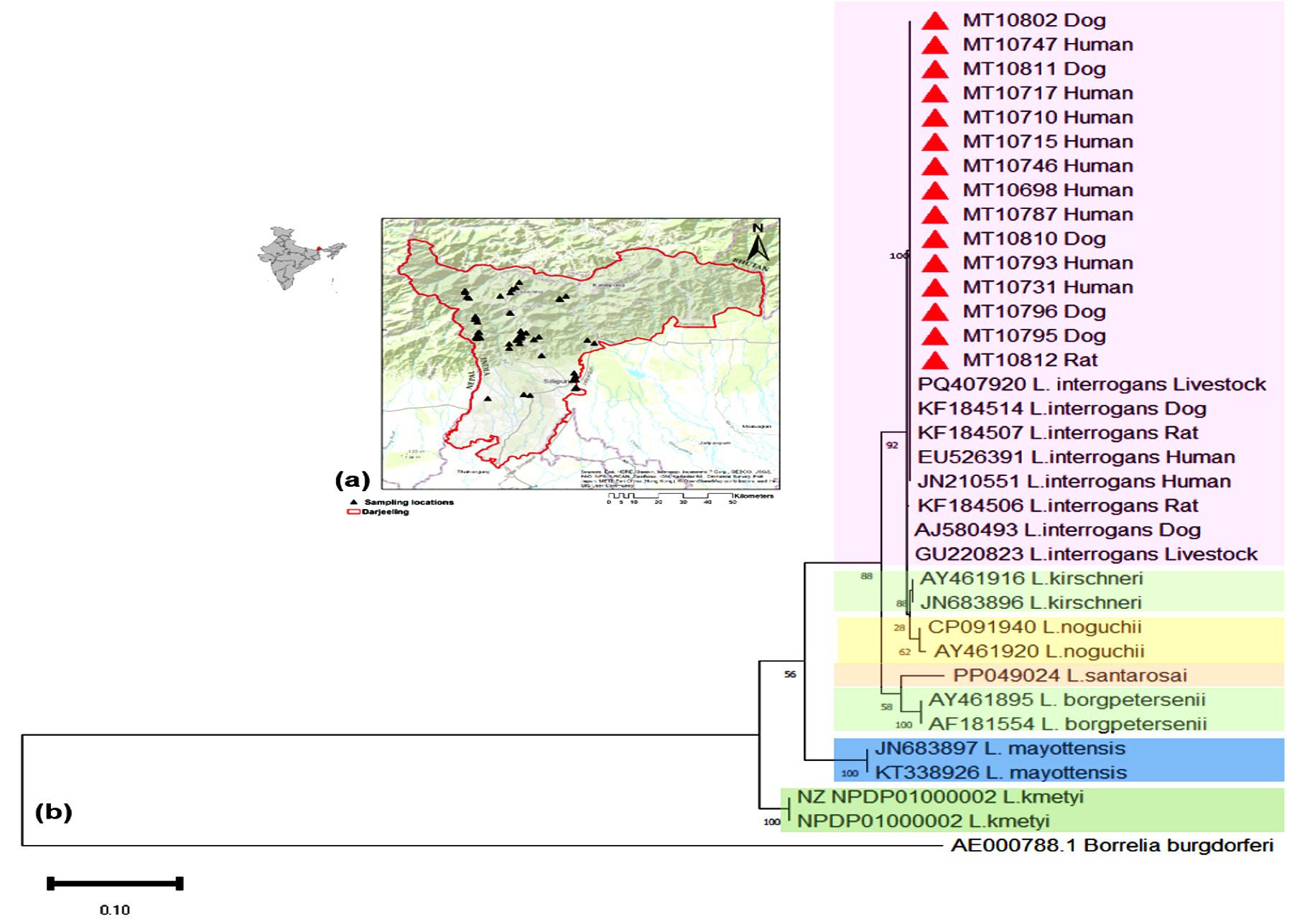
Figure 1. (a) Map of study area and the sampling sites (black triangle), (b) Maximum-likelihood (ML) phylogenetic tree based on partial LipL32 gene sequences obtained from this study showing genetic relationship with L. interrogans reference sequences from different host. The sequences obtained from this study are labelled (red triangles) and highlighted in red
Ectoparasite identification
The ectoparasite specimens (ticks, fleas and louse) were examined under a stereomicroscope (Investa 3, Leica) and identified morphologically using standard taxonomic keys.21-23
Genomic DNA extraction and molecular analysis
The genomic DNA was extracted from blood and ectoparasite samples using the phenol-chloroform-isoamyl alcohol (PCI) method.24 Molecular screening for Leptospira spp. was carried out by polymerase chain reaction (PCR) targeting the LipL32 gene (423 bp).13,14 PCR reactions were performed in a final volume of 10 µL containing 2 µL of 20-40 ng template DNA, 0.3 µL of 10 picomoles of each forward and reverse primer, 4 µL of 2X DreamTaq PCR Master Mix (Thermo Fisher Scientific) with the remaining adjusted with nuclease-free water. Thermal cycling conditions consisted of an initial denaturation at 95 °C for 2 min, followed by 40 cycles of denaturation at 95 °C for 30 sec, annealing at 60 °C for 30 sec, and extension at 72 °C for 30 sec, with a final extension at 72 °C for 5 min.13,14 PCR-positive amplicons were purified using ExoSAP-IT Express and subjected to sequencing using the BigDye™ Terminator Cycle Sequencing Kit v3.1 (Thermo Scientific, USA) on a SeqStudio™ 24 Flex Genetic Analyzer (Applied Biosystems, USA). The sequences were cleaned in Sequencher v4.7 (Gene Codes Corporation), and multiple sequence alignment was performed using the ClustalW algorithm implemented in MEGA 11.25
Phylogenetic analyses
Twenty reference sequences of six Leptospira species were retrieved from the NCBI GenBank database for phylogenetic tree reconstruction using one sequence of Borrelia burgdoferi as an outgroup (Figure 1b and Supplementary Table). Phylogenetic relationships were inferred using the Maximum-Likelihood method using 1000 bootstraps in Mega 11.25 T92 model was selected as the best-fit nucleotide substitution model based on the low BIC value.
A total of 294 samples i.e. 94 humans, 67 dogs, 62 cattle, 40 goats, 15 cats, 12 fleas, and one sample each of rat, lice, pig and tick from Darjeeling district of West Bengal (Figure 1a, Table) were collected during this cross-sectional survey. Among the ectoparasites, the fleas were morphologically identified into two species, i.e. Xenopsylla cheopis, (Rat flea, n = 11) and Ctenocephalides felis (Cat flea, n = 1), whereas the tick was identified to be of Haemaphysalis spp. and the louse was identified as belonging to the Suborder Ischnocera from the Order Phthiraptera. The rodent was identified to be Rattus rattus.
Table. Distribution of samples collected and PCR positive from humans, domestic animals, and ectoparasites included in the study
Sample Type |
Number of Samples (N) |
PCR positive (n) |
|---|---|---|
Humans |
94 |
9 |
Dogs |
67 |
5 |
Cows |
62 |
0 |
Goats |
40 |
0 |
Cats |
15 |
0 |
Fleas |
12 |
0 |
Rat |
1 |
1 |
Lice |
1 |
0 |
Pig |
1 |
0 |
Tick |
1 |
0 |
Total |
294 |
15 |
Molecular detection of Leptospira spp.
Out of the 294 samples screened, 15 (5.10%) tested positive for pathogenic Leptospira by LipL32 specific PCR, including 9 humans, 5 dogs, and 1 rodent sample. Sequence similarity analysis of the representative amplicons using BLAST showed 100% identity with Leptospira interrogans reference sequence GenBank accession CP092161, confirming that the amplified products belonged to a well-recognized pathogenic species associated with leptospirosis in both humans and animals. The sequences generated in the present study were deposited in the NCBI GenBank database. As no sequence variation was observed among the amplicons within each host group, only one representative sequence from each host category was submitted to avoid redundancy (Supplementary Table). The representative GenBank accession numbers are PZ201988 (human), PZ201989 (dog), and PZ201987 (rodent).
Phylogenetic analysis
Phylogenetic analysis based on the partial LipL32 gene showed that all study-derived sequences clustered within the pathogenic Leptospira interrogans clade with strong bootstrap support (100%) (Figure 1b). The sequences obtained from humans, dogs, and a rodent grouped closely with previously reported L. interrogans reference sequences derived from multiple host sources and did not exhibit any clear host-specific clustering. In contrast, other pathogenic Leptospira species formed distinct clades separate from the study sequences, indicating that the circulating strains detected in the present study belonged to L. interrogans.
The present study provides baseline molecular evidence of pathogenic Leptospira infection among humans and animals from the Darjeeling district of the Eastern Himalayas. Of the 294 samples screened, 15 (5.10%) were positive by LipL32 specific PCR, comprising 9 humans, 5 dogs, and 1 rodent sample. The detection of Leptospira DNA in samples from different host groups within the same geographical landscape indicates pathogenic leptospires circulating in the study area. However, as the sampling was not based on matched human-animal households, the findings should be interpreted at the landscape level and not as evidence of direct transmission between individual humans and animals.
The detection of Leptospira among acute undifferentiated febrile illness cases highlights its relevance as a differential diagnosis in febrile patients from Darjeeling. Leptospirosis often presents with nonspecific symptoms and can be clinically indistinguishable from other acute febrile illnesses; therefore, laboratory confirmation remains essential.1,4,17 The identification of positives among dogs further supports the need to include companion and peri-domestic animals in local surveillance, as dogs may act as sentinels of environmental exposure and may reflect contamination in shared human-animal settings. The single rodent-positive sample is also epidemiologically relevant because rodents are recognized maintenance hosts for pathogenic Leptospira. However, the small number of rodent samples in the present study limits any firm inference regarding rodent reservoir status in the district.
Phylogenetic analysis based on the partial LipL32 gene showed that all study-derived sequences clustered within the pathogenic Leptospira interrogans clade with strong bootstrap support. Since LipL32 is conserved and largely restricted to pathogenic Leptospira, its amplification and phylogenetic placement support the detection of clinically important leptospires rather than incidental environmental organisms.26,27 The sequences obtained from humans, dogs, and a rodent grouped within the same L. interrogans lineage and did not show clear host-specific clustering. This finding indicates that the molecular positives detected in the study belonged to a well-recognized pathogenic species associated with human and animal leptospirosis. The separation of other pathogenic Leptospira species into distinct clades further supports the placement of the Darjeeling sequences within the L. interrogans lineage. This pattern suggests that the detected organisms may be part of a shared exposure ecology within the Darjeeling landscape.
The absence of clear host-specific clustering among sequences from humans, dogs, and the rodent suggests that the detected L. interrogans sequences may represent circulation within a shared ecological setting rather than independent host-restricted events. This interpretation is consistent with the ecology of Darjeeling district, where high rainfall, steep terrain, moisture-retaining environments, mixed land use, peri-domestic animals, and close human-animal contact may together create favourable conditions for environmental persistence and cross-host exposure.28,29 However, the study design did not involve matched household-based sampling of humans and animals; therefore, direct epidemiological linkage between individual human and animal infections cannot be inferred.
The findings should also be interpreted in view of the sample type used for screening. PCR detection from blood is most useful during the leptospiremic phase of infection. Therefore, negative blood PCR results do not exclude past infection, renal carriage, or urinary shedding, particularly in animal hosts.1 Since leptospiremia is transient, PCR positivity is dependent on the stage of infection, and negative blood PCR results do not exclude chronic carriage.1 This is especially relevant when interpreting animals in the context of One Health surveillance, because reservoir status is better assessed through urine, kidney tissue, repeated sampling, or longitudinal follow-up rather than blood PCR alone. Thus, the present study demonstrates molecular occurrence of pathogenic L. interrogans across selected host groups, but does not establish reservoir competence or direct transmission pathways.
Another limitation relates to the use of LipL32 for phylogenetic inference. Although LipL32 is a useful marker for confirming pathogenic Leptospira, it is a conserved gene and has limited resolution for defining strain-level diversity, serovar identity, or recent transmission events. Therefore, the close clustering observed in the present tree should be interpreted as evidence of related pathogenic L. interrogans circulation within the same landscape, not as proof of direct interspecies transmission. Future studies using higher-resolution approaches such as secY sequencing, multilocus sequence typing (MLST), or whole-genome sequencing would be required to clarify local lineage diversity and transmission dynamics.30-32
Despite these limitations, the present study provides important baseline molecular evidence from a region where data on pathogenic Leptospira across host groups remain limited. The detection of L. interrogans in humans, dogs, and a rodent from the same broad geographical landscape highlights the value of a One Health approach for leptospirosis surveillance in the Eastern Himalayas. Future surveillance should include larger and more balanced sampling of humans, livestock, companion animals, rodents, ectoparasites, and environmental matrices such as water and soil. Such integrated surveillance would be useful not only for estimating local disease burden, but also for identifying high-risk interfaces, improving outbreak preparedness, and guiding control measures such as rodent management, environmental sanitation, and community-level risk awareness during periods of heavy rainfall and increased water exposure.10
This study provides a baseline molecular evidence of pathogenic Leptospira interrogans in humans, dogs, and a rodent from Darjeeling district. Although the findings suggest circulation of L. interrogans across multiple host groups within the same landscape, direct transmission or reservoir status could not be inferred from blood/serum-based PCR. Broader One Health surveillance incorporating larger animal sampling, urine or environmental testing, and higher-resolution molecular typing is needed to define local transmission dynamics and guide control measures in the Eastern Himalayas.
Additional file: Table S1
ACKNOWLEDGMENTS
The authors acknowledge the support of the officials of the Animal Resources Development Department and North Bengal Medical College, Darjeeling, West Bengal, for assistance with sample collection.
CONFLICT OF INTEREST
The authors declare that there is no conflict of interest.
AUTHORS’ CONTRIBUTION
MT conceptualized the study and acquired funding. SK, SG, and LKW developed the methodology, while AS performed sample acquisition. SG, SD, SDG, and MT performed data curation. SD, SDG, and MT conducted the formal analysis and visualization. LKS and MT supervised the study. SG wrote the original draft. SD, AS, SDG, MT, and LKS wrote, reviewed, and edited the manuscript. All authors read and approved the final manuscript for publication.
FUNDING
This work was supported by the National Mission on Himalayan Studies (NMHS2024-25/SC-XIII/MG/SL-06), Ministry of Environment, Forest and Climate Change (MoEFCC) and National One Health Programme for Prevention and Control of Zoonoses (NOHPPCZ) (ISC/57/15105/2022/DZDP/NCD-Part(1)(8248723); Dated:13/11/2025), National Centre for Disease Control, Ministry of Health and Family Welfare, New Delhi, Government of India.
DATA AVAILABILITY
The sequence data generated in this study are available in GenBank under accession numbers PZ201987-PZ201989.
ETHICS STATEMENT
The study was conducted under a project aligned with the NOHPPCZ framework (NCDC-ZSI collaboration). The laboratory procedures were approved by the Institutional Biosafety Committee (IBSC), Zoological Survey of India (Reg. No ZOOL031220243577) with compliance reported to the IBKP portal (DBT, 2025). Animal sampling was conducted in collaboration with the Animal Resource Development Department, Government of West Bengal (Permit No. :339/DD/ARD-GTA/DRJ; dated 11/08/2025).
- Levett Paul N. Leptospirosis. Clin Microbiol Rev. 2001;14(2):296-326.
Crossref - Adler B, de la Pena Moctezuma A. Leptospira and leptospirosis. Vet Microbiol. 2010;140(3-4):287-296.
Crossref - Costa F, Hagan JE, Calcagno J, et al. Global morbidity and mortality of leptospirosis: a systematic review. PLoS Negl Trop Dis. 2015;9(9):e0003898.
Crossref - Bharti AR, Nally JE, Ricaldi JN, et al. Leptospirosis: a zoonotic disease of global importance. Lancet Infect Dis. 2003;3(12):757-771.
Crossref - Schuller S, Francey T, Hartmann K, et al. European consensus statement on leptospirosis in dogs and cats. J Small Anim Pract. 2015;56(3):159-179.
Crossref - Murray Gerald L, Srikram A, Hoke DE, et al. Major Surface Protein LipL32 Is Not Required for Either Acute or Chronic Infection with Leptospira interrogans. Infect Immun. 2009;77(3):952-958.
Crossref - Haake DA, Levett PN. Leptospirosis in Humans. In: Adler B, ed. Leptospira and Leptospirosis. Current Topics in Microbiology and Immunology, vol 387. Springer, Berlin, Heidelberg. 2014;387:65-97.
Crossref - Ravindranathan AT, Mukundan A, Puthanpurayil SNT, Kavuthodi B, Karunakaran S, John R. Molecular and genomic characterization of Leptospira isolates in humans and its relation to disease severity. Indian J Med Microbiol. 2025;56:100910.
Crossref - Lau CL, Smythe LD, Craig SB, Weinstein P. Climate change, flooding, urbanisation and leptospirosis: fuelling the fire? Trans R Soc Trop Med Hyg. 2010;104(10):631-638.
Crossref - Sandoval KL, Cada KJS, Dimasin RVD, Labana RV. A One Health approach to the prevention, control, and management of leptospirosis: a scoping review. Discov Public Health. 2025;22(1):108.
Crossref - Sunder J, Alyethodi RR, Sujatha T, et al. Seroprevalence of Leptospira in Cattle and Goats from Andaman and Nicobar Islands, India. Indian J Anim Res. 2024;1(8)
Crossref - Haake DA, Zuckert WR. The Leptospiral Outer Membrane. In: Adler B, ed. Leptospira and Leptospirosis. Current Topics in Microbiology and Immunology, vol 387. Springer, Berlin, Heidelberg. 2015;387:187-221.
Crossref - Smythe LD, Smith IL, Smith GA, et al. A quantitative PCR (TaqMan) assay for pathogenic Leptospira spp. BMC Infect Dis. 2002;2(1):13.
Crossref - Stoddard RA, Gee JE, Wilkins PP, McCaustland K, Hoffmaster AR. Detection of pathogenic Leptospira spp. through TaqMan polymerase chain reaction targeting the LipL32 gene. Diagn Microbiol Infect Dis. 2009;64(3):247-255.
Crossref - National Guidelines. Diagnosis, case management Prevention and Control of Leptospirosis. https://www.medbox.org/index.php/document/national-guidelines-diagnosis-case-management-prevention-and-control-of-leptospirosis
- Jones KE, Patel NG, Levy MA, et al. Global trends in emerging infectious diseases. Nature. 2008;451(7181):990-993.
Crossref - Gupta N, Wilson W, Ravindra P. Leptospirosis in India: a systematic review and meta-analysis of clinical profile, treatment and outcomes. Infez Med. 2023;1(31):290-305.
Crossref - Das D, Ponnampurathu S, Panda PK, Mathuria YP. Different clinical profile of leptospirosis in a tertiary care Indian hospital: A Himalayan experience. World Journal of Clinical Cases. 2025;13(25):106335.
Crossref - Ghosh S, van Westen CJ, Carranza EJM, Jetten VG. Integrating spatial, temporal, and magnitude probabilities for medium-scale landslide risk analysis in Darjeeling Himalayas, India. Landslides. 2012;9(3):371-384.
Crossref - Mathur R, Swaminathan S. National Ethical Guidelines for Biomedical and Health Research Involving Human Participants, 2017: A commentary. Indian J Med Ethics. 2018;3(3):201-204.
Crossref - Miranpuri GS. Tick Taxonomy in India (Ixodoidea: Acarina):a Review Including Notes on Their Biology, Ecology, Geographical Distribution, Host-relationship, Ticks and Tick-borne Diseases and Kyes for Species Identification. IVRI. 1979.
- Iyengar R. The Siphonaptera of the Indian Subregion. Oriental Insects. 1973;7(Sup3):1-91.
Crossref - Clayton DH, Johnson KP. The biology, ecology, and evolution of chewing lice. Chewing lice: world checklist and biological overview (Special Publication 24). Illinois Natural History Survey; 2003:451-475.
- Sambrook J, Fritsch EF, Maniatis T. Molecular cloning: a laboratory manual. Cold Spring Harbor Laboratory Press; 1989:xxxviii:1546.
- Tamura K, Stecher G, Kumar S. MEGA11: Molecular Evolutionary Genetics Analysis Version 11. Mol Biol Evol. 2021;38(7):3022-3027.
Crossref - Haake DA, Chao G, Zuerner RL, et al. The leptospiral major outer membrane protein LipL32 is a lipoprotein expressed during mammalian infection. Infect Immun. 2000;68(4):2276-2285.
Crossref - Murray GL. The lipoprotein LipL32, an enigma of leptospiral biology. Vet Microbiol. 2013;162(2-4):305-314.
Crossref - Bierque E, Thibeaux R, Girault D, Soupe-Gilbert M-E, Goarant C. A systematic review of Leptospira in water and soil environments. PLoS One. 2020;15(1):e0227055.
Crossref - Narkkul U, Thaipadungpanit J, Srisawat N, et al. Human, animal, water source interactions and leptospirosis in Thailand. Sci Rep. 2021;11(1):3215.
Crossref - Di Azevedo M, Lilenbaum W. An overview on the molecular diagnosis of animal leptospirosis. Lett Appl Microbiol. 2021;72(5):496-508.
Crossref - Ahmed N, Devi SM, De los Valverde M, et al. Multilocus sequence typing method for identification and genotypic classification of pathogenic Leptospira species. Ann Clin Microbiol Antimicrob. 2006;5(1):28.
Crossref - Guglielmini J, Bourhy P, Schiettekatte O, Zinini F, Brisse S, Picardeau M. Genus-wide Leptospira core genome multilocus sequence typing for strain taxonomy and global surveillance. PLoS Negl Trop Dis. 2019;13(4):e0007374.
Crossref
© The Author(s) 2026. Open Access. This article is distributed under the terms of the Creative Commons Attribution 4.0 International License which permits unrestricted use, sharing, distribution, and reproduction in any medium, provided you give appropriate credit to the original author(s) and the source, provide a link to the Creative Commons license, and indicate if changes were made.